Poolside Desktop Assistant Launch: A New AI Coding Paradigm That Decouples Models from Interfaces

Poolside Desktop Assistant decouples UI from AI models, giving developers freedom to swap engines.
Poolside has launched Desktop Assistant, a desktop AI coding tool built on the principle of decoupling user interfaces from underlying models and execution harnesses. This modular approach lets developers swap models freely without changing tools, reflecting a broader industry shift from vertical integration to composable architectures. The article analyzes how this Separation of Concerns philosophy returns technology choice to users and what challenges lie ahead in standardization.
An Overlooked Industry Consensus
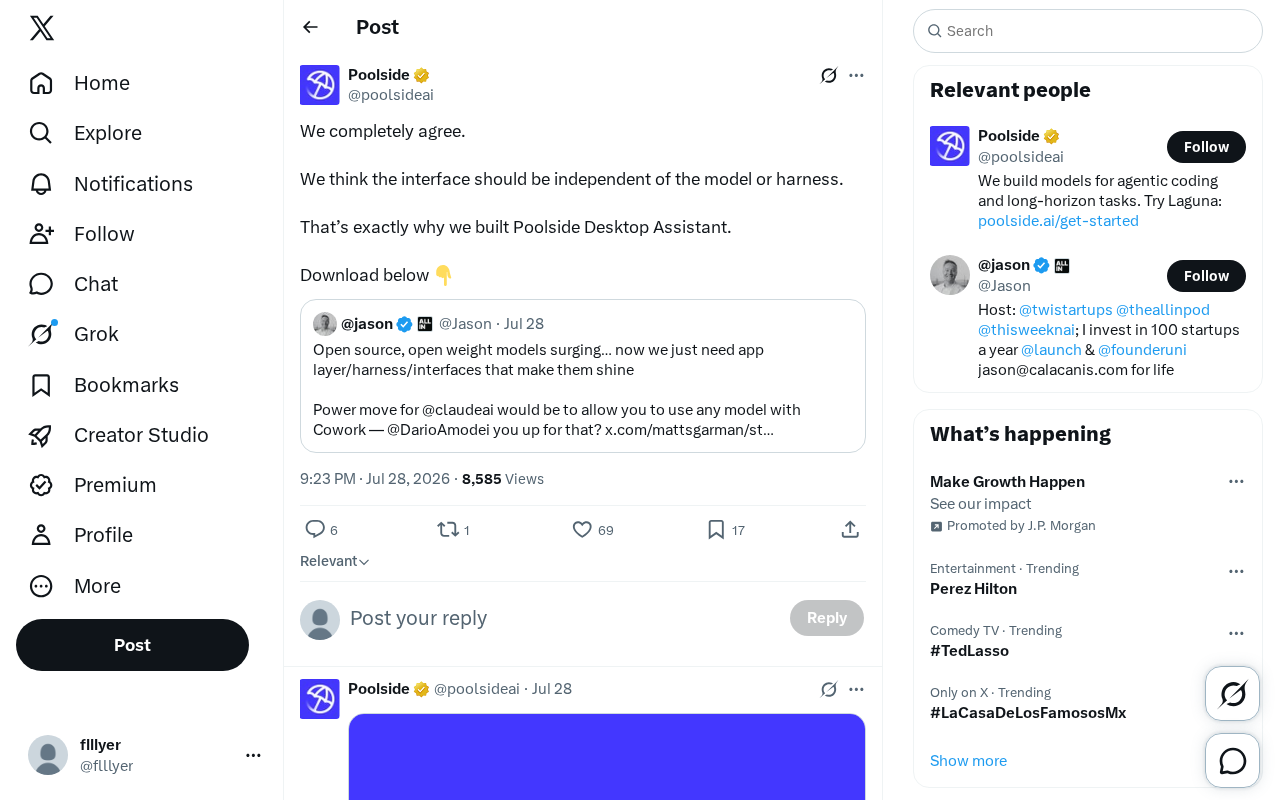
Amid the explosive growth of AI coding tools, a core debate is gradually surfacing: should the user interface of an AI coding assistant be tightly coupled with the underlying model and execution harness? Poolside made its stance clear in a social media post — "We fully agree that the interface should be independent of the model or the harness."
Behind this statement lies a deep-seated contradiction in the current AI coding tool ecosystem. Many mainstream tools bundle a specific model, execution logic, and interaction interface together into a closed technology stack. While this design can deliver a more consistent experience, it also locks users into a single vendor's technology choices. Poolside's Desktop Assistant is a direct response to this problem.
Poolside is an AI code generation startup founded in 2023 by former Meta and Google AI researchers in San Francisco, securing substantial funding from the outset. Unlike mainstream AI coding tools such as GitHub Copilot and Cursor, Poolside's core strategy involves training large language models from scratch specifically optimized for software engineering tasks, rather than fine-tuning general-purpose models. The launch of Desktop Assistant marks Poolside's strategic extension from pure model R&D to end-user products, attempting to carve out a unique position in the increasingly crowded AI coding tools market with an "open and neutral" approach.
Why Interface Independence from Models Matters
Flexibility Through Decoupling
Decoupling the interface from the model essentially splits the "interaction layer" and the "intelligence layer" into two independently evolving components. This means:
- Models are swappable: Users don't need to switch their entire toolset to try a new model — the interface stays the same while the underlying model can be flexibly switched.
- Frameworks are pluggable: The execution harness (the logic layer responsible for orchestrating, executing, and validating AI outputs) can also be updated independently without disrupting the user's familiar workflows.
- Reduced migration costs: When stronger models emerge in the industry, users can benefit from technological advances with minimal friction, rather than being trapped in an existing ecosystem.
The concept of "execution harness" deserves further explanation. In the AI coding tool technology stack, the execution harness is the complete orchestration and execution logic layer built around the large language model. It is responsible for decomposing user intent into model-understandable prompts, parsing, validating, and post-processing model outputs, managing context windows and multi-turn conversation state, and safely applying model-generated code to the user's project. Different execution harnesses may employ vastly different strategies — some focus on automated test validation after code generation, others emphasize deep integration with version control systems, and still others specialize in multi-step reasoning and task decomposition. Even with the same underlying large language model, different execution harnesses can produce dramatically different user experiences, which is precisely the value of separating them out.
Returning Control to Users
At the core of this architectural philosophy is returning technology choice to users. In an era of rapidly iterating AI model capabilities, today's strongest model may be surpassed within months. A tool bound to a specific model leaves users passive in the face of technological waves, while modular design ensures users can always stay at the capability frontier.
Poolside Desktop Assistant's Product Positioning
Based on Poolside's statements, Desktop Assistant is not yet another "all-in-one" closed AI coding platform, but rather aims to be a neutral interaction gateway. Its value proposition can be summarized as: providing a consistent, stable desktop-grade interaction experience while maintaining openness to different models and execution harnesses behind the scenes.
For developers, such a product means being able to choose the right model for the task at hand within the same familiar interface — whether optimizing for speed, cost, or domain-specific capabilities. This "one interface, multiple engines" approach is directly aligned with the long-championed software engineering principle of Separation of Concerns.
Separation of Concerns is one of the most important design principles in software engineering, first proposed by computer science pioneer Edsger Dijkstra in 1974. Its core idea is decomposing complex systems into modules with single responsibilities that are independent of each other. In practice, this principle has spawned numerous classic architectural patterns: MVC (Model-View-Controller) in web development separates data, presentation, and logic; front-end/back-end separation allows interface development and server-side development to iterate independently; microservices architecture splits monolithic applications into independently deployable service units. Poolside's application of this principle at the AI coding tool level essentially ensures that the interaction interface has no hard dependency on the specific model or reasoning strategy used underneath, communicating instead through standardized abstract interfaces to enable independent evolution of each layer.
Industry Trend Signals for AI Coding Tools
From Vertical Integration to Modularity
Poolside's move reflects a paradigm shift underway in the AI coding tools market. In the early stages, vendors tended toward vertical integration, building moats through end-to-end closed experiences. But as the ecosystem matures, modular, composable architectures are gaining favor — a trajectory highly similar to the evolution seen in cloud computing, microservices, and other domains.
The debate between vertical integration and modularity has actually run throughout the entire history of the tech industry. In the PC era, Apple represented the vertical integration approach — self-developed chips, operating system, and hardware forming a closed ecosystem; while the IBM PC-compatible ecosystem represented the modular approach — CPUs from Intel, operating system from Microsoft, hardware from numerous OEM manufacturers. Cloud computing underwent a similar evolution: AWS initially provided tightly coupled full-stack services, but the rise of container orchestration technologies like Kubernetes drove the adoption of multi-cloud and hybrid cloud architectures. The general pattern is: early-stage industries are dominated by vertical integrators to establish standards and user trust, while modular solutions gradually take the mainstream after ecosystem maturation due to higher flexibility and competitive efficiency. Poolside's choice to emphasize open decoupling at this point in time may reflect their judgment that the AI coding tools market has reached the inflection point of transitioning from early integration to mature modularity.
The trend toward interface independence, to some extent, signals that the competitive focus of AI coding tools will shift in the future: no longer just about who has the stronger model, but about who can provide the best interaction experience and the most open ecosystem compatibility.
Potential Challenges in Implementation
Of course, this philosophy also faces real-world challenges in actual implementation. Decoupling the interface from models means establishing standardized interface protocols and handling experience inconsistencies caused by capability differences between models. How to maintain openness without sacrificing the seamless experience that deep integration provides will be an ongoing engineering challenge for Poolside.
From a technical implementation perspective, there are already some standardization attempts in the AI field that can serve as references: Anthropic's Model Context Protocol (MCP) attempts to standardize how AI models interact with external tools; OpenAI's Function Calling and Tool Use specifications define unified formats for models to invoke external capabilities; and Language Server Protocol (LSP) provides a mature example for communication between IDEs and language servers. However, the challenges facing AI coding tools are more complex — different models have significant differences in context window size, multi-turn conversation capabilities, code generation style, error handling strategies, and more. How to design an interface layer that is sufficiently abstract without losing each model's unique advantages, and how to maintain conversation state continuity and code context consistency when switching models — these all require carefully designed state management mechanisms and protocol specifications. This is not only an engineering problem but also involves industry-level consensus building and standard setting.
Conclusion: A Battle Over "Who Controls the Gateway"
The launch of Poolside Desktop Assistant is, on the surface, a new product release, but at a deeper level, it's a statement about the architectural philosophy of AI coding tools. In an era where model capabilities change daily, liberating the interface from models and frameworks to give users greater freedom of choice may well be the wisest approach to navigating uncertainty.
For developers and practitioners following the AI coding ecosystem, what's worth watching is: whether this "decoupling" approach can become the industry mainstream, and whether Poolside can secure its place in fierce competition through its open and neutral positioning.
Related articles

Cloudflare OS Explained: An Edge Computing Open Platform for AI Agents
Deep dive into Cloudflare OS's technical architecture and strategic positioning—how it leverages its global edge network, Workers runtime, and Durable Objects to provide low-latency, secure environments for AI agents.

Fastmail Launches EU Data Region: A New Option for Email Data Sovereignty
Fastmail launches its EU Data Region, letting users store email data on EU servers. Analysis of its GDPR compliance implications, data sovereignty benefits, and comparison with ProtonMail.

Superbrain Review: How the TokenFold Architecture Saves 50% on Token Costs
In-depth analysis of macOS AI coding tool Superbrain and its proprietary TokenFold retrieval architecture, comparing it with Cursor, Claude Code, and other mainstream products.