Pope Leo XIV Criticizes AI Art: Algorithms Lack the Spark of Humanity

Pope Leo XIV says AI art lacks humanity's spark, calling it ontologically distinct from human creation.
Pope Leo XIV has publicly criticized AI-generated art, arguing it is ontologically distinct from human art — a difference he says precedes even aesthetic considerations. His core claim, that "algorithms lack the spark of humanity," points to the fact that AI image generation is fundamentally a statistical recombination of existing human works, not an expression of independent consciousness or lived experience. The Pope also implicitly raised concerns about the legality of AI training data and creators' rights, echoing ongoing legal action by artists over copyright. As the leader of the Catholic Church, his remarks add an important ethical and spiritual dimension to the escalating debate over AI and human creativity.
Pope Leo XIV's Clear Stance on AI-Generated Art
Pope Leo XIV recently expressed a critical view of AI-generated art, zeroing in on what he sees as a fundamental difference between AI creation and human artistry. In his view, this difference is not merely aesthetic — it is a deeper, ontological distinction.
In his remarks, the Pope wrote: "Between art and what algorithms generate through statistical calculations based on millions of images created by others, there is an ontological difference that precedes even the aesthetic one." This statement shifts the conversation from "does AI art look good?" to the more foundational question: "is AI art actually art?"
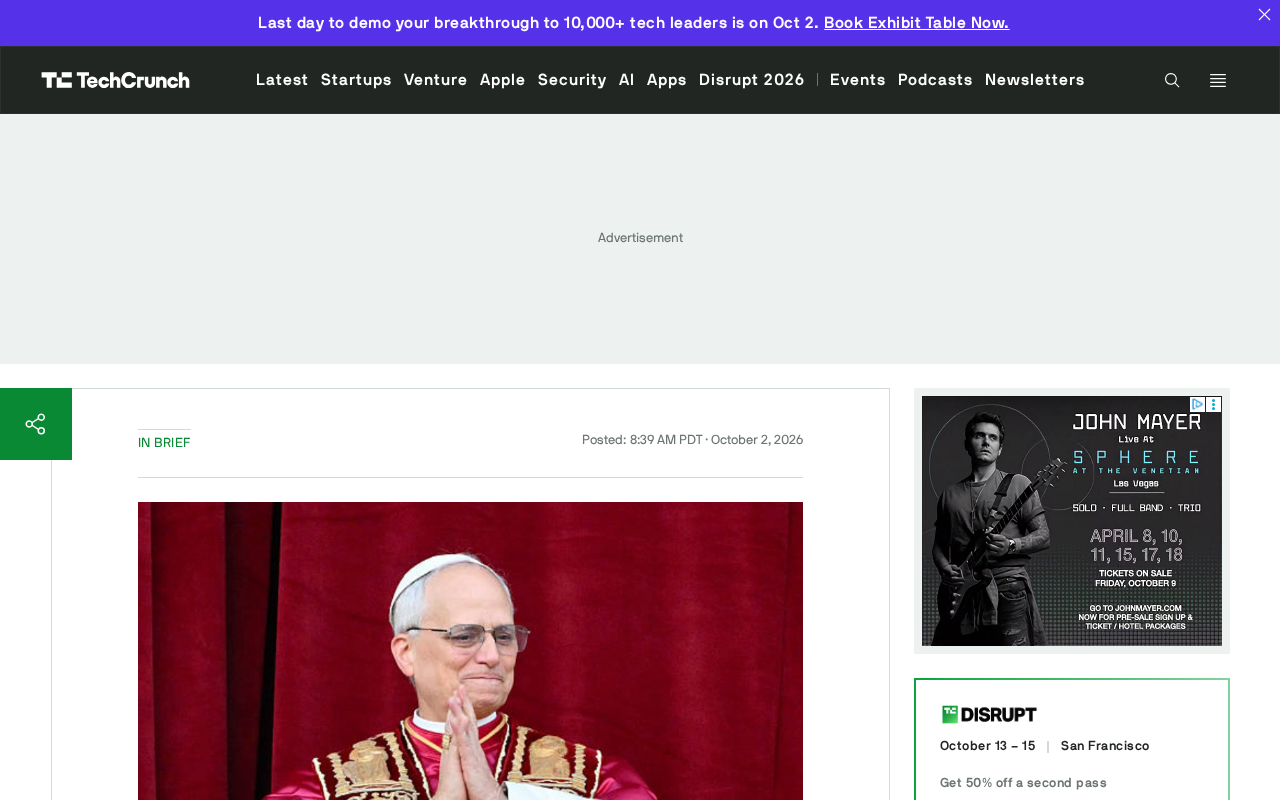
"Algorithms Lack the Spark of Humanity"
The Pope's most widely circulated remark is: "Algorithms lack the spark of humanity." This phrase cuts to the heart of one of the central debates around AI art — whether human intention, emotion, and lived experience are irreplaceable components of genuine artistic creation.
From a technical standpoint, the Pope's characterization is not inaccurate. Today's mainstream AI image generation models — such as diffusion models — work by learning from vast quantities of existing images and statistically predicting pixel combinations. In other words, AI "creation" is essentially a probabilistic recombination of existing human works, not an expression rooted in independent consciousness or lived experience.
Background: How Diffusion Models Work Diffusion models are the dominant technology behind AI image generation today, powering products like Stable Diffusion, Midjourney, and DALL·E. The process works by progressively adding random noise to training images until they are completely degraded, then training a neural network to learn the reverse "denoising" process. When generating a new image, the model starts from pure noise and iteratively denoises it guided by a text prompt, ultimately producing a pixel distribution that conforms to statistical patterns. At no point does the model "understand" the image content — it is fitting conditional probability relationships between pixels in a high-dimensional space. Critics seize on exactly this point: the output of a diffusion model is fundamentally a statistical interpolation of its training data, with no corresponding channel through which a creator's ideas, emotions, or life experiences can be expressed.
The Philosophical Debate Over the Nature of Art
The Pope's position touches on a long-standing question in aesthetics and philosophy: does the value of art lie in the final product, or in the human dimension embedded in the creative process itself?
Those who agree with the Pope would argue that art is the externalization of human emotion, memory, and lived existence — and that even if a machine can replicate style and technique, it cannot possess genuine "intent." The opposing view holds that aesthetic experience is something the viewer brings to a work, and that once a piece is complete, its origin — human or otherwise — does not diminish its value as an experience.
By framing his position as an "ontological difference that precedes the aesthetic one," the Pope deliberately sidesteps the question of whether AI images look good, and instead asserts something more absolute: no matter how visually stunning an AI-generated image may be, it simply does not belong to the category of art by its very nature. It is a fairly uncompromising stance.
The Significance of a Religious Leader Entering the AI Debate
As the supreme leader of the Catholic Church, the Pope's public statement on AI art carries influence well beyond the art world. In recent years, religious institutions have paid increasing attention to the ethical, labor, and humanistic implications of artificial intelligence, and their interventions tend to focus on the technology's potential impact on human dignity and creativity.
The Pope's emphasis on "millions of images created by others" also implicitly raises concerns about the legal legitimacy of AI training data and the rights of creators — one of the most contentious legal and ethical flashpoints in the current AI art debate. Many artists have voiced frustration over their work being used without permission to train commercial models, and the Pope's language clearly resonates with that position.
Background: Legal Disputes Over AI Training Data Legal battles over AI training data are already underway in multiple countries. Class-action lawsuits filed by artists against companies such as Stability AI and Midjourney are being heard in U.S. courts, with the central question being whether scraping artworks without authorization for use in commercial model training constitutes copyright infringement. The EU's AI Act, which formally took effect in 2024, requires high-risk AI systems to disclose the sources of their training data, with specific provisions requiring generative AI providers to publish training data summaries. On the Vatican's side, Pope Francis launched the "Rome Call for AI Ethics" in 2020, signed by technology companies including Microsoft and IBM, focusing on AI transparency and the protection of human dignity. Pope Leo XIV's latest remarks can be seen as the Catholic Church's most recent response to the generative AI wave within that same framework.
Conclusion
Pope Leo XIV's criticism of AI-generated art is not simply technological conservatism — it is a profound challenge framed in ontological and humanistic terms. His judgment that "algorithms lack the spark of humanity" offers a perspective from a spiritual leader on the ongoing debate between AI and human creativity. Whatever one's view, this discussion serves as a reminder to developers and users alike: in the pursuit of generative efficiency, the unique value of human creation should not be casually dismissed.
It should be noted that this article is based on brief public quotations currently available. Further context from the Pope's complete remarks may be forthcoming.
Related articles

Reinforcement Learning Takes On Getting Over It: Distributed Training Strategies Behind 63% Progress
A developer uses deep reinforcement learning to tackle Getting Over It. The agent climbs from the bottom to 63% progress but gets stuck at the anvil. The project is open-sourced, using divide-and-conquer training and CPU-only training, seeking community collaboration to break the bottleneck.

Sigma FP2 Released: The World's Smallest Full-Frame Camera Gets Sensor and Screen Upgrades
Sigma launches the FP2 full-frame camera, retaining its smallest-and-lightest design with three key upgrades: improved sensor, articulating LCD screen, and longer battery life—built for portable video creators.

AAAI 2027 Phase 2 Decisions Imminent: Community Debates Review Fairness and Submission Ecosystem
AAAI 2027 phase 2 review results are imminent, with the Reddit community debating reviewer consistency and process transparency. This article examines pre-decision sentiment, structural tensions in top conference review, and practical strategies for authors.