PostNitro for Agents: Let AI Agents Design and Publish Social Posts

PostNitro for Agents lets AI agents move beyond publishing to designing branded social content.
PostNitro for Agents earned 108 votes and ranked #7 on Product Hunt, advocating for AI agents to complete the entire social content chain from topic to finished product. Unlike traditional social APIs that only handle publishing, it hands design to agents too: after connecting Claude or ChatGPT, agents can output branded carousels, image posts, or animated videos from a topic, an article, or an X post. Access supports one-click OAuth and offers a 35-tool MCP server, CLI, and REST API, serving both ordinary creators and developers. Generated content can be scheduled to LinkedIn, Instagram, TikTok, Threads, Facebook, and Pinterest, or handed back as editable drafts for human finishing. Target users include marketing teams seeking to automate social operations and developers building agent workflows.
PostNitro for Agents: Let AI Agents Design and Publish Social Posts
Social media content production is undergoing a role shift: in the past, AI agents mostly acted as a "publish button," pushing text or images that humans had already written onto platforms. Now, PostNitro for Agents is trying to push agents one step further — not just publishing, but also handling design. This product, which earned 108 votes and ranked #7 on Product Hunt, has a core proposition of letting AI agents complete the entire chain from topic to finished product.
The Positioning Difference: From "Posting on Behalf" to "Designing on Behalf"
The PostNitro team's critique of existing tools is quite direct: most social APIs only allow agents to publish text or media they already have. In other words, the creative part is still done by humans, and AI is just the last-mile courier.
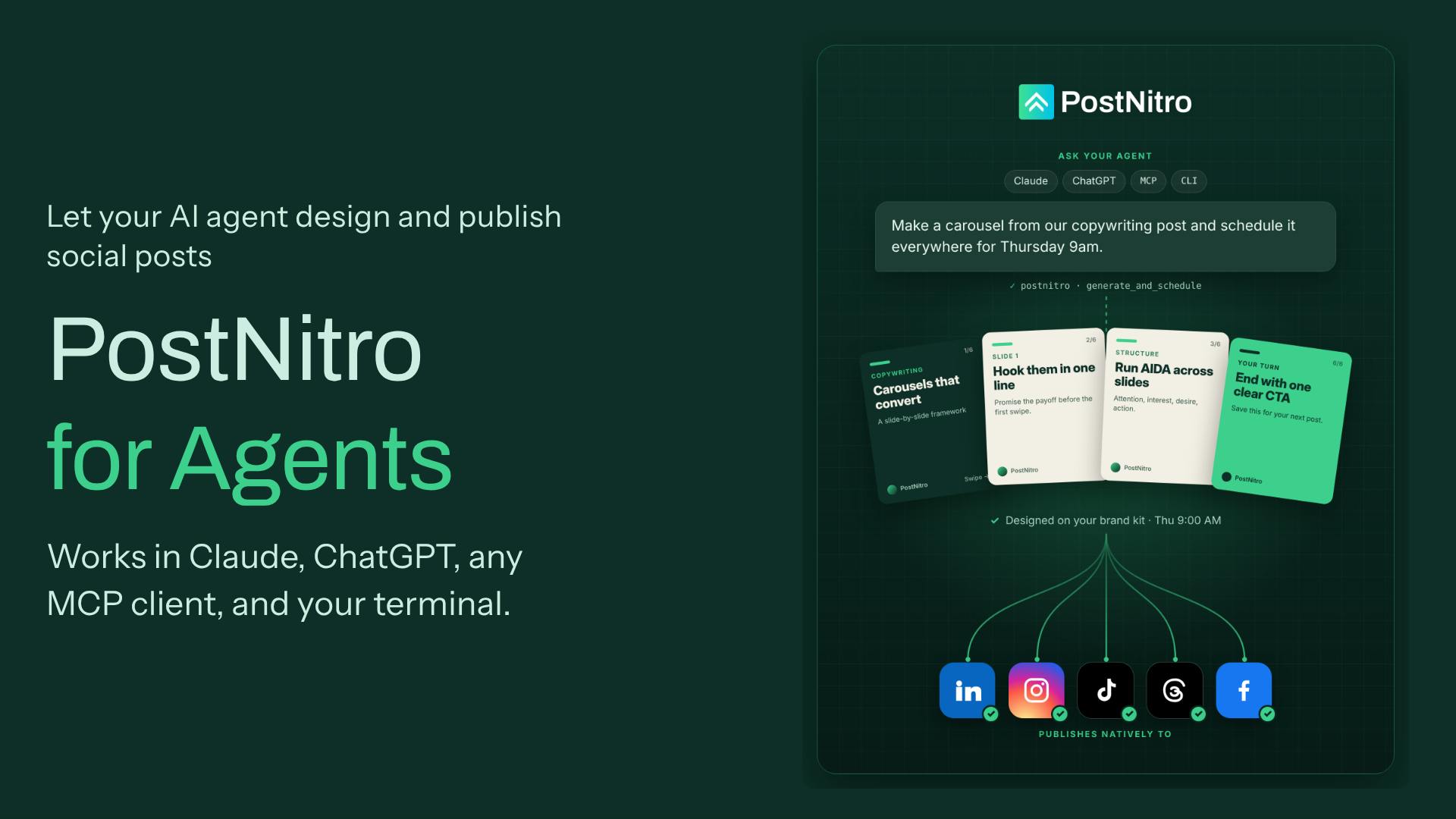
What sets PostNitro for Agents apart is that it hands design capabilities over to agents as well. Users can connect Claude or ChatGPT, or call its MCP server with 35 tools, CLI, and REST API. After receiving a topic, an article, or an X post, the agent outputs branded carousels, image posts, or animated videos — rather than plain text that still needs post-processing.
This positioning hits a real pain point: the bottleneck in social content production is often not "what to write," but "how to present it." Handing visual design to agents means the automation level of the content workflow can be raised another notch.
MCP (Model Context Protocol) is a standardized protocol proposed and open-sourced by Anthropic at the end of 2024, designed to establish a unified connection between large language models and external tools and data sources. Before MCP emerged, developers who wanted Claude, ChatGPT, and other models to call third-party services typically had to write plugins or function-calling logic separately for each model platform — repetitive and hard to migrate. MCP abstracts this layer into a "server-client" structure: service providers only need to implement an MCP server once, and any agent supporting the protocol can directly call its capabilities. For PostNitro, providing an MCP server with 35 tools means developers integrating it don't have to adapt separately for each model vendor — they can embed its design capabilities into Claude Desktop, Cursor, or other MCP-compatible clients. This is also the technical foundation for its emphasis on a "multi-entry" strategy.
One-Click OAuth and Multi-Entry Access
The access method is another selling point for PostNitro. The official emphasis is on "one-click connection," using OAuth authorization rather than API keys — for ordinary users, this means a lower configuration barrier and avoids the hassle of key management.
For developers, the product offers a richer access surface: the MCP server with 35 tools suits teams already in the Model Context Protocol ecosystem; the CLI targets users who prefer command-line workflows; and the REST API is for more traditional integration scenarios. This "multi-entry" strategy shows that PostNitro wants to capture both ordinary creators and the developer market.
From a product design perspective, the combination of one-click OAuth connection + MCP server + multi-platform publishing is effectively packaging the entire chain from "topic selection to publishing" into a capability layer that agents can call, rather than an isolated editor.
The difference between OAuth and API keys is worth elaborating on. An API key is a long-lived string; possessing it equals possessing permission. Once leaked or written into a public code repository, an attacker can directly call the interface, and it's usually impossible to trace the specific user. OAuth, by contrast, uses a token mechanism: users click to authorize on their own account page, and the platform issues an access token with a short validity period that can be revoked at any time, with permission scope that can also be narrowed as needed. For a tool like PostNitro that needs to publish content to LinkedIn, Instagram, and other platforms on behalf of users, OAuth means the "connect" step doesn't require users to copy and paste keys — lowering the configuration barrier and making platform-side compliance reviews more comfortable. Mainstream social platforms' developer terms generally require OAuth rather than direct key connections. This is the substantive reason why the official materials tout "one-click connection" as a selling point.
Generate Once, Distribute Across Multiple Platforms
After generation, PostNitro supports scheduling content for publishing to LinkedIn, Instagram, TikTok, Threads, Facebook, and Pinterest. These six platforms cover different scenarios — professional social, image social, short video, text communities, and interest-based commerce — essentially covering the mainstream Western social media landscape.
The team also retains a "semi-automatic" option: agents can hand content back to users in the form of editable drafts for human finishing. This design is quite pragmatic — not everyone is willing to let AI speak directly to the outside world, especially in scenarios sensitive to brand tone, where a review step remains essential.
Who Should Use It
Judging from the feature combination, PostNitro for Agents has roughly two target user groups. One is marketing teams looking to further automate social media operations, who can have agents produce visual content in batches by topic and schedule it. The other is developers building agent workflows, who can embed PostNitro as a content generation and distribution capability module into their own systems via MCP or REST API.
It's worth noting that the product's disclosed information so far focuses on access methods and publishing channels. The stability of design quality, the degree of brand style controllability, and the actual publishing experience across platforms still need more real-world feedback to verify. The result of 108 votes and 29 comments is medium-level popularity on Product Hunt, indicating it has sparked some discussion but has not yet formed large-scale word of mouth.
Social content automation is shifting from "what to post" to "what to make it look like," and PostNitro for Agents is a concrete attempt on this path. Whether it can convince users to hand the creative step over to AI depends on whether generation quality can consistently reach a publish-ready level.
One-line Summary
PostNitro for Agents lets AI agents move beyond simple publishing to designing branded social content.
Paragraph Summary
PostNitro for Agents earned 108 votes and ranked #7 on Product Hunt, advocating for AI agents to complete the entire social content chain from topic to finished product. Unlike traditional social APIs that only handle publishing, it hands design to agents too: after connecting Claude or ChatGPT, agents can output branded carousels, image posts, or animated videos from a topic, an article, or an X post. Access supports one-click OAuth and offers a 35-tool MCP server, CLI, and REST API, serving both ordinary creators and developers. Generated content can be scheduled to LinkedIn, Instagram, TikTok, Threads, Facebook, and Pinterest, or handed back as editable drafts for human finishing. Target users include marketing teams seeking to automate social operations and developers building agent workflows.
Related articles

Should U.S. College Fraternities Be Banned? A Researcher's Incisive Observations
Why not just ban U.S. college fraternities? A researcher finds the key resistance comes from decision-makers' own fraternity identities and schools' "willful ignorance."

Microsoft Discovery: Accelerating Scientific Discovery with AI Agents
Microsoft's Discovery platform runs specialized AI agents to help researchers screen and prioritize the most promising compounds and experimental paths, reducing experiments and accelerating scientific discovery.

Cambridge Heavy Industries Secretly Develops Desktop-Scale Nuclear Fusion Device
Cambridge Heavy Industries is secretly developing a desktop-scale laser-driven nuclear fusion device, targeting the equipment supply market for fusion power plants. This article analyzes its miniaturization technology path, commercialization logic, and unique positioning in the fusion startup wave.