Powered by 34 AI Agents: Allie Miller's 'Claude Walks' Work Method

CEO runs 34 AI agents to handle her workday, coining 'Claude walks' to describe the shift from executor to orchestrator.
Open Machine CEO Allie K. Miller describes an extreme AI collaboration model: running 34 AI agents simultaneously to handle her entire workday while she steps away for walks — what she calls 'Claude walks.' The approach illustrates a broader shift driven by AI agent technology, where humans move from executing tasks to designing, delegating, and overseeing automated workflows. This new model demands new skills: task decomposition, clear instruction-writing, output validation, and exception handling. The article also urges caution about idealized narratives from industry influencers, noting that running dozens of parallel agents carries real API costs, error propagation risks, and coordination complexity.
When a CEO Fits 34 AI Agents Into a Single Workday
Allie K. Miller, CEO of Open Machine and a prominent AI thought leader, recently shared a glimpse into her daily workflow: she takes walks while 34 AI agents run in parallel handling her workday. She calls these "Claude walks." The concept sparked discussion on Reddit, largely because it paints a picture of human-AI collaboration that looks nothing like the traditional model. Rather than executing tasks one by one, the human becomes more of a conductor orchestrating a large fleet of automated processes running in the background.
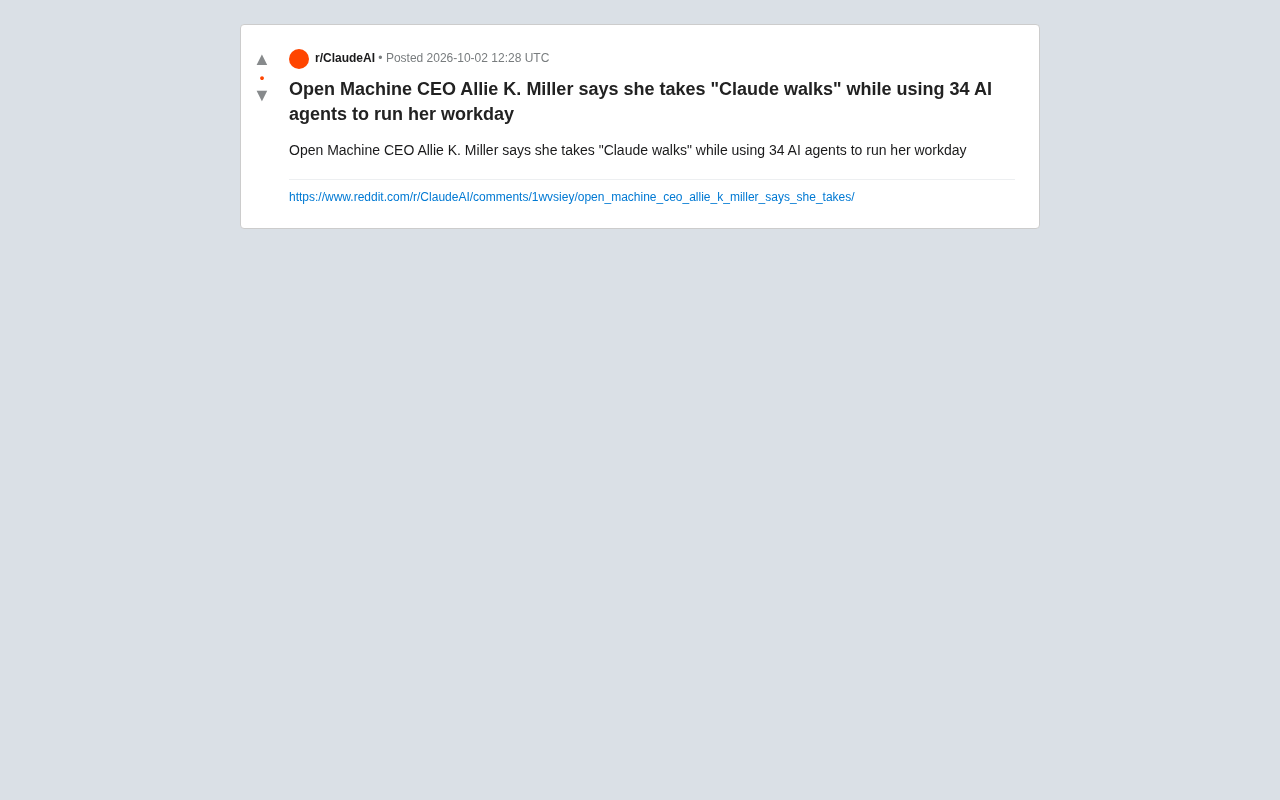
The logic behind "Claude walks" goes roughly like this: once you've delegated enough tasks to AI agents running in parallel, you actually reclaim free time during the gaps while they work — time you can spend walking or thinking, rather than staring at a screen. This is a different narrative from the familiar "use AI to boost efficiency on a single task." It points instead toward a fundamental restructuring of work rhythm and role.
What 34 Agents Actually Implies
It's worth noting that the original post is light on specifics — Miller hasn't publicly detailed what each of these 34 agents actually does. But from the description of them running her entire workday, it's reasonable to infer they likely cover highly structured, delegatable work: email processing, scheduling, information retrieval, content drafting, data organization, monitoring and alerts, and so on.
What's really worth paying attention to isn't the number 34 itself, but the directional signal it represents: AI agents are moving from "individual assistant" to an orchestrated "agent fleet" model. When someone is managing dozens of autonomously running agents simultaneously, the focus naturally shifts from "how do I complete this task" to "how do I design, delegate, and oversee these tasks."
From Executor to Orchestrator
This model places new demands on knowledge workers. In the past, productivity was measured by how much you personally got done. Under the "agent fleet" model, the critical skills become:
- Task decomposition: Breaking complex goals into sub-tasks that can be delegated to individual agents
- Clear instruction: Writing precise enough prompts to define each agent's scope and boundaries
- Output validation: Quickly assessing quality after an agent delivers results, rather than starting from scratch
- Exception handling: Knowing when and how to step in and correct course
"Claude walks" only works if this delegation-and-verification system is reliable enough. Otherwise, coming back from a walk to a pile of errors that need reworking defeats the whole point.
The fundamental difference between an AI agent and a standard AI chat tool lies in autonomy and continuity. Traditional AI chat tools (like talking directly with Claude or ChatGPT) operate on a question-and-answer basis — every interaction requires a human to actively trigger it. An AI agent, by contrast, is given a goal and can autonomously plan steps, call external tools (search, code execution, file read/write, API calls, etc.), adjust its actions based on intermediate results, and carry through to completion — all without requiring step-by-step human involvement. An "agent fleet" takes this further: multiple specialized agents run in parallel, each handling a specific domain (one for email, one for monitoring competitors), coordinated by an orchestrator layer that manages the whole automated network — much like functional divisions within a company. Technically, this architecture relies on LLMs that support tool use/function calling, along with orchestration frameworks capable of managing multi-agent state and communication, such as LangGraph, AutoGen, or Anthropic's own Agent SDK.
Aspirational Narrative or Real Workflow?
Some skepticism is warranted when it comes to claims like these from industry influencers. Miller, as an AI thought leader and founder, shares content that naturally carries a certain demonstrative and promotional quality. "34 agents" and "Claude walks" are highly shareable phrases — but to what extent they represent a stable, reproducible daily workflow versus an occasional highlight reel, there isn't enough detail for outside observers to verify.
In practice, running dozens of parallel agents introduces real costs and complexity: API call expenses, coordination conflicts between agents, error accumulation, context management, and more. For most people, blindly chasing a high agent count is meaningless. The real question is identifying which tasks in your own work are high-frequency, structured, and genuinely worth delegating.
What This Means for the Average Knowledge Worker
Setting aside the headline numbers, this case offers a few genuinely transferable ideas.
First, start identifying which parts of your work are repetitive and rule-based — those are what agents can take over first. Second, rather than shooting for full automation all at once, start with a few reliable small agents and gradually build trust in delegated outputs. Third — and most importantly — what you do with the time you save matters enormously. Whether you use it for higher-level thinking and decision-making, or simply fill it with more tasks, is the real dividing line in whether "AI-powered productivity" actually means anything.
Running multiple AI agents in parallel introduces several concrete engineering challenges worth understanding. First, there's the tension between context isolation and information sharing: each agent typically runs within its own context window and doesn't naturally "know" what other agents are doing. When tasks have dependencies, you need to explicitly design information-passing mechanisms. Second, there's error propagation: in automated pipelines, one agent's flawed output can become the next agent's input, allowing errors to compound undetected until the final result is far worse than any single mistake would suggest. Finally, cost control is a real constraint — 34 agents each making frequent API calls could generate substantial daily expenses that aren't trivial for individuals or small teams. This is precisely why enterprise-grade agent deployments typically enforce strict budget controls and human-in-the-loop checkpoints, rather than letting everything run fully autonomous.
Closing Thoughts
"Claude walks" is a breezy phrase, but it reflects something more substantial: AI agent technology is actively reshaping how knowledge work gets organized. As orchestrating multiple autonomous agents becomes feasible, the core value a human brings increasingly concentrates around goal-setting, judgment, and creativity — not execution. Whether and at what cost this will become widespread remains to be seen. But it offers at least one thought-provoking glimpse of what the future of work might look like.
Related articles

Amphibious Transforming Drone: Beyond 100x Power Savings, What Are the Real Needs?
Is the amphibious transforming drone just a gimmick? Starting from the 100x power difference of the M4 Morphobot, explore real application scenarios and thesis topic ideas, analyzing boundary conditions where pure drones and pure ground robots both fail.

Warhound Raises $200 Million: Genetically Engineered "War Dogs" Paired with Anduril Gear
Warhound raises $200M, backed by Ben Lamm and Palmer Luckey, to genetically engineer dogs for military and law enforcement use and equip them with Anduril gear. This article analyzes its technology direction, funding logic, and ethical controversy.

Claude API Comes to Google Cloud: IAM Integration and SDK Access Guide
Anthropic hosts the full Claude API on Google Cloud with IAM-controlled permissions and unified billing. This guide covers the Vertex AI and Anthropic-hosted entry points, IAM role configuration, and SDK access.