Practical Guide to AI Side Hustles: How Ordinary People Can Earn $100 to $1,000+ Monthly with AI Skills
AI side hustles offer real income opportunities, but require skill-building and realistic expectations.
Online AI side hustles are emerging as a viable income path for ordinary people. AI tools have lowered the execution barriers in art, video, writing, voiceover, and digital human creation, enabling individuals to efficiently produce commercial content. However, AI only lowers the execution threshold—what truly differentiates earners is creativity, judgment, and the ability to continuously iterate. Claims of "easy five-figure monthly income" are mostly hype; rational positioning and combining multiple AI skills is the real key to monetization.
Why Online AI Side Hustles Are Becoming a New Option for Ordinary People
In today's job market, more and more people are exploring ways to earn extra income through side hustles. Traditional offline gigs—food delivery, ride-hailing, retail work—are easy to start but offer low hourly pay, heavy physical demands, and seriously eat into rest time. In contrast, online AI side hustles are emerging as a direction worth serious attention.
This isn't baseless hype. Look around: promotional posters for businesses, content on short-video platforms, web novels, tireless "hosts" in livestream rooms… AI tools are increasingly behind the scenes. AI art, AI video editing, AI writing, AI voiceover, AI digital humans—these technologies are reshaping content production and creating numerous new monetization opportunities.
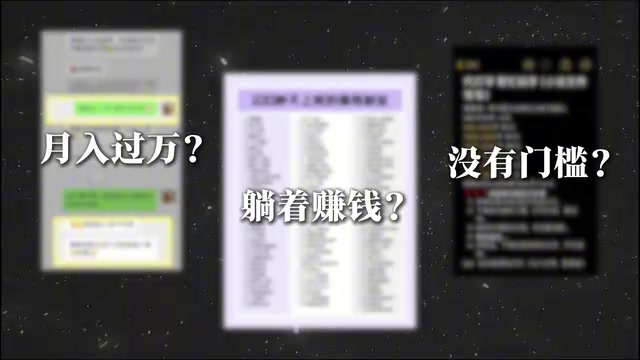
But first, a dose of reality: Those online claims of "easily earning $10,000+ a month" are almost certainly misleading. If it were truly that easy to make money, why would someone share the secret with you? Look at this space rationally—its real value lies in the fact that AI applications are genuinely in an early stage of exploding demand and scarce talent. Those who position themselves early have a chance to capture dividends, but this absolutely does not mean you can earn money while doing nothing.
What Barriers Does AI Actually Lower?
Many people's first reaction is: "I have zero experience and no skills—can I really do this?" This question needs to be unpacked.
What AI tools truly disrupt are execution-level barriers:
- You can't draw, but you can use AI to generate commercial-grade posters and product images
- You can't edit video, but AI can help you auto-compose clips, add voiceover, and generate subtitles
- You can't write copy, but AI can help you build viral content frameworks
- You're afraid of livestreaming, but AI digital humans can appear on camera 24/7 on your behalf
Creating impressive video effects used to require hiring expensive professional teams. Now one person with one computer can handle it. This is truly a rare window of opportunity for ordinary people.
But you need to clearly understand that AI lowers the execution barrier while amplifying your creativity and judgment. Everyone can use the tools—what truly creates differentiation is: Can you understand client needs? Can you produce commercially valuable work? Can you continuously iterate on your skill set? In other words, AI has made "getting it done" simple, but "doing it well" still requires investing time and effort to refine.
Breaking Down the Monetization Logic of Five Major AI Skills
Currently, the AI side hustle skills with the highest market demand are concentrated in five areas. Understanding their respective monetization logic matters far more than blindly learning tools.
1. AI Art/Design: Essential for Small and Medium Businesses
Businesses need product photos, e-commerce banners, and social media graphics. Traditional designers charge high fees with long turnaround times, while AI generates images quickly at low cost—small and medium businesses are willing to pay for this.
The core technology behind AI art is the Diffusion Model, represented by Stable Diffusion, Midjourney, and DALL-E. These models train on massive image datasets and learn to progressively "denoise" random noise into images. The core competitive advantage lies in mastering prompt engineering—this is crucial because models interpret natural language instructions differently from human intuition. Precisely describing style, lighting, composition, and color tone often produces images several times better than vague descriptions. Knowing what kind of instructions generate "valuable" images is the real key to getting AI art clients. In commercial settings, you also need to master advanced techniques like ControlNet (controlling pose and composition) and LoRA fine-tuning (customizing specific styles or characters) to truly meet clients' differentiated needs.
2. AI Video Production: An Efficiency Revolution in the Content Space
From short dramas on Douyin to corporate promotional videos, demand for video content is enormous. The AI video production field has experienced explosive growth in the past two years—in text-to-video, models like Sora, Runway Gen-3, and Kling can now generate high-quality video clips ranging from seconds to minutes. In practical commercial applications, the more mainstream workflow is "AI-assisted editing": using ChatGPT to generate scripts, ElevenLabs or Microsoft Azure to synthesize voiceover, Stable Diffusion to generate visual assets, then using CapCut's AI features to automatically handle subtitles, transitions, and rhythm matching. This "AI toolchain" combination allows a solo creator to achieve 3-5x the output of a traditional team. One person can handle the capacity of a small video studio—something previously unimaginable.
3. AI Writing: Text Demand Is Always Strong
Xiaohongshu product reviews, WeChat articles, product descriptions, SEO content… text-based demand never stops. The value of AI writing monetization isn't in having AI directly output finished pieces, but in using AI to boost efficiency while manually controlling quality and tone—achieving both speed and quality.
4. AI Voiceover: An Underestimated Blue Ocean Market
Short videos, audiobooks, and course recordings all need voiceover. AI speech synthesis (TTS, Text-to-Speech) technology has evolved from early mechanical-sounding concatenative synthesis to end-to-end neural network generation. Voice cloning features offered by platforms like Microsoft Azure TTS, ElevenLabs, and iFlytek can replicate a specific person's timbre, intonation, and emotional characteristics from minimal audio samples. Products from ByteDance (CapCut) and Alibaba (Tongyi) have also deeply integrated AI voiceover into creation tools, significantly lowering the barrier to entry. AI speech synthesis technology is quite mature, capable of generating highly natural-sounding voice content. The entry barrier for taking on voiceover projects is relatively low, making it a suitable starting point for AI side hustles. It's worth noting that voice cloning technology also raises copyright and ethical issues—when using it commercially, ensure you're using authorized voice libraries to avoid infringement risks.
5. AI Digital Humans: Rapidly Expanding Use Cases
Livestream commerce, brand IP creation, customer service—digital human applications are expanding rapidly. AI digital human technology integrates computer vision, speech synthesis, and real-time rendering, with two main technical approaches: one is "2D digital humans" driven by real human video (like HeyGen and Silicon Intelligence), which generate lip-sync and facial expression animations from real photos or videos at low cost and with a quick learning curve; the other is "virtual digital humans" based on 3D modeling, offering more realistic visuals but at higher production costs. In livestream commerce, 2D digital humans are already widely adopted by small and medium businesses, with their core value being 24/7 uninterrupted livestreaming that reduces the time and energy costs of real human hosts. Major domestic platforms like Taobao and Douyin have also opened dedicated traffic support policies for AI digital human livestreams. Building and operating AI digital human livestream rooms has become a skill that can generate stable income.

Key Insight: These five skills don't exist in isolation. Those who land high-value projects are typically "full-stack" practitioners who can combine multiple AI tools like building blocks.
Related articles
 Tutorials
ChatGPT Plus Subscription Guide: Are GPT-5.5, image-2, and Codex Worth the Upgrade?
A detailed look at ChatGPT Plus features — GPT-5.5, image-2, and Codex — with a Plus vs Pro comparison and a complete step-by-step subscription guide for users outside the US.
 Tutorials
Harness AI Engineering in Practice: Using Claude Code to Master Enterprise-Level E-Commerce Development
Deep dive into Harness AI Engineering: master enterprise e-commerce development with Claude Code using the Rules, Skills, Wiki, and Changes framework.
 Tutorials
Cursor + Codex Dual-IDE Collaboration: A Practical Methodology for Open-Source Project Customization
A complete methodology for open-source project customization based on real-world experience, detailing the Cursor+Codex dual-IDE workflow, seven-stage process, MVP validation, and AI source code reading techniques.