Practical Guide to Building a Dual-Terminal Skill System with Cursor + Claude Code

A three-layer directory architecture to resolve Cursor and Claude Code dual-terminal Skill conflicts
When developers use Cursor (Claude Opus) and Claude Code (DeepSeek v4) simultaneously for parallel development, the two tools' Skill/Rules systems are incompatible, doubling maintenance costs. This article proposes a three-layer Skill directory architecture: a Cursor-dedicated directory (concise goal-oriented instructions), a Claude Code-dedicated directory (detailed step-by-step instructions), and a shared information directory (common factual knowledge), resolving conflicts through physical isolation and MasterRule entry files.
The Skill Conflict Problem in Dual-Terminal Parallel Development
With the launch of DeepSeek v4, many developers have started using two AI capabilities simultaneously within Cursor: Cursor's built-in Claude Opus handles high-level reasoning, while the Claude Code plugin connected to DeepSeek v4 handles execution and implementation. This combination sounds ideal, but in practice you quickly run into a problem—the two tools' Skill systems are incompatible with each other.
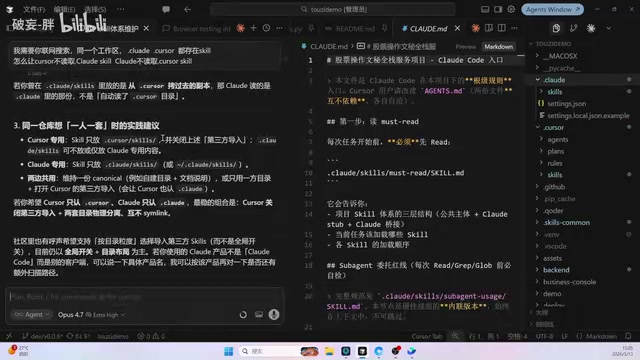
Specifically, Cursor reads Skill files and .cursorrules (or Agent.md) from its own directory, while Claude Code reads from CLAUDE.md. They are completely independent systems, each with their own rules files and skill-loading logic.
The Technical Nature of Skill/Rules Files: In AI-assisted programming tools, "Skill" or "Rules" files are a system-level prompt injection mechanism. When a developer opens a project, the tool automatically injects the contents of these files into the system prompt for every conversation, ensuring the model continuously follows specific behavioral norms and domain knowledge throughout the entire session. Cursor and Claude Code have fundamental differences in their file scanning logic and context window management strategies—Cursor recursively scans for specific filenames in the project directory, while Claude Code has its own independent file discovery protocol. These underlying differences mean that even with identical content, the two tools will parse and prioritize the same file differently.
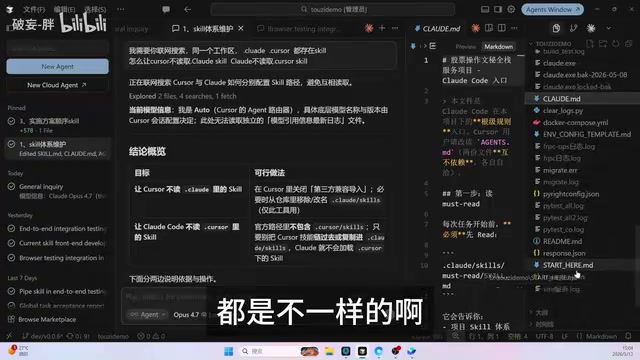
Although Cursor officially claims compatibility with Claude's Skills, the actual compatibility experience is poor. When Cursor has its own Skills, it prioritizes its own system over Claude's. This means if you want to use both effectively, you must maintain two separate Skill configurations simultaneously, instantly doubling your maintenance burden.
Core Differences in Tool Capabilities and Model Characteristics
The essence of this problem goes beyond just different file paths. The deeper reason lies in fundamental differences between the model capabilities and use cases behind the two tools.
Model Capability Differences Dictate Instruction Style
Claude Opus (by Anthropic) is widely recognized as one of the top reasoning models, trained using the "Constitutional AI" methodology. It excels at complex instruction following, multi-step logical reasoning, and autonomous decision-making in tool calling. When facing ambiguous instructions, Opus can autonomously infer intent and flexibly choose execution paths, so it requires lower granularity in Skill instructions—you only need to provide the goal, and it can flexibly determine how to execute without overly detailed step-by-step instructions.
DeepSeek v4 (by DeepSeek) offers strong cost-effectiveness in code generation and execution tasks, but is relatively conservative in autonomous reasoning chains for tool calling, relying more on explicit step decomposition and constraint conditions. This isn't a deficiency but rather a different design trade-off—more deterministic execution behavior actually reduces unexpected side effects from "hallucinatory autonomous improvisation" in automated pipelines. However, this also means you need to provide more detailed and specific instruction content to ensure accurate execution.
This difference directly explains why the two Skill sets must adopt different instruction styles: writing overly detailed steps for Opus actually constrains its reasoning space, while writing overly abstract goals for DeepSeek leads to execution drift.
Natural Separation of Responsibilities
In actual workflows, the two serve different roles:
- Opus (Cursor): Responsible for solution design, solution review, complex debugging, and other tasks requiring high-level reasoning
- DeepSeek (Claude Code): Responsible for solution execution, automated testing, operations cleanup, simple debugging, and other execution tasks
This natural division of labor effectively forms a heterogeneous multi-agent collaboration system: Cursor/Opus plays the Orchestrator role, responsible for understanding high-level requirements and formulating execution plans; Claude Code/DeepSeek plays the Executor role, responsible for receiving clear instructions and implementing them. This responsibility separation means the corresponding Skills must also be designed differently for different scenarios.
Detailed Three-Layer Skill Directory Architecture
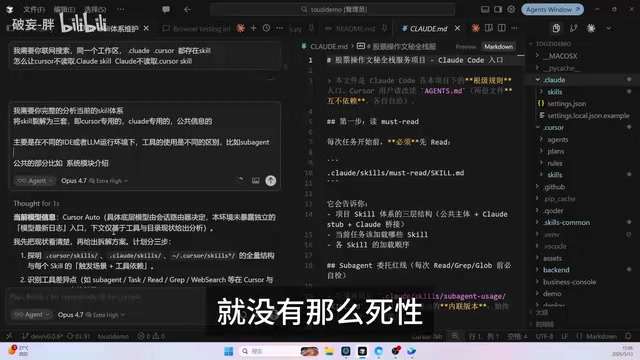
After extensive research and practice, the final solution splits the Skill system into three independent directories, each serving its own purpose. This architecture draws from the classic software engineering principle of Separation of Concerns, combined with practical wisdom from the DRY principle (Don't Repeat Yourself)—managing content with different change frequencies in separate layers, maintaining tool-specific instruction styles independently, and sharing stable business knowledge centrally.
Layer 1: Cursor-Dedicated Directory
Stores Cursor/Opus-exclusive Skill files, including a MasterRule main entry file. This file introduces the overall architecture of the current skill system and tells the model how to load and use each skill. Since Opus is highly capable, instructions can be written relatively concisely, focusing on goal orientation.
Layer 2: Claude Code-Dedicated Directory
Stores Claude Code/DeepSeek-exclusive Skill files, also with its own MasterRule. However, since DeepSeek is the underlying model, instructions need to be written in much more detail, including more step-by-step explanations and constraint conditions.
Layer 3: Shared Information Directory
This is the shared knowledge base for both tools, storing factual information independent of any specific model:

- System module descriptions
- Operations knowledge documentation
- Tool creation guides
- Various conventions (taste/conventions)
- Experience case libraries
These contents are objective factual records that don't involve model-specific instruction styles, so they can be referenced by both tools simultaneously, avoiding duplicate maintenance. The shared directory serves as a shared knowledge graph in the multi-agent architecture, ensuring different Agents reference a consistent factual foundation when handling the same business domain, preventing execution conflicts caused by information asymmetry.
Scalability Advantage: This layered design is highly similar to the configuration center concept in modern software architecture. As AI tool chains become more complex (potentially integrating three or more models simultaneously in the future), adding a new tool only requires creating a new dedicated directory—the shared knowledge layer needs no modification, making extension costs extremely low.
Implementation Key Points and Best Practices
MasterRule Is the Critical Entry Point for the Entire System
Whether in the Cursor or Claude Code directory, the MasterRule file is the mandatory entry point. It's equivalent to telling the Orchestrator "what tools you have available to call" while also defining "the calling conventions for each tool." It fulfills three core responsibilities:
- Introducing the overall structure of the current Skill system
- Explaining the purpose and loading priority of each Skill file
- Guiding the model to select appropriate Skills based on task type
Physical Isolation Is Better Than Logical Mixing
The core principle is to prevent Cursor from reading Claude Code's Skills and vice versa. Although there's currently no perfect global switch to achieve selective import at directory granularity, through physically isolating directory structures combined with each tool's MasterRule guidance, conflicts can be effectively avoided.
Differentiated Configuration for SubAgents
When using SubAgent (sub-agent) mode, different tools handle SubAgent orchestration differently. Cursor can leverage its domain expertise
Related articles
 Tutorials
ChatGPT Plus Subscription Guide: Are GPT-5.5, image-2, and Codex Worth the Upgrade?
A detailed look at ChatGPT Plus features — GPT-5.5, image-2, and Codex — with a Plus vs Pro comparison and a complete step-by-step subscription guide for users outside the US.
 Tutorials
Harness AI Engineering in Practice: Using Claude Code to Master Enterprise-Level E-Commerce Development
Deep dive into Harness AI Engineering: master enterprise e-commerce development with Claude Code using the Rules, Skills, Wiki, and Changes framework.
 Tutorials
Cursor + Codex Dual-IDE Collaboration: A Practical Methodology for Open-Source Project Customization
A complete methodology for open-source project customization based on real-world experience, detailing the Cursor+Codex dual-IDE workflow, seven-stage process, MVP validation, and AI source code reading techniques.