Practical Guide to Prompt Engineering: Core Optimization Techniques and Pitfalls to Avoid in 2026

A systematic overview of core prompt engineering techniques, strategies, and common pitfalls in 2026.
This article provides a hands-on introduction to the essence of prompt engineering (guiding, not programming), format and language choices (recommending Markdown/XML and English), the principle that system messages override user messages, and five core strategies: role setting, output format control, rule constraints, structured output, and few-shot learning. It also warns about common pitfalls like the "I don't know dilemma" and discusses Prompt Injection defense and hallucination mitigation methods.
Prompt Engineering is one of the most essential and nuanced skills in AI application development. With the rapid iteration of large language models, best practices from six months ago may already be outdated. This article, based on a senior developer's hands-on experience in early 2026, systematically covers key prompt engineering techniques and a guide to avoiding common pitfalls.
The Essence of Prompt Engineering: Guiding, Not Programming
The essence of prompt engineering is guiding a model to perform specific tasks—a process more akin to communicating with a person than writing deterministic program code. Different models have different "personalities"—Claude prefers being given high-level goals and figuring things out on its own; the ChatGPT 5.x series excels at following explicit instructions; Google's models fall somewhere in between.
A key insight is: Large language models are non-deterministic systems. Ask the same question three times, and you might get three different answers. The simpler the question, the more consistent the answers; the more complex, the greater the variation.
This non-determinism has deep technical roots. LLMs are based on the Transformer architecture, and their output is fundamentally a probabilistic sampling process—at each step when predicting the next token, the model doesn't simply choose the single highest-probability answer but samples from a probability distribution. This is controlled by the "Temperature" parameter: higher temperature means more random sampling, greater creativity but lower consistency; as temperature approaches 0, output becomes more deterministic. The model is essentially predicting the next token, and once the early direction deviates, subsequent content diverges into entirely different information. Understanding this is essential to properly appreciating the "artistic" component of prompt engineering.
Prompt Format and Language: Two Fundamental Decisions
Use Markdown or XML Format, Not JSON
For prompt formatting, Markdown, XML, or a hybrid of both is recommended. The industry consensus is that JSON is unsuitable as a prompt format—not because it lacks structure, but because it lacks clear expression of the meaning of elements within the system. In practice, starting with Markdown and gradually introducing XML tags (such as <example> tags to mark the beginning and end of examples) is a pragmatic evolutionary path.
Write Prompts in English Whenever Possible
Even if English isn't your native language, it's strongly recommended to write prompts in English. There are two reasons: First, the vast majority of internet content is in English, and general-purpose models have the deepest understanding of English; Second, non-English vocabulary typically consumes more tokens, directly impacting usage costs.
System Message vs. User Message: The Priority Principle
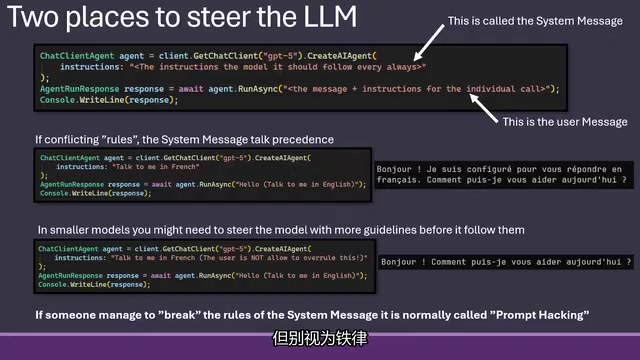
There are two pathways to guide a model: System Messages and User Messages. When rules from both conflict, the system message always takes priority.
For example, if the system requires conversation in French but the user says "please use English," the model will still respond in French. This is also the foundation of security design—if users could easily override system instructions, it would amount to "jailbreaking" the system message (known as Prompt Injection).
Prompt Injection is an attack vector targeting LLM applications, where attackers craft special inputs to attempt to override or bypass security instructions in the system message. Analogous to SQL injection, it exploits the model's inability to strictly distinguish between "instructions" and "data." Defense measures include: sandboxing input content, using XML tags to clearly separate user input from system instructions, performing permission verification on the backend, and employing dedicated Guardrail Models to conduct secondary review of outputs. While excellent large models will strictly follow system instructions, no model is absolutely unjailbreakable—this has become a kind of "competition" after every new model release.
Five Core Prompt Guidance Strategies
1. Role and Persona Setting
A common approach is to write "You are a certain type of expert"—such as a math expert, lawyer, or history professor. It's important to clarify that this does not activate a specific module within the model; rather, it guides the model to respond in that role's tone, thinking style, and professional terminology. This still has value because it focuses the AI's output direction toward your intent.
Personas can be set arbitrarily—pirate accent, British butler style, or even a dog that can only bark. A practical tip: use "pirate accent" to test whether instructions are being followed, because if the model isn't speaking in pirate dialect, the problem is immediately obvious.
2. Output Format Control
You can precisely control the length, format, and style of responses:
- Length control: Request "25 words maximum" and the model will comply. When AI answers are too long, limiting word count or paragraph count is an effective approach.
- Format control: Request heavy use of Markdown lists, emojis, or even binary responses (though processing takes longer, the underlying encoding is correct).
- Technical format: You can request output in XML-like structures, containing layers such as summary, formula, and final answer.

However, note: Don't use prompts to implement structured data output—use the model's dedicated Structured Output functionality instead.
Structured Output is a dedicated feature provided by modern LLM APIs that constrains token generation during the decoding phase through JSON Schema or Function Calling mechanisms, ensuring output strictly conforms to predefined data structures. This is fundamentally different from asking "output in JSON format" in a prompt—the latter relies on the model's instruction-following ability and has a probability of format errors; the former guarantees structural compliance at the underlying level through Constrained Decoding, making it suitable for production environments requiring programmatic processing.
3. Rule Setting and Behavioral Constraints
You can set explicit rules for the model, such as "do not answer questions about space and astronomy." An important finding when setting rules: AI is better at understanding "prohibitions" than "permissions". So if you want to use rules to constrain behavior, starting with "what not to do" works better.
But remember: don't treat prompt rules as a data security defense line. Real data access control needs to be implemented on the backend—prompt-level restrictions can be bypassed.
4. Structured Output as Implicit Instructions
Structured output itself acts like a form of instruction. For example, defining a movie object with title, year, and director fields will cause the model to automatically populate this information without additional explanation.
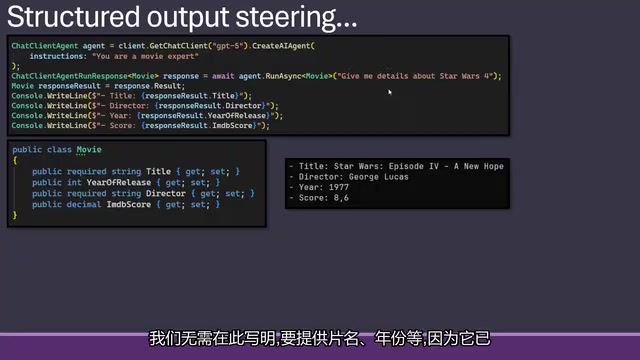
Furthermore, you can add descriptions to fields, such as requiring "movie title returned in German" or "director information must include their country of birth." These descriptions become part of the schema and effectively guide model output. When structured output descriptions conflict with system messages, the system message has the highest priority.
5. Few-shot Learning
Rather than using lengthy text to describe the expected response style, simply provide a few examples. For instance, to simulate a wise elder answering grandchildren's questions, instead of describing "be nostalgic, call the child 'little one,'" use <example> tags to provide two or three real conversation samples.
The effectiveness of few-shot learning stems from the pattern recognition ability LLMs acquire during pre-training. Through examples in context, models can quickly infer the implicit rules of a task—highly similar to human analogical reasoning mechanisms. Research shows that example quality matters far more than quantity: 3 high-quality examples covering edge cases often outperform 10 mediocre ones. The order of examples also affects output, with the last example typically carrying the greatest influence weight on the model. The model learns tone, vocabulary, and response patterns from examples, with far better results than abstract descriptions.
The "I Don't Know Dilemma": A Prompt Pitfall Worth Watching
Large language models are not good at identifying their own areas of ignorance—this is one of the fundamental causes of hallucinations. The deep mechanism behind LLM hallucination lies in the fact that models are optimized to generate text that "sounds reasonable" rather than text that is "factually accurate." Models don't have an independent "knowledge retrieval" module; all output is probabilistic recombination of parameterized memory. When queries involve areas sparse in training data, time-sensitive information, or highly specific facts, models tend to "confidently fabricate" rather than acknowledge uncertainty. Mitigation strategies include: Retrieval-Augmented Generation (RAG), Chain-of-Thought prompting, and requiring models to output confidence scores.
Intuitively, we'd want to add "if you don't know, say you don't know" to prompts, but in practice this often backfires.

Real-world experience shows: virtually all production instructions that included an "I don't know" option eventually had to remove it. Because models will overuse this "escape hatch"—even when they should know the answer or should attempt reasoning, they'll simply give up and say "I don't know."
Related articles
 Tutorials
ChatGPT Plus Subscription Guide: Are GPT-5.5, image-2, and Codex Worth the Upgrade?
A detailed look at ChatGPT Plus features — GPT-5.5, image-2, and Codex — with a Plus vs Pro comparison and a complete step-by-step subscription guide for users outside the US.
 Tutorials
Harness AI Engineering in Practice: Using Claude Code to Master Enterprise-Level E-Commerce Development
Deep dive into Harness AI Engineering: master enterprise e-commerce development with Claude Code using the Rules, Skills, Wiki, and Changes framework.
 Tutorials
Cursor + Codex Dual-IDE Collaboration: A Practical Methodology for Open-Source Project Customization
A complete methodology for open-source project customization based on real-world experience, detailing the Cursor+Codex dual-IDE workflow, seven-stage process, MVP validation, and AI source code reading techniques.