Predicting Alignment Generalization with Value Representations: A New Paradigm for LLM Behavior Transfer

The paper proposes using model activation representations to predict cross-value generalization effects of alignment fine-tuning, achieving a correlation of 0.45, far outperforming text baselines.
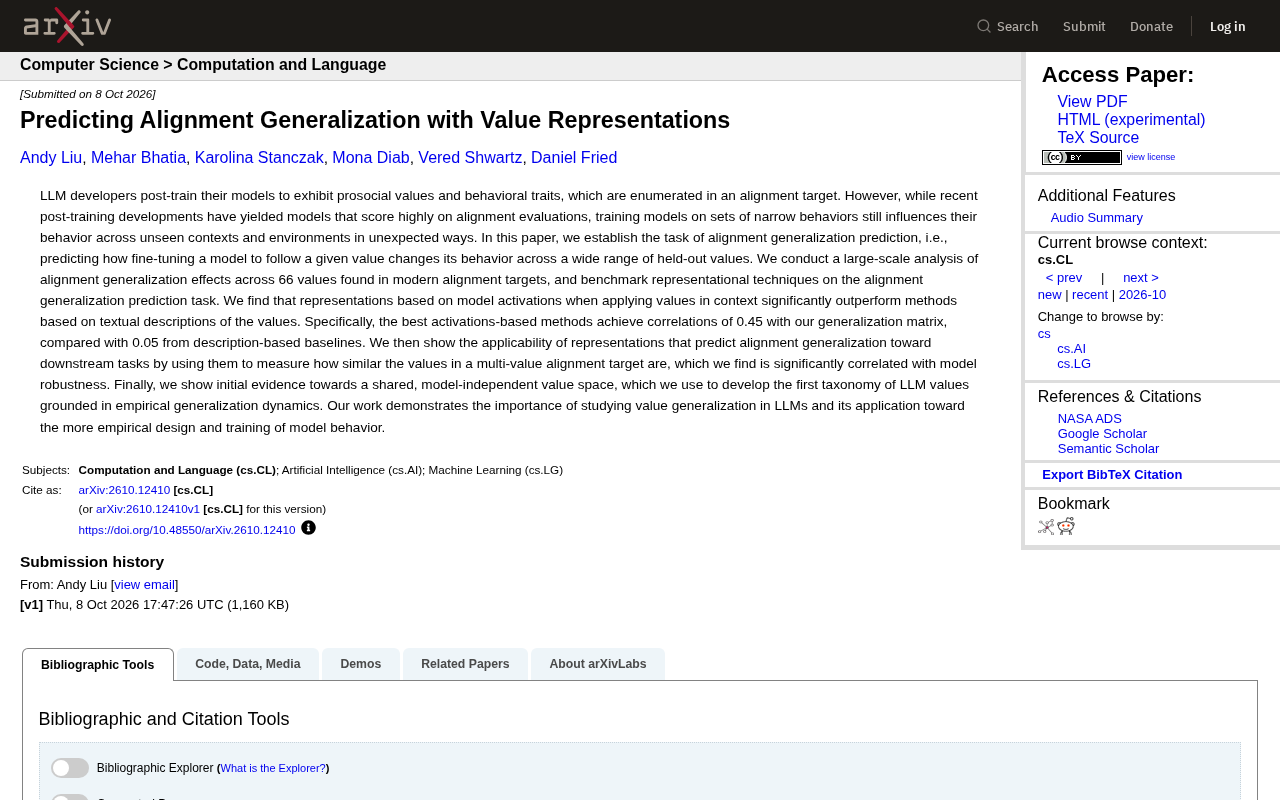
The paper "Predicting Alignment Generalization with Value Representations" studies spillover effects in alignment training: fine-tuning one value unexpectedly changes model behavior on other values. The authors formalize the "alignment generalization prediction" task, build a generalization matrix across 66 value dimensions, and compare text description and model activation representations. Results show activation-based representations achieve a correlation of 0.45 with the generalization matrix, while the text baseline achieves only 0.05, indicating that value name semantics is insufficient to predict generalization—internal model activations must be observed. The paper further uses value similarity to measure the robustness of multi-value alignment objectives and provides preliminary evidence of a shared model-agnostic value space, based on which the first LLM value taxonomy is constructed. Its core claim is to transform alignment generalization from a post-training observation into a quantifiable diagnostic tool before training.
Alignment training for large language models often faces an awkward reality: models perform well on evaluation sets, yet during actual deployment, fine-tuning causes unexpected behavior drift. A paper titled "Predicting Alignment Generalization with Value Representations" raises a key question—can we predict, before training even begins, how fine-tuning on a particular value will change the model's behavior in other unseen contexts?
Why Alignment Generalization Is So Tricky
Current alignment pipelines typically revolve around a well-defined set of value objectives. Developers use post-training to make models exhibit prosocial behavior and achieve high scores on alignment evaluations. But the paper points out that even when training targets only a narrow set of behaviors, the model's behavior in unseen contexts and environments is still affected in unexpected ways.
This means alignment training has spillover effects: adjusting one value dimension may tug at other seemingly unrelated value dimensions. The paper formalizes this phenomenon as the "alignment generalization prediction" task—predicting how a fine-tuned model's behavior changes across a large set of held-out values after it has been trained to follow a particular value.
Alignment in the context of large language models refers to the process of making model behavior conform to human intent and value norms through supervised fine-tuning, reinforcement learning from human feedback (RLHF), or constitutional AI. Alignment Generalization focuses on whether these training objectives remain stable outside the training distribution: when a model is fine-tuned only to follow one category of values, how will it behave in unseen contexts, tasks, or value dimensions? Behavior Drift typically refers to the phenomenon where a model's output distribution deviates from its original alignment objectives after deployment or further fine-tuning, potentially manifesting as reduced safety, abrupt style changes, or inconsistent value judgments. Understanding the relationships among these three concepts is the prerequisite for grasping the paper's problem statement: alignment training does not modify a single behavior in isolation but triggers chain reactions within the model's internal value representation space, so generalization must be predicted at the representation level rather than merely the behavioral level.
Large-Scale Analysis Across 66 Value Dimensions
The research team conducted a large-scale generalization effect analysis across 66 values commonly found in modern alignment objectives and constructed a generalization matrix as a benchmark. On this matrix, they compared two types of representation methods: one based on text descriptions, and the other based on the model's activation representations when applying values in context.
The gap in results was striking. The best version of the activation-based representation method achieved a correlation coefficient of 0.45 with the generalization matrix, while the description-based baseline achieved only 0.05. This shows that to understand how a value generalizes, the textual semantics of the value name alone is far from sufficient—one must observe the model's internal activation patterns when processing that value.
This finding has direct methodological implications for alignment research: there is a substantial gap between text-level value definitions and the value representations the model actually learns.
Activation Representation refers to vectors extracted from a model's internal neurons or hidden layer states, typically obtained by recording activation values at specific layers and token positions during forward propagation. Unlike text description embeddings, activation representations directly reflect how the model "computes" a concept in a specific context, rather than the concept's semantic position in vocabulary space. Correlation Coefficient here is used to measure the consistency between predicted representations and the true generalization matrix, commonly using Pearson or Spearman coefficients, where values closer to 1 indicate more accurate predictions. The gap between 0.45 and 0.05 in the paper shows that textual semantics of value names alone can hardly predict cross-value behavioral changes after model fine-tuning, while the model's internal activations carry much richer generalization information. This methodological shift also echoes the ideas of "linear probes" and "representational similarity analysis" in interpretability research.
From Prediction to Downstream Applications
The paper further demonstrates the practical utility of these predictive representations. Researchers used them to measure the similarity between individual values within multi-value alignment objectives and found that this similarity is significantly correlated with model robustness.
In other words, if an alignment objective contains values that are highly conflicting with each other, the model may be more fragile after fine-tuning. This provides a quantifiable diagnostic tool for designing alignment objectives—one that can assess the inherent tension of a value combination before training even begins.
Toward a Model-Agnostic Value Space
The paper concludes with preliminary evidence pointing to a shared, model-agnostic value space and constructs the first LLM value taxonomy based on generalization dynamics. If this value space is consistent across different models, then predictions of alignment generalization could transfer across models, reducing the cost of conducting large-scale generalization experiments for every new model.
However, the paper also indicates that this remains early-stage evidence, and the strength and boundary conditions of model-agnosticism require further validation.
Model-Agnostic Value Space is a hypothetical shared representational structure: if large models with different architectures and different training data converge to similar geometric or semantic layouts when representing human values, then generalization relationships measured on one model could potentially transfer to another. LLM Value Taxonomy is a hierarchical classification built on this space, used to systematically organize the 66 value dimensions and their interrelationships. The paper's preliminary evidence suggests that the value space may have some consistency across different models, but the strength and boundary conditions remain unclear. If this hypothesis holds, alignment teams would no longer need to repeat expensive generalization matrix experiments for each new model, but could instead reuse existing value space priors, significantly reducing the cost of alignment diagnostics.
Implications for Alignment Practice
The most valuable aspect of this work is that it transforms alignment generalization from a post-hoc observation into a predictable, quantifiable object. For teams engaged in post-training and alignment evaluation, this implies several practical takeaways:
- Value representations should be extracted from model activations rather than relying on textual embeddings of value names
- Multi-value alignment objectives need to assess inter-value similarity and conflict as a priori indicators of robustness
- The generalization matrix can serve as a diagnostic tool before alignment training, helping identify potential behavioral spillover
The paper's core conclusion is that studying value generalization in LLMs and applying it to more empirically grounded design and training of model behavior should become a standard part of alignment workflows.
One-line Summary
The paper proposes using model activation representations to predict cross-value generalization effects of alignment fine-tuning, achieving a correlation coefficient of 0.45, far outperforming text-based baselines.
Paragraph Summary
The paper "Predicting Alignment Generalization with Value Representations" investigates spillover effects in alignment training: fine-tuning on one value unexpectedly changes model behavior on other values. The authors formalize the "alignment generalization prediction" task, construct a generalization matrix across 66 value dimensions, and compare two types of representations—text descriptions and model activations. Results show that activation-based representations achieve a correlation coefficient of 0.45 with the generalization matrix, while text baselines achieve only 0.05, demonstrating that the semantics of value names is insufficient to predict generalization and that internal model activations must be observed. The paper further uses value similarity to measure the robustness of multi-value alignment objectives and provides preliminary evidence of a shared model-agnostic value space, based on which the first LLM value taxonomy is constructed. Its core claim is to transform alignment generalization from a post-training observation into a quantifiable diagnostic tool before training.
Related articles

Structuring Data for AI Agents: Five Approaches and a Selection Guide
There's no single best way to structure data for AI Agents. This article compares semantic models, knowledge graphs, RAG, Markdown+grep, and open formats, drawing on research from dbt, Microsoft, and Chroma to help you pick the right data architecture based on question type.

Fish Audio Drama 3 Open-Source Launch Sparks Debate: The 35B Speech Model's Selling Points and Licensing Controversy
Fish Audio Drama 3 sparks debate with 35B parameters and open weights, ranking first on pronunciation benchmarks with director-style control and word-level inpainting, but its community license restricts commercial resale, API prices are rising, and local runs need ~39GB VRAM.

curl 8.23.0 Fixes 24 CVEs, AI-Assisted Research Contributed 20
curl 8.23.0 fixes 24 CVEs, 20 found by AI-assisted research, including a High-severity HTTP/2 use-after-free that could become RCE. Here's the source, fix details, and upgrade checklist.