Prelulu Launches: Bringing Real-Time Avatar Roleplay to the Mass Consumer Market

Prelulu launches on Product Hunt with dual-mode chat and video AI roleplay, aiming to bring real-time avatar tech to consumers.
Prelulu is an AI roleplay product gaining attention on Product Hunt, featuring a "chat + video" dual-mode immersive story experience and allowing users to create real-time avatar characters. It ranked 3rd in the AI category with 114 votes and 21 comments. The article notes that real-time avatars aren't new, but Prelulu aims to consumerize them by lowering the barrier to creating and driving virtual characters. This requires solving real-time latency, avatar quality, and compute costs—though technical metrics aren't disclosed. The article positions Prelulu as interactive entertainment and analyzes content governance, retention, and cost structure as key challenges, concluding the direction has exploratory value but scalability remains unproven.
Prelulu Launches: Bringing Real-Time Avatar Roleplay to the Mass Consumer Market
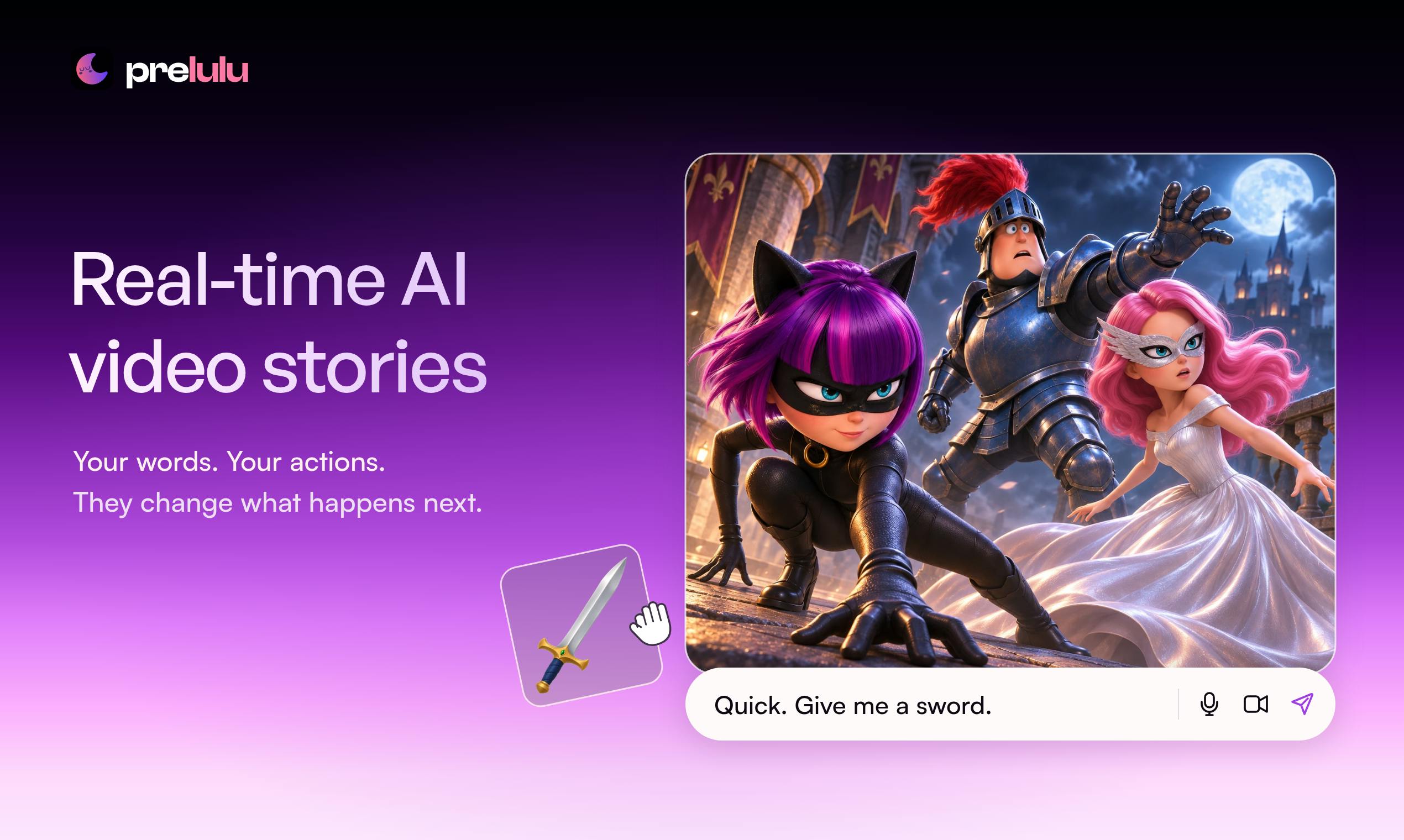
A new product called Prelulu has appeared on Product Hunt with the tagline "Be the protagonist: chat and video roleplay with any story." It ranked 3rd in the AI category for the day, gathering 114 upvotes and 21 comments. More noteworthy than the vote count is what it claims to be doing—bringing real-time avatar technology to consumer scale for the first time—and allowing users to create their own characters with real-time avatar capabilities.
What Prelulu Actually Offers
Based on the product page description, Prelulu's core experience is "immersive stories + AI characters." Users can message and chat with AI characters in a story, or switch to video mode for face-to-face roleplay, making themselves the protagonist of the story.
This clearly distinguishes it from the many text-based AI character chat products on the market. Text chat is essentially a conversation with a language model, whereas video roleplay requires the system to generate and drive a real-time virtual avatar alongside the conversation—lip sync, expressions, and movements all need to keep pace with the dialogue. Prelulu packages these two pipelines into an entertainment product aimed at ordinary users.
The product also opens up character creation: users aren't limited to consuming officially provided story characters but can define their own and give that character real-time avatar expressiveness. If this step is smooth enough, it means content supply can be driven by users themselves rather than relying on the team to produce characters one by one.
Real-time Avatar refers to an AI-driven virtual persona that responds to user input in real time, generating corresponding expressions, lip movements, and actions. Unlike traditional pre-rendered animation, real-time avatars rely on the coordination of multiple modules—speech recognition, natural language processing, speech synthesis, and facial animation generation—completing the loop from user speech to avatar response within hundreds of milliseconds. Consumer scenarios are particularly sensitive to latency: once response exceeds about 300 milliseconds, the "sense of presence" in conversation drops noticeably, and users feel they're talking to a machine rather than interacting with a character. Therefore, bringing real-time avatars to consumers is not just a technical problem but an experience engineering problem.
The Weight of "First to Bring Real-Time Avatars to Consumer Scale"
Real-time avatars are not a new concept. Digital human livestreaming, virtual anchors, and enterprise-level virtual customer service have existed for years, but these scenarios typically involve high production barriers, fixed scripts, or expensive compute costs—ordinary users find it hard to create a virtual character that can converse in real time.
Prelulu's ambition is to "consumerize" it—lowering the barrier so an ordinary user can create a character, open a camera or enter a video interface, and start roleplaying directly. This requires simultaneously solving three problems: real-time inference latency, avatar driving quality, and cost control. If any link fails, the experience collapses immediately. The product page doesn't disclose specific technical solutions or performance metrics, so whether it truly meets the "consumer scale" requirement needs to be verified through actual use.
Judging from Product Hunt's categorization, Prelulu is listed under Artificial Intelligence, Games, and Entertainment simultaneously—a positioning that itself suggests it's closer to an interactive entertainment product than a productivity tool.
Competitive Landscape: The Fragmentation of the AI Roleplay Track
AI roleplay is not a blank market. Text-based character chat products have already established a user base, while video-oriented attempts have mostly remained at the demo or limited-scenario stage. Prelulu's differentiation lies in treating "video" as a first-class citizen rather than a supplementary feature to text chat.
| Format | Typical Characteristics | Barrier |
|---|---|---|
| Text character chat | Pure text dialogue, characters shaped through language | Low |
| Pre-recorded avatars | Fixed scripts, no real-time interaction | Medium |
| Real-time video roleplay | Dialogue and avatar synchronized in real time | High |
The third category is exactly where Prelulu positions itself. Its challenge isn't whether it can produce a stunning demo, but whether it can reliably deliver real-time avatar experiences to a large number of ordinary users and keep them coming back to play.
Character Consistency refers to an AI character's ability to maintain stable personality settings, language style, memory, and emotional responses across multiple rounds and extended interactions. In text chat, consistency mainly depends on context windows and character prompt engineering; in video roleplay, consistency must also extend to the avatar's expression and movement style, aligning visual presentation with linguistic personality. If a character frequently exhibits personality drift, forgets previous conversations, or has mismatched expressions and tone during extended interactions, users' emotional investment quickly breaks down. For products focused on immersive stories, character consistency is the hidden infrastructure for retention.
Several Issues Worth Watching
Content governance. Users can create their own characters and engage in video roleplay with them, which means the platform needs to balance openness and safety. Roleplay scenarios inherently involve emotional investment, making boundary management more complex than for ordinary chat products.
Retention rather than novelty. The first experience of video roleplay easily creates surprise, but long-term retention depends on story quality and character consistency. If characters frequently "break character" during extended interactions, immersion quickly disintegrates.
Cost structure. Real-time avatars consume far more compute than pure text chat. Whether the product can maintain experience quality under a reasonable subscription or payment model is the key variable for whether it can scale.
Summary
Prelulu pushes real-time avatars from technical demonstrations and B2B scenarios into ordinary consumers' entertainment consumption—a direction with exploratory value in itself. The 114 upvotes and 3rd-place ranking show it has gained initial attention in the Product Hunt community, but the real test is whether the product can find a sustainable balance among latency, visual quality, cost, and content governance. For those following AI interactive entertainment, this is a product worth trying firsthand and observing its subsequent iterations.
Background Notes
Real-time inference latency is one of the core metrics for measuring the experience of such products, typically referring to the time between the end of user voice input and the avatar beginning to produce voice and visual responses. In video roleplay, latency must cover four stages simultaneously: speech recognition, language model generation, speech synthesis, and facial driving—queuing or computation at any stage adds up. The industry generally considers under 300 milliseconds as the threshold for near-natural conversation, while exceeding 1 second causes immersion to drop significantly. Additionally, avatar driving quality involves lip-sync accuracy, micro-expression naturalness, and head pose coherence. Subtle flaws in these metrics are amplified in video mode and become key criteria for users judging whether it "looks like a real person."
One-line Summary
Prelulu launches on Product Hunt, featuring dual-mode chat and video AI roleplay, attempting to bring real-time avatar technology to the consumer market.
Paragraph Summary
Prelulu is an AI roleplay product gaining attention on Product Hunt, featuring a "chat + video" dual-mode immersive story experience and allowing users to create their own characters with real-time avatar capabilities. It ranked 3rd in the AI category for the day, receiving 114 votes and 21 comments. The article notes that real-time avatars are not a new concept, but Prelulu attempts to consumerize them, lowering the barrier for ordinary users to create and drive virtual characters. This goal requires simultaneously solving three major challenges: real-time inference latency, avatar driving quality, and compute costs—while the product page doesn't disclose specific technical metrics. The article positions Prelulu as an interactive entertainment product and analyzes three key challenges: content governance, long-term retention, and cost structure. It concludes that the direction has exploratory value, but scalability remains to be verified.
Related articles

AI Detection False Positive Controversy: Writer Accused of Using AI, Who Should Bear the Burden of Proof?
A 2026 Commonwealth Short Story Prize regional winner was flagged by Pangram as 100% AI-generated but cleared after drafts were reviewed. The case exposes AI detection false positives and the burden-of-proof dilemma facing creators.

How Stanford Teaches AI-Native Engineering: Inside CS146S
Stanford's CS146S course confronts AI one-click assignment generation, exploring AI-native engineering education. Mihail Eric shares how to treat AI as an engineering partner and build system design and code review skills, offering a new model for engineering education.

Stanford's AI-Native Engineering Course: How to Teach Programming in the Age of Agents
Stanford CS146S course reform: Mihail Eric brings open-source maintainers into the classroom, having students propose changes in unfamiliar real codebases, exploring AI-native engineering teaching in the age of agents, shifting from writing code to cultivating engineering decision-making skills.