Prestel and Micronet: Britain's Lost Proto-Internet
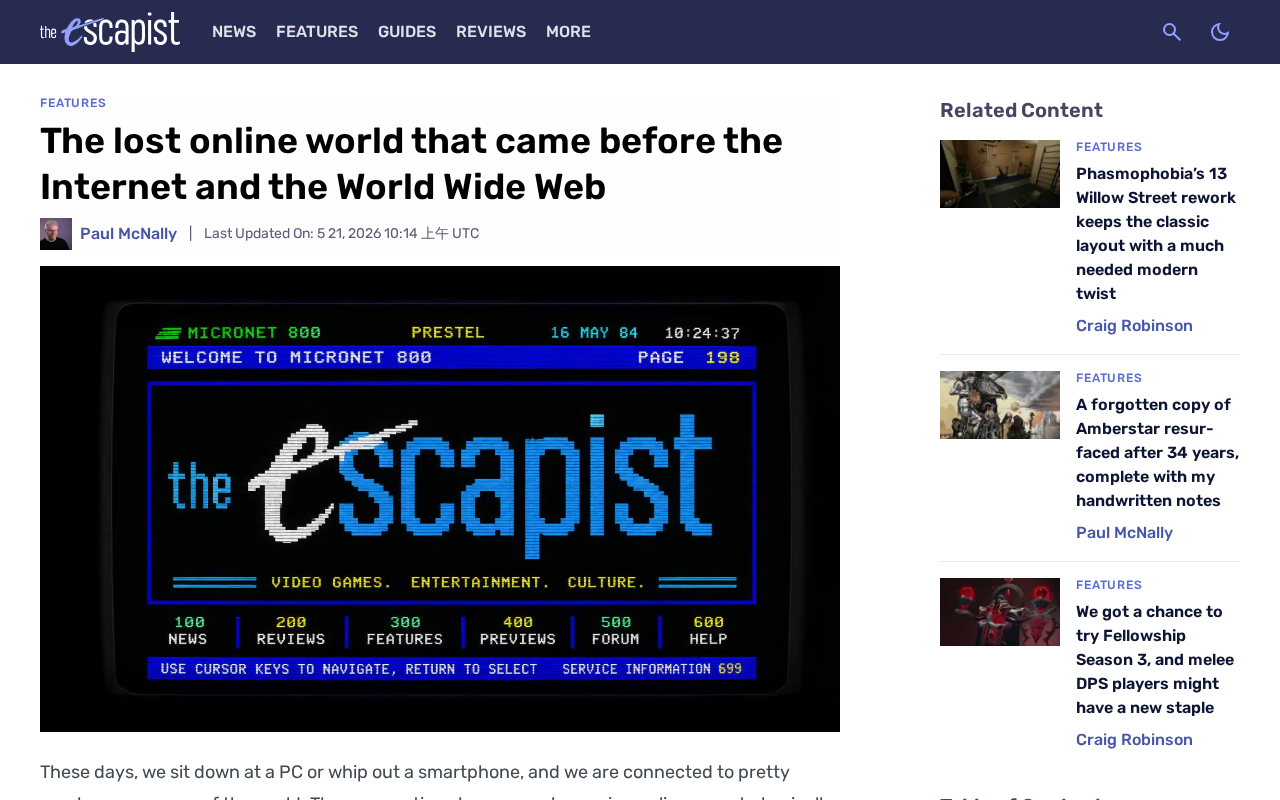
How Britain's 1979 Prestel system pioneered online services a decade before the web — and why it failed.
In 1979, Britain launched Prestel, a Viewdata system delivering interactive information over phone lines, along with Micronet 800, a community platform for microcomputer enthusiasts. Despite pioneering features like bidirectional interaction, software downloads, and online communities years before the World Wide Web, Prestel's high costs and closed architecture led to its demise by 1994 — a reminder that openness and accessibility matter more than being first.
A Forgotten Internet Pioneer
In popular understanding, the internet originated from America's ARPANET, and the World Wide Web was born from Tim Berners-Lee's vision at CERN in 1989. Yet beyond these widely told narratives lies a lesser-known chapter of history — as early as the late 1970s, Britain had already launched a public-facing online information service: Prestel, along with its community platform Micronet.
This story has been called "Britain's Lost Internet," and it reveals a fascinating fact: in an era when personal computers had yet to become widespread and the concept of the internet hadn't even taken shape, the British were already exploring the experience of "accessing digital information over telephone lines" — something we take entirely for granted today.
Prestel: An Information Revolution Over Phone Lines
Technical Origins
Prestel was officially launched in 1979 by the British Post Office (later British Telecom) and was built on a technology called "Viewdata." The core idea was to use ordinary telephone lines to transmit information stored on central computers — in the form of text and simple graphics — to television sets or dedicated terminals in users' homes.
It's worth noting that the General Post Office (GPO) had long held a monopoly over postal and telecommunications services in Britain. In 1981, the Thatcher government's privatization reforms separated telecommunications from postal services, establishing British Telecom (BT), which was floated on the stock market in 1984 in one of Britain's largest privatizations. Prestel was born right in the midst of this upheaval — initially developed under a state-owned monopoly, it soon found itself facing an entirely new competitive commercial environment. As a newly privatized company, BT needed to demonstrate profitability, transforming Prestel from a government-led public information service into a product that had to pay its own way. This identity shift intensified the tension between its pricing and its potential for mass adoption.
Technical Details of Viewdata
The underlying principle of Viewdata technology was data transmission over standard analog telephone lines (PSTN) at an asymmetric rate of 1200/75 baud — 1200bps downstream for receiving page data and 75bps upstream for users to send simple page number requests. This asymmetric design was a pragmatic engineering choice at the time, since user input consisted mainly of keypad numbers with minimal data volume. Each Prestel page comprised 24 rows of 40 columns of characters, using a graphics display standard based on 7-bit character encoding that supported limited block graphics (rendering simple images in a mosaic-like fashion).
Unlike the contemporaneous "Teletext" (such as Britain's Ceefax), Prestel was bidirectional and interactive. Teletext embedded data in the vertical blanking interval (VBI) of television signals and was essentially a one-way broadcast — users could only wait for the page they wanted to appear in a rotating cycle of a few hundred pages, unable to actively request specific content. Prestel, by contrast, allowed users to "request" specific information pages via telephone lines and even perform simple interactive operations. This interactivity was precisely what distinguished it from other information services and brought it closer to the modern concept of the internet.
Commercial Positioning and Content
Prestel was initially positioned as a platform for business users and information services. Users could look up flight schedules, stock prices, news, travel information, and even conduct early forms of online shopping and banking. These functions seem unremarkable today, but in the early 1980s, being able to sit at home and query real-time information on a television screen was undeniably a futuristic experience.
However, Prestel's pricing strategy and technical barriers made it difficult to truly reach ordinary households. Expensive terminal equipment and usage fees kept most potential users out, laying the groundwork for its later commercial struggles.
By contrast, France's Minitel system (launched in 1982) took a radically different approach to adoption — France Télécom distributed free terminals to every household to replace paper telephone directories, solving the terminal adoption problem at a stroke. By the early 1990s, Minitel had over 25 million users, offered more than 26,000 services, and generated billions of francs in annual transactions. Minitel's success precisely confirmed the key reason for Prestel's failure — prohibitively high terminal costs hindering mass adoption. Yet Minitel's success also became its burden: France's over-reliance on this closed system actually delayed its transition to the open internet, and Minitel wasn't finally retired until 2012. These two parallel cases together demonstrate that the path chosen for technology adoption is often more decisive than the technology itself.
Micronet 800: The Embryo of Online Community
From Information Service to Community Platform
If Prestel was an officially-led information infrastructure, then Micronet 800, which ran on top of it, displayed a side much closer to modern internet communities. Micronet was specifically aimed at the burgeoning home microcomputer enthusiast community in Britain — users of machines like the Sinclair ZX Spectrum, Commodore, and BBC Micro.
Britain in the early 1980s experienced a unique "micro revolution." In 1982, the BBC launched the "Computer Literacy Project" in collaboration with Acorn Computers to develop the BBC Micro, using television programs to teach programming and directly inspiring a generation of Britons' passion for computing. Simultaneously, Sir Clive Sinclair's ZX Spectrum brought color computing into homes for under £200, spawning a vast "bedroom coder" culture. These young people wrote games and applications in their bedrooms, and many went on to become founders of the British gaming industry. It was this unique cultural soil that provided Micronet 800 with a natural user base — these curious and technically capable microcomputer enthusiasts were eager to connect with like-minded people and hungry for the latest software and technical news.
Micronet offered not only software downloads (users could download programs directly to their home computers), programming tips, and hardware news, but more importantly, it built a community where users could interact with one another. This kind of user group — connected by shared interests through a network — can be seen as a spiritual precursor to BBS forums and even social networks.
An Early "Download Culture"
One of Micronet's most forward-looking features was allowing users to download software directly to their computers via telephone lines. In an era when software was primarily distributed physically on cassette tapes and floppy disks, this model of "obtaining programs online" was genuinely revolutionary. It foreshadowed the fundamental transformation in software distribution — from physical media to network delivery. From Micronet's online downloads, to 1990s shareware FTP sites, to the launch of Steam in 2003 and the Apple App Store in 2008, the dematerialization of software distribution forms a clear historical thread, and Micronet was one of the earliest nodes on that thread.
Security Breaches and Historical Turning Points
Prestel's history includes a famous episode: in 1984, two British hackers, Robert Schifreen and Stephen Gold, successfully broke into the Prestel system and even accessed the private mailbox of the Duke of Edinburgh (Prince Philip). They exploited vulnerabilities in Prestel's security design — system maintenance staff used simple default passwords with unencrypted transmission — obtaining an engineer's login credentials through "shoulder surfing" at a trade show.
The incident shocked British society and directly catalyzed the legislative process for Britain's Computer Misuse Act 1990. Notably, the legal proceedings themselves were full of drama: since British law at the time contained no specific provisions for computer crime, prosecutors could only charge them under the Forgery and Counterfeiting Act 1981, alleging they had "forged" an electronic instrument. The case was ultimately appealed to the House of Lords, which ruled them not guilty in 1988 — the judges held that electronic signals did not constitute a "forged document." This legal vacuum directly exposed the inadequacy of existing legal frameworks to address digital-age crime, ultimately prompting Britain to pass the dedicated Computer Misuse Act in 1990, which remains the core legal basis for combating cybercrime in the UK to this day.
This incident reflects, from another angle, that the security and trust challenges Prestel faced were fundamentally the same as those confronting today's internet. Once information begins flowing through networks, questions of security and privacy inevitably follow.
Why Prestel Ultimately Became "Lost"
Despite its visionary concepts, Prestel and Micronet ultimately failed to achieve mainstream adoption. The reasons for their decline are worth contemplating:
- Prohibitive costs: Terminal equipment and usage fees remained stubbornly high, limiting mass adoption. By comparison, France's Minitel achieved massive adoption by distributing terminals for free, proving that pricing strategy may matter more than the technology itself.
- Closed ecosystem: Prestel was a centralized, closed system where information was controlled by official and authorized providers, lacking the decentralized, anyone-can-participate vitality of the open internet. All content required platform review and authorization, information providers had to pay BT for "page space," and users could only browse within a preset tree-structured navigation system.
- Overtaken by technology: As personal computers became widespread and the World Wide Web emerged in the 1990s, the open, free, globally connected internet rapidly displaced these regional, closed information services.
Prestel finally ceased operations in 1994, and Micronet had already shut down in 1991.
Lessons from History: Being First Doesn't Mean Winning
The story of Prestel and Micronet offers a valuable perspective for understanding technological evolution. It demonstrates that the concepts of "online information services" and "network communities" were not exclusive inventions of the internet age, but rather inevitable directions explored repeatedly across different countries and different technological paths.
More importantly, it reveals a profound pattern: being technologically ahead does not guarantee ultimate victory. Prestel was remarkably advanced in interactivity, content richness, and community building, but its closed architecture and high costs ultimately led to its defeat by the open, affordable, and decentralized World Wide Web.
When Tim Berners-Lee designed the World Wide Web, he deliberately chose a decentralized architecture: anyone could set up a server to publish content, hypertext links broke free of hierarchical structural constraints, and the HTTP and HTML protocols were completely open and free. The internet's underlying TCP/IP protocol similarly upheld the "end-to-end principle" — the network itself was only responsible for data transmission, without exercising control over content. This open architecture unleashed explosive innovation — because innovation required no one's permission. Prestel's "walled garden" design stood in stark contrast, and history has rendered its verdict.
This "lost internet" reminds us that what truly changes the world is often not the earliest technology to appear, but rather the solution that most effectively lowers barriers to entry and offers the greatest openness and inclusivity. In today's debates over open-source versus closed-source AI models, the gap between Web3's decentralization ideals and reality, and the degree of openness in various platform ecosystems, this story from forty years ago remains well worth reflecting on. From the early ecosystem rivalry between iOS and Android, to the current debate over open weights for large language models, the tension between openness and control has always been the central theme of technological ecosystem evolution — and the rise and fall of Prestel may be the earliest and most complete historical footnote to this enduring theme.
Key Takeaways
Related articles

Disaster and Glory of the Apollo Program: The History We Must Revisit Before Returning to the Moon
From the fatal Apollo 1 fire to Apollo 8's daring lunar orbit to Apollo 11's successful landing—revisiting the disasters, fears, and compromises of the Apollo program and their lessons for today's return to the Moon.

Netflix Trust Exercise Turns Into Firing Trap: Where Are the Boundaries of Corporate Trust?
A Netflix employee was fired after sharing private info in a trust exercise. We analyze the risks of corporate trust exercises and how employees can protect themselves.

AMD CDNA5 Architecture Deep Dive: Technical Evolution and the AI Computing Competition Landscape
Deep analysis of AMD's CDNA5 architecture covering Chiplet packaging upgrades, HBM memory evolution, and low-precision compute optimization, examining how AMD challenges NVIDIA's AI chip dominance.