Privacy and Fairness Cannot Both Be Maximized: The ZK Dilemma of Federated Learning Token Rewards

ZK threshold privacy gating doubles attackers' reward capture rate and triggers a late-stage failure cascade.
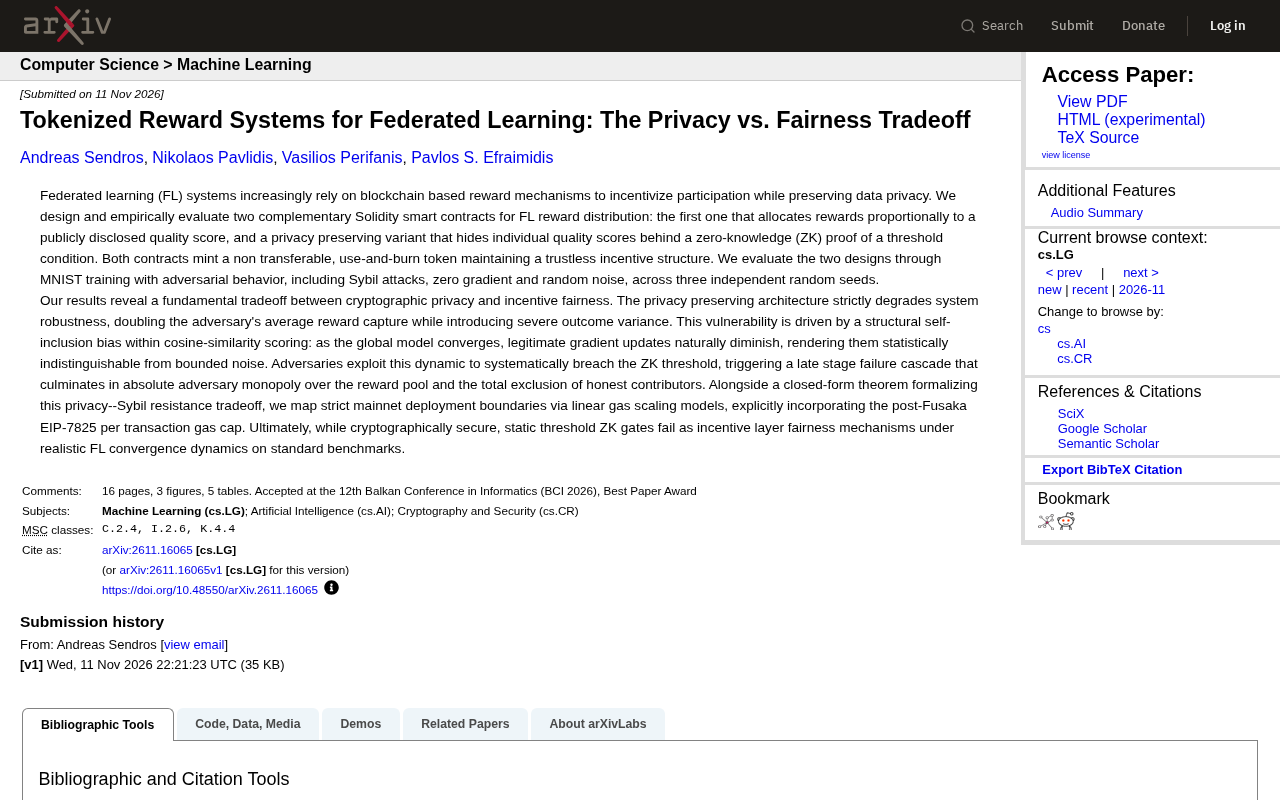
The study implements two federated learning token reward contracts on Ethereum: a public quality score version and a ZK threshold privacy version, tested on MNIST with Sybil attacks, zero gradients, and noise injection. Results show the privacy version strictly weakens robustness: attackers' average reward capture rate doubles and result variance surges. The root cause is self-contained bias in cosine similarity scoring—after model convergence, honest gradients decay to indistinguishability from noise, while ZK thresholds verify only the score, not its origin, allowing attackers to systematically breach thresholds, triggering a late-stage failure cascade and monopolizing the reward pool. The paper further provides a closed-form theorem for the privacy-Sybil resistance trade-off and delineates mainnet deployment boundaries using a linear gas model combined with the EIP-7825 cap, concluding that static threshold ZK gating cannot serve as an effective incentive fairness mechanism.
The integration of Federated Learning (FL) with blockchain incentive mechanisms is giving rise to a new class of systems: participants contribute local model updates, and smart contracts distribute token rewards based on contribution quality—all without exposing raw data. This design appears to balance privacy and incentives, but recent research reveals a structural contradiction: when privacy protection is strengthened to the level of zero-knowledge proofs (ZK), the system's attack resistance may decrease rather than increase.
Design Logic of Two Reward Contracts
The research team implemented two complementary reward distribution contracts in the Ethereum Solidity environment. The first uses a public quality score mechanism: participants' contributions are rewarded proportionally to a publicly disclosed quality score. The second is a privacy-enhanced version, where individual quality scores are hidden and replaced by a zero-knowledge proof that only proves the score satisfies a certain threshold condition.
Both contracts mint a non-transferable "use-and-burn" token to maintain a trustless incentive structure—tokens cannot be circulated or speculated upon and can only be used for internal utility redemption, which to some extent suppresses speculative behavior.
Zero-Knowledge Proof (ZK) and Threshold Proofs: Zero-knowledge proofs allow a prover to convince a verifier that a statement is true without revealing the underlying data. In this context, participants use ZK proofs to convince the smart contract that "my quality score is not below threshold T" without disclosing the score itself. Such proofs consume gas when verified on-chain, and their computational overhead is directly related to the complexity of the proof circuit. Threshold proofs are a simplified application of ZK: they only verify a comparison relation (score ≥ T), not the specific value or origin of the score—this is precisely the technical root of the vulnerability later identified as "verifying only whether the threshold is met, not why it is met."
Cosine Similarity: Cosine similarity measures directional consistency by computing the cosine of the angle between two vectors, with values ranging from -1 to 1, independent of vector magnitude. In federated learning, it is often used to measure the consistency between local model updates and the global update direction. However, its characteristic of "ignoring magnitude" introduces a hidden risk: when the global model converges and honest gradient magnitudes approach zero, directional information is dominated by noise, and the discriminative power of cosine similarity significantly degrades.
Sybil Attack: Refers to a single attacker forging a large number of fake identities to gain disproportionate influence or rewards in a decentralized system. In token-incentivized federated learning, attackers can register participating nodes in bulk and submit low-quality updates to dilute the reward share of honest contributors. Sybil resistance is one of the core metrics for evaluating the fairness of the incentive layer.
Experimental Setup: MNIST and Three Types of Attacks
The evaluation uses the MNIST training task, repeating experiments under three independent random seeds and introducing various adversarial behaviors: Sybil attacks, zero-gradient submissions, and random noise injection. The choice of three random seeds is noteworthy—it means the researchers are concerned not only with average performance but also with the variance of results, and the latter turns out to be a fatal weakness of the privacy version.
Core Finding: Privacy Strictly Weakens Robustness
The experimental results point to a fundamental trade-off: privacy-preserving architectures strictly reduce system robustness. After enabling ZK threshold proofs, the attacker's average reward capture rate doubles, while introducing severe result variance. In other words, the privacy mechanism not only fails to penalize malicious behavior but actually creates more favorable arbitrage opportunities for attackers.
This conclusion is counterintuitive. It is commonly believed that hiding individual quality scores can prevent attackers from strategically manipulating scores, but the actual effect is the opposite.
Reward Capture Rate: Measures the proportion of token rewards an attacker actually obtains relative to what they would deserve under honest behavior, quantifying the degree to which the incentive layer is manipulated. A doubled capture rate means the attacker obtains approximately twice the return for the same computational or data investment, directly eroding honest participants' earnings and, in the long run, causing rational participants to exit and the system to collapse.
The Importance of Result Variance: The article emphasizes the variance of results across three random seeds because in token incentive systems, variance itself is an attack surface. High variance means reward distribution is highly uncertain; attackers can profit in expectation through repeated attempts (akin to "lottery drawing"), while risk-neutral honest participants leave due to unstable returns. The severe variance introduced by the privacy version essentially provides attackers with a low-cost trial-and-error arbitrage environment.
Self-Contained Bias in Cosine Similarity Scoring
The root of the vulnerability lies in the structural flaw of the scoring mechanism. The system uses cosine similarity to measure the consistency between local updates and the global model, and as the global model converges, honest participants' gradient update magnitudes naturally decay. The problem is that the decayed legitimate updates become statistically indistinguishable from bounded noise.
Attackers exploit this dynamic to systematically breach the ZK threshold—because threshold proofs only verify "whether the score meets the threshold," not "why the score meets the threshold." When honest contributions become weak due to convergence, malicious submissions are more likely to slip through threshold judgment.
This ultimately triggers what researchers call a "late-stage failure cascade": in the later stages of training, attackers gradually monopolize the reward pool, and honest contributors are completely excluded. A mechanism designed to protect privacy ultimately evolves into systematic exclusion of honest participants.
Self-Contained Bias: Refers to the phenomenon where the input to the scoring function (updates submitted by participants) and the scoring baseline (global model) evolve synchronously during training, causing the scoring criterion itself to drift as training progresses. Specifically, the global model is aggregated from all participants' updates; once honest participants' contributions are absorbed into the global model, the difference between their subsequent updates and the global model naturally shrinks, whereas attackers' fixed noise or zero gradients are unaffected. This structure—where "the scoring baseline is contaminated by the objects being scored"—makes it impossible for the scoring to distinguish honest decay from malicious noise in the late convergence stage, creating systematic bias.
Late-Stage Failure Cascade: Describes a positive feedback collapse process—in late training, honest gradients become weak → misjudged as noise or below threshold → honest participants' rewards decrease or they are excluded → attacker proportion rises → global model is further contaminated → honest gradients become even harder to meet the threshold. Once initiated, this cascade self-reinforces, ultimately leading to the reward pool being monopolized by attackers.
Theoretical Formalization and Deployment Boundaries
The research goes beyond experiments and provides a closed-form theorem that formalizes the trade-off between privacy and Sybil resistance. Additionally, the team delineates strict boundaries for mainnet deployment through a linear gas scaling model, explicitly incorporating the per-transaction gas cap of EIP-7825 after the Fusaka upgrade.
This means that even if the fairness issue is corrected at the theoretical level, actual deployment remains constrained by on-chain computational costs—the verification overhead of ZK proofs and the gas cap together constitute hard constraints on the feasible design space.
EIP-7825 and Per-Transaction Gas Cap: EIP-7825 is a proposal introduced in Ethereum's Fusaka upgrade that sets an upper limit on gas consumption per transaction, aimed at preventing any single transaction from excessively consuming computational resources within a block and improving network DoS resistance. For federated learning incentive contracts that rely on on-chain ZK proof verification, this cap directly constrains the size and complexity of proofs that can be verified in a single transaction, thereby limiting the number of supported participants or the granularity of scoring logic. The linear gas scaling model links verification overhead to participant scale, allowing estimation of the maximum number of participating nodes the system can support during mainnet deployment—constituting a hard boundary of the feasible design space.
Conclusion and Implications
The paper's final judgment is straightforward: under the realistic convergence dynamics of federated learning on standard benchmarks, cryptographically secure static threshold ZK gating fails as a fairness mechanism for the incentive layer.
This conclusion serves as an important reminder for the currently popular "blockchain + federated learning" narrative. Privacy and fairness are not two dimensions that can be simultaneously maximized; static cryptographic gating cannot adapt to the dynamically changing contribution distribution during training. To truly balance both, it may be necessary to introduce threshold mechanisms that adaptively adjust with the training stage, or to fundamentally redesign the scoring function to eliminate self-contained bias.
For teams building decentralized AI training networks, this research provides a clear warning: before treating ZK proofs as a universal solution for incentive fairness, first test their behavior in the late stages of model convergence.
One-line Summary
ZK threshold privacy gating in federated learning incentives反而 doubles attackers' reward capture rate and triggers a late-stage failure cascade.
Related articles

Programmers in the AI Era: How Deep Should You Learn Legacy Tech?
How should programmers transform under AI's impact? How deep should legacy tech be learned? Drawing on a Bilibili creator's share, this breaks down the levels of embracing AI, the shift from process-driven to project-driven learning, and how lower technical barriers affect junior and mid-level roles.

OpenAI Releases GPT-6.2 Dual Models Astra and Sol, API Price Cut by 20%
OpenAI releases GPT-6.2 Astra and Sol, with Astra's API price cut 20% to $8/$40 per million tokens and ranking second on the Artificial Analysis Intelligence Index. This article analyzes the dual-model strategy, price-cut impact, and developer selection advice.

Perplexity Computer Launches Multiagent: 16 AI Agents Cross-Validate Each Other
Perplexity launches Multiagent mode for Computer: a lead agent orchestrates up to 16 sub-agents on Claude, GPT, and Gemini, sharing findings and cross-validating work with effort above Ultra.