Privacy-First AI Assistant Ollie Shuts Down Within a Week: Survival Struggles in the AI Assistant Melee

Privacy-first AI assistant Ollie announces shutdown within a week, reflecting the commercialization plight of independent AI products.
Ollie, a privacy-focused AI assistant, will cease operations in a week, as confirmed by its founder without disclosing financial or user data. The article argues the shutdown is not a technical failure but a mismatch between business model and market rhythm: oversupply dilutes user attention and willingness to pay, the privacy-first approach forgoes data monetization, and leading platforms' ecosystem bundling and scale make it hard for independent products to compete on price and iteration speed. For privacy-sensitive users, this means migration and trust-rebuilding costs, and it highlights that service sustainability should be a key factor when choosing tools.
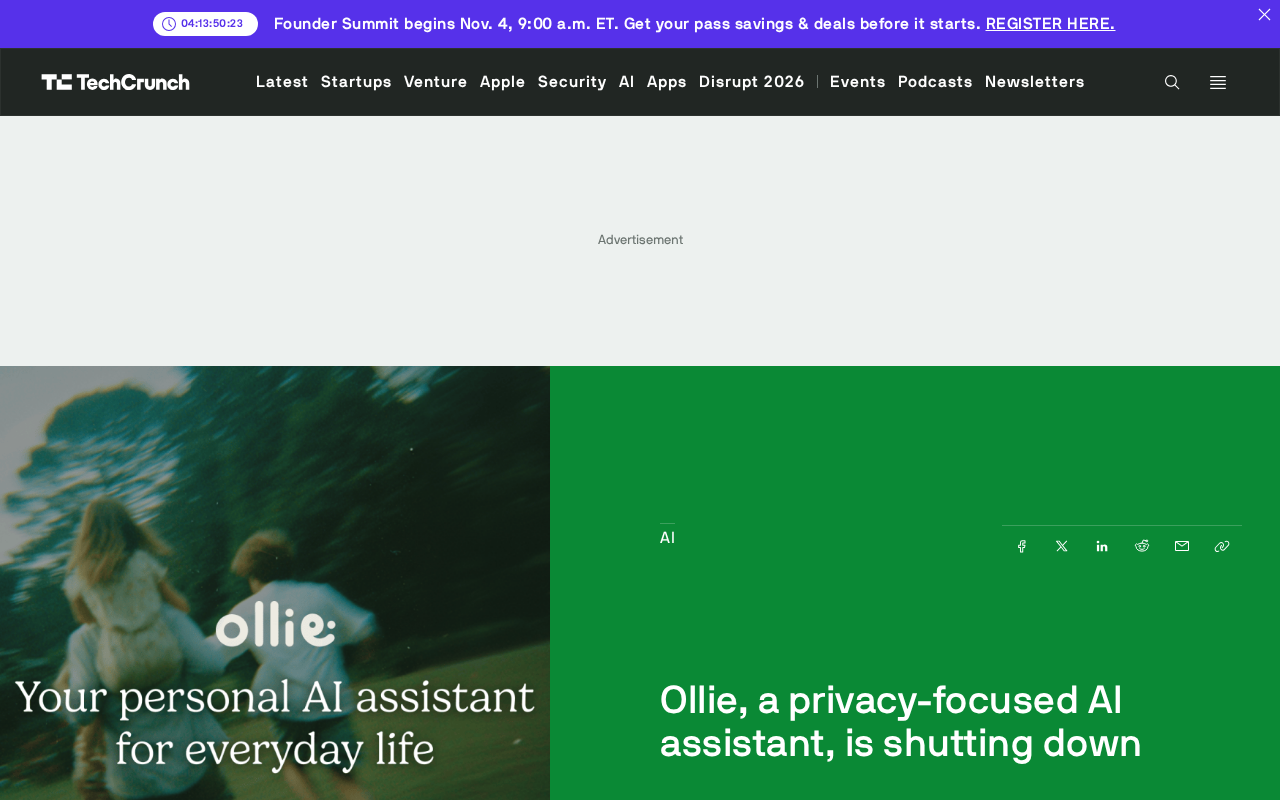
The AI assistant market is becoming increasingly crowded, and privacy-focused products don't seem to be catching a breather because of it. According to an RSS source, Ollie, an AI assistant built around the core principle of respecting user privacy, will officially cease operations in a week, a decision confirmed by its founder in a statement.
The Exit of a "Counter-Trend" Product
Ollie's positioning stands out in today's AI assistant landscape. While mainstream products tie data collection to personalized services, Ollie made privacy protection its core selling point—user conversations and usage data are not used for training or commercial exploitation. This stance earned it a reputation among privacy-sensitive users, but it failed to translate into a commercial foundation strong enough to sustain operations.
The founder's shutdown statement was measured in tone, disclosing no specific financial data or user numbers, only mentioning changes in the market environment. From publicly available information, Ollie's exit wasn't due to technical failure, but rather a mismatch between its business model and the market's rhythm.
Why the AI Assistant Market Is "Harder to Survive in the Busier It Gets"
Ollie's predicament reflects a structural contradiction in the current AI assistant race. A flood of products means user attention and willingness to pay are heavily diluted, while a privacy-first approach often means forgoing data-driven value-added opportunities, resulting in a narrower path to profitability.
On the other side, leading platforms continue to drive down customer acquisition costs through ecosystem bundling and economies of scale. Even when independent products occupy the moral high ground in philosophy, they struggle to compete head-on in pricing and feature iteration speed. Ollie's shutdown is yet another footnote to this logic.
The barrier to entry in the AI assistant race dropped significantly after 2023: open-source foundation models, hosted inference APIs, and ready-made RAG (retrieval-augmented generation) frameworks allow a small team to build a usable assistant product in weeks. This explosive growth on the supply side has led to severe homogenization—most products differ only marginally in capability, so competition has shifted to customer acquisition and ecosystem. Meanwhile, leading vendors compress customer acquisition costs to near zero by embedding assistants into operating systems, office suites, and search entry points, while independent products must pay for every bit of user growth. This combination of "oversupply + channel concentration" is the deep-seated reason independent AI assistants struggle to survive long-term.
The Monetization Challenge for Privacy AI
The core promise of privacy-first products is "not monetizing user data," which directly cuts off the most mainstream revenue imagination in the current AI industry. Subscriptions are the common path for such products, but users' willingness to pay for "not being tracked" is far lower than their willingness to pay for "better usability."
Ollie's case shows that philosophical differentiation is not enough to constitute a moat. Privacy protection needs to be translated into perceptible product value rather than merely remaining in policy clauses—otherwise, once the market enters a elimination phase, such products are often the first to go.
"Privacy-first" typically corresponds to several specific technical approaches: on-device inference (the model runs on the local device, and data never leaves the device), federated learning (model updates are completed locally, uploading only gradients rather than raw data), and cryptographic and statistical methods such as zero-knowledge proofs or differential privacy. Each approach has its costs—on-device models are limited by device compute and are typically weaker than cloud-based large models; federated learning incurs high communication overhead and engineering complexity; differential privacy sacrifices some model accuracy. In other words, privacy protection is not a free add-on but a trade-off among product capability, cost, and experience. This also explains why privacy-first products often lag behind leading products that rely on large-scale data feedback in terms of feature iteration speed.
The Real Impact on Privacy-Sensitive Users
For users who chose Ollie, the shutdown means they need to find trustworthy alternatives and face the costs of data migration and rebuilding trust. It also reminds users who rely on niche privacy tools that, when evaluating products, sustainability of the service provider is a variable that cannot be ignored alongside the privacy policy.
Ollie's departure doesn't mean the demand for privacy has disappeared, but it does cast a shadow over this niche segment—in an era of AI assistant oversupply, how privacy-first products can survive remains a question without a standard answer.
When a product shuts down, users face not just switching tools but also data sovereignty issues. For services that promise "data is not used for training," users need to confirm whether their data will be completely deleted after shutdown or potentially transferred to an acquirer along with assets—the latter is not uncommon in shutdown cases of privacy products and often conflicts with users' original trust expectations. Feasible practices include: prioritizing products that support data export (in common formats such as JSON and Markdown), paying attention to "change of control" clauses in terms of service, and adopting local storage and on-demand input for highly sensitive content to reduce dependence on any single provider's continued operation.
One-line Summary
Privacy-first AI assistant Ollie announces shutdown within a week, reflecting the commercialization plight of independent AI products.
Paragraph Summary
Ollie, an AI assistant whose core selling point is privacy protection, will cease operations in a week. The founder has confirmed the decision but disclosed no financial or user data. The article points out that the shutdown is not a technical failure but a mismatch between business model and market rhythm: oversupply in the AI assistant race dilutes user attention and willingness to pay, while the privacy-first approach voluntarily forgoes data monetization, narrowing the path to profitability. Meanwhile, leading platforms leverage ecosystem bundling and economies of scale to lower customer acquisition costs, making it hard for independent products to compete on price and iteration speed. For privacy-sensitive users, this means migration and trust-rebuilding costs, and it also reminds people that service sustainability should be an important variable when choosing tools.
Related articles

Salesforce Acquires Rune for $375M: AI Logistics Tech Bolsters Defense Business
Salesforce reportedly acquires defense tech startup Rune for $375M. Rune's AI logistics tech will strengthen Salesforce's Missionforce defense platform, continuing its M&A spree.

Why Fair Use Benefits Everyone in the AI Era
Starting from a Hacker News discussion, this article analyzes the legal logic and controversies of the fair use principle in AI training and content creation, and its dual impact on creators and the tech ecosystem.

Mistral Large 4 Open-Sources a Trillion Parameters, Microsoft Offers Voluntary Severance to 60,000 Employees
Mistral Large 4 open-sources a trillion-parameter multimodal model with a coding agent score of 48; SanDisk earnings show AI inference reshaping NAND demand; Google Gemini adds in-app file editing, OpenAI raises Codex quotas, and Microsoft offers voluntary severance to 60,000 employees.