Prompt Engineering for Beginners: From Writing Prompts to Engineering Thinking

Systematically breaks down the essence, engineering methodology, and real boundaries of prompts to build correct understanding.
Based on a popular Bilibili tutorial, the article systematically organizes the complete cognitive framework of prompt engineering. It clarifies the essence of prompts and their four functions, distinguishes single prompts from prompt engineering's six-step methodology and four success criteria, argues for the necessity of learning, and focuses on analyzing technical and practical limitations. The conclusion: prompts are good tools but not a master key.
Many people think prompting is just sending a message to AI, but the reality is far from it. A popular tutorial series on Bilibili starts from the most basic understanding and systematically breaks down the essence of prompts, the methodology of prompt engineering, and its real capability boundaries. This article is based on the core content of that tutorial, combined with multi-angle analysis, to help you build a complete understanding of prompt engineering.
What Exactly Is a Prompt?
A prompt is any instruction you give to AI—whether it's a question, a description, or a piece of text. The tutorial uses a vivid metaphor: a prompt is like the neural signal you send to AI—whatever signal you send, AI thinks in that direction. It is the most direct means we have to control AI, bar none.
With the same AI, some people can only get it to write elementary-school essays, while others can produce professional industry reports. The difference isn't in the AI itself, but in the input prompt. It is through instructional language that we can establish effective communication with AI and guide it to produce the desired results.
The Four Functions of Prompts
Communication bridge is the most fundamental function. Just as you can't order takeout by only saying "bring me some food"—you need to specify what dish, how spicy, and whether to add rice. A prompt translates the vague needs in your head into clear instructions that AI can understand. If this step isn't done well, the subsequent output will definitely be wrong.
Task navigation tells AI what exactly to do. A single sentence like "help me process this file" leaves AI with no idea whether to do statistical analysis, visualization, or write a summary—it will just pick one at random, which most likely isn't what you want. A good prompt gives AI clear goals and boundaries, just like navigation requires an accurate destination.
Style control is often overlooked but particularly important. Writing a business email and writing a social media post are completely different styles. AI's default output is a neutral, generic style with no distinct characteristics. Through prompts, you can make AI become whatever you want—Lu Xun-style commentary, elementary-school-toned diary entries, rigorous academic language.
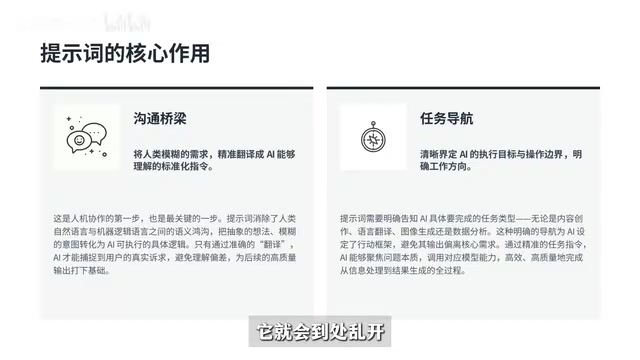
Boundary constraints are one of the most effective ways to solve AI's hallucination problem. AI is particularly talkative—without limits, it can ramble from one point to something ten thousand miles away, and it will fabricate things that don't exist. For example, when analyzing industry data, requiring it to only look at financial reports from specific quarters and not digress into macro policy will make the output more focused and useful.
An Intuitive Comparison
The tutorial provides an example: asking AI to write an article about spring. The basic prompt is too broad—northern or southern? Prose or narrative? How long? What style? AI can only guess, resulting in cookie-cutter output.
The optimized prompt provides in sequence: identity (you are a prose writer), word count (800 words), setting (spring in Jiangnan), style (beautiful language, lyrical, focusing on the misty and rainy water town atmosphere). From vague requirements to specific, executable rules, the output is naturally completely different.
The Difference Between Prompts and Prompt Engineering
Many people conflate these two concepts, but the difference is actually significant. A prompt is single-use, like writing one line of code to execute once and solve one problem—if it works this time, it may not work next time with a different problem. So-called "universal prompts" don't exist; there are only prompts suitable for specific scenarios.
Prompt engineering, on the other hand, is a complete methodology: without modifying AI's own code and parameters, it designs input instructions to make AI stably output the desired results. It relies not on inspiration but on a scientific process—from analyzing problems to designing solutions, testing results, continuous optimization, and finally crystallizing into reusable assets. It solves not a single problem but a class of problems.
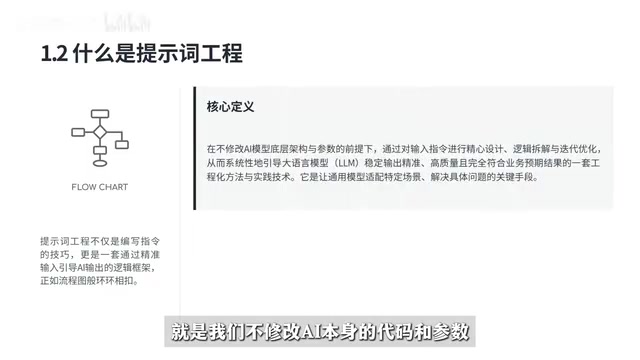
The Six-Step Engineering Process
The tutorial breaks prompt engineering into six steps: requirement decomposition (breaking complex problems into small problems AI can solve), solution design (designing corresponding prompts and roles), execution testing (actually running it to see the results), effect evaluation (judging results with specific criteria), strategy iteration (continuously optimizing weak points), and solution crystallization (saving useful solutions for future reuse). This process is very similar to software development, except what you're writing isn't code but natural language.
Four Success Criteria
Prompt engineering ultimately serves four goals: improving accuracy so that what AI says is exactly what you want; reducing hallucinations so AI makes up less nonsense; enhancing stability so results are consistent regardless of who uses it or when; and reducing costs by getting the best results with the fewest tokens. These four points are the criteria for evaluating how well prompt engineering is done.
Why Learn Prompt Engineering Now?
The tutorial cites data claiming that over 90% of users only use AI for basic Q&A. It's like buying a sports car but only driving it in first gear—such a waste. Learning prompt engineering is about learning to unleash AI's full capabilities.

The barrier to entry is very low—no programming required, no need to understand algorithms, just the ability to speak and express things clearly. The most direct benefit is efficiency improvement: what used to take a day can now be done in an hour, and it can solve many problems AI previously couldn't, such as writing professional reports and doing complex data analysis.
The commercial value is equally significant. You can use it for side work—many enterprises and independent media need people who can use AI, helping them optimize prompts or generate content, which can be done in fragmented time. If you want to start a business, what used to require a team can now be done by one person, with very low trial-and-error costs and rapid idea validation. For independent media, what used to be 10 articles a month can now be dozens with no drop in quality, enabling rapid audience growth and monetization opportunities.
The Limitations of Prompts: They're Not Omnipotent
This is the most easily overlooked part. Prompts cannot break through AI's inherent capability ceiling—training data has a cutoff, so it doesn't know things after that point; it can't solve complex math problems no matter how much you optimize the prompt. Unstable output is also the norm—changing one word can produce completely different results, and prompts that are too long cause AI to "forget things." Hallucinations can only be reduced, not completely eliminated—as long as it's a large model, it will make things up, and you must verify important matters yourself.
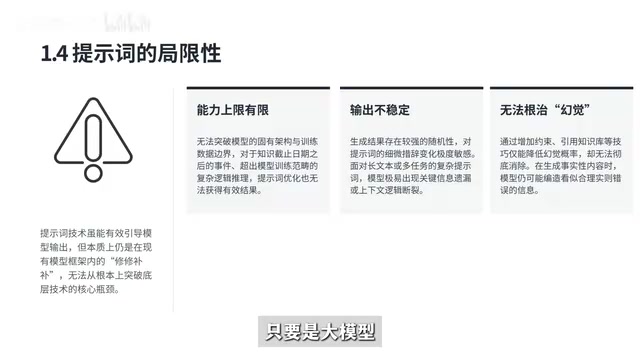
Three Technical Limitations
Context length is limited, similar to a phone's RAM—when too many apps are open, the system automatically clears background processes. AI's memory capacity is fixed; if the prompt is too long or the conversation goes on too long, it will forget the initial requirements.
Complex tasks are unstable—things that can be done in one step are fine, but multi-step calculations and proposal writing tend to skip steps and break logic, requiring decomposition into small tasks before handing them over.
No true long-term memory—every conversation is completely new to it, and it can't remember your preferences and background, so you have to explain everything again each time. This problem can only be solved with additional databases. These three issues are determined by the underlying technology; prompts can only optimize and mitigate them, not cure them.
Context Window refers to the upper limit of tokens a model can simultaneously "see" in a single inference, including system prompts, historical conversation, and current input. Mainstream large models' context windows have expanded from early 4K tokens to 128K or even 1M token levels, but it remains a hard resource limit. Beyond the window, the model either truncates the earliest content or relies on internal attention mechanisms to compress information, manifesting as "forgetting" the opening instructions. Engineering mitigations include: placing key constraints at both the beginning and end of prompts (leveraging primacy and recency effects), using structured summaries to replace lengthy history, or storing long-term information in external vector databases for on-demand retrieval.
Three Practical Pitfalls
Safety and alignment restrictions are AI's underlying red lines—illegal or non-compliant content absolutely cannot be generated, but sometimes completely legitimate requests may be incorrectly flagged and blocked, which is a common problem across all large models.
Pure prompts cannot be engineered into products—using them alone is fine, but turning them into a product for hundreds or thousands of users won't work—there's no version management, no problem tracing, and it can't handle large-scale batch tasks. Enterprise-grade applications must combine prompts with code.
The cost trap: AI charges by token, and the longer the prompt, the more expensive it is—and costs don't grow linearly. With high-frequency calls, hidden costs are frighteningly high. Prompts must be concise.
Building Correct Understanding
The core of the tutorial's first chapter is to help beginners establish a basic judgment: prompts are indeed useful tools, but not a master key. Things that should be done manually still need to be done manually. Understanding what it can and cannot do is far more important than learning a few "universal templates." From single prompts to engineering thinking, and then to a clear understanding of boundaries—this is the proper path for entering prompt engineering.
Background Supplement
Token is the smallest unit of text processing for large models, roughly equivalent to 0.75 English words or 1–2 Chinese characters. API billing typically prices input tokens and output tokens separately, with output often being more expensive. Since each call requires resubmitting the complete conversation history, the cost of multi-turn conversations grows approximately linearly or even super-linearly with the number of turns. This is also why prompt engineering emphasizes "getting the best results with the fewest tokens"—streamlining instructions, avoiding repeated pasting of background materials, and placing fixed knowledge in system prompts for reuse are all common cost-control practices.
Prompt engineering, model fine-tuning, and retrieval-augmented generation (RAG) are three different paths to capability enhancement. Fine-tuning changes model weights through additional training data, with high costs and long cycles, suitable for solidifying domain knowledge or specific output formats; RAG retrieves relevant fragments from external knowledge bases at inference time and inserts them into prompts, solving the timeliness of model knowledge and private data issues without changing the model itself; prompt engineering doesn't touch model parameters at all, only optimizing input. The three are often used in combination: the typical architecture of enterprise-grade applications is "prompt engineering + RAG + a small amount of fine-tuning + code orchestration," which echoes the article's judgment that "pure prompts cannot be engineered into products."
One-line Summary
Systematically breaks down the essence of prompts, engineering methodology, and real capability boundaries to help beginners build correct understanding.
Paragraph Summary
Based on a popular Bilibili tutorial, the article systematically organizes a complete cognitive framework for prompt engineering. It first clarifies the essence of prompts—the most direct means of controlling AI, with four functions: communication bridge, task navigation, style control, and boundary constraints—and demonstrates the huge difference before and after optimization through a "writing a spring article" comparison. It then distinguishes single prompts from prompt engineering: the latter is a reusable methodology comprising six steps—requirement decomposition, design, testing, evaluation, iteration, and crystallization—with success criteria of accuracy, reduced hallucinations, stability, and cost reduction. The article also argues for the necessity of learning—low barrier, significant efficiency gains, and considerable commercial value. Finally, it focuses on limitations: technically constrained by context length, complex task stability, and lack of long-term memory; practically facing safety alignment misjudgments, difficulty in productization, and token cost traps. The conclusion is that prompts are good tools but not a master key.
Related articles

Anthropic Launches Nasdaq IPO: AI Giant's Listing and Risk Disclosures
Anthropic officially launches its Nasdaq IPO under ticker ANT, with market valuation expected to potentially exceed SpaceX's record. The prospectus devotes nearly 100 pages to AI risks, while first-half revenue grew over 14x but net losses widened sharply, reigniting the AI bubble debate.

Rust cURL Clone Uses 4,832 unsafe Blocks—Is the Memory Safety Myth Broken?
A Rust cURL clone uses 4,832 unsafe keywords, challenging Rust's memory safety narrative. We analyze what unsafe really means, compare Fil-C, and examine rewrite motives.

Decoupling Place Form from Content: A New Perspective on AI Perception
Explore the importance of separating place form from content in AI perception, analyze technical paths and challenges, and outlook on impacts in robotics, autonomous driving, and other fields.