Prompting Claude Opus 5.5: How to Work More Effectively with the New Model

Claude Opus 5.5 pushes developers to recalibrate prompts — shifting from step-by-step commands to intent-based guidance.
With the release of Claude Opus 5.5, the Hacker News community debated how to tune prompts for the new flagship model. The article argues that each model iteration brings not just capability gains but behavioral shifts, requiring prompt strategies to be recalibrated. The key insight: as models reason more powerfully, prompts should shift from granular imperative instructions to clearly expressing goals and constraints. Practical tips include defining hard constraints, using few-shot examples over lengthy rules, leveraging XML tags to reduce misinterpretation, and leaving room for reasoning on complex tasks. While the community is divided on the future of prompt engineering, the article concludes it remains an empirical discipline requiring ongoing experimentation.
Introduction: How a New Model Shifts the Prompting Paradigm
Anthropic's Claude series has long been known for its strong instruction-following and long-context handling. With the arrival of Claude Opus 5.5, the developer community has once again turned its attention to a familiar question: how do you write high-quality prompts that fully unlock the potential of this new flagship model?
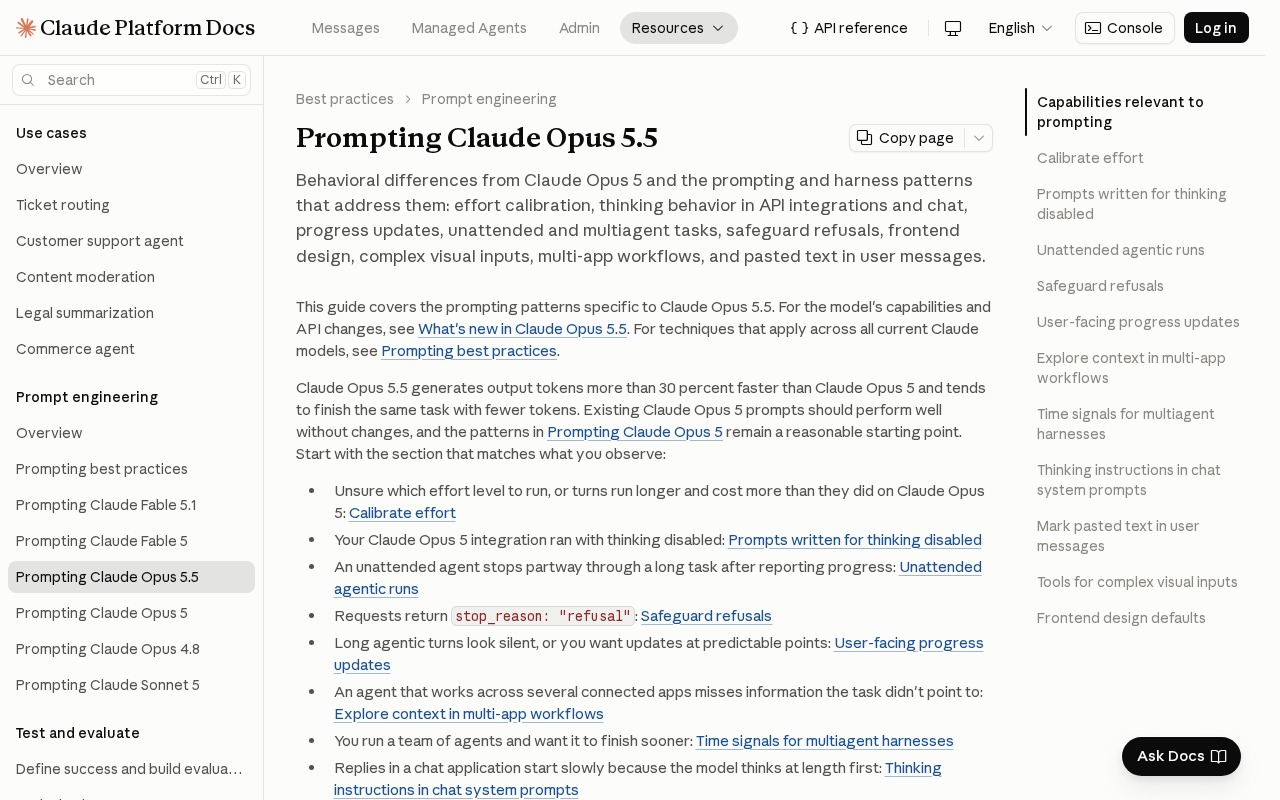
A thread titled "Prompting Claude Opus 5.5" earned 47 points and sparked 36 comments on Hacker News — a reflection of an enduring reality: every time a model is upgraded, previously accumulated prompting techniques often need to be recalibrated, because a new model's behavioral characteristics, default tendencies, and reasoning patterns can shift in subtle but critical ways.
Why Every Model Generation Requires Re-tuning Your Prompts
Model iteration doesn't just mean improved capabilities — it also means a shift in "personality." A prompt that performs well on an older model may produce verbose, overly cautious, or format-drifted outputs on a newer one.
For a flagship model like Opus 5.5, which typically possesses stronger autonomous reasoning, this is both an advantage and a challenge. More powerful reasoning means the model is more inclined to "figure out what to do on its own," so overly detailed, step-by-step instructions can actually conflict with the model's internal judgment. Conversely, clearly stating goals and constraints while leaving the model some room to determine how to proceed often yields better results.
The Shift from Imperative to Intent-Based Prompting
A recurring theme in the community discussion is this: when working with more capable models, prompts should shift from being imperative (step-by-step, hand-holding instructions) to intent-based (clearly expressing goals, boundaries, and success criteria). This creates some tension with traditional prompt engineering wisdom — early best practices emphasized breaking tasks down as granularly as possible, but with the latest generation of models, over-decomposition can sometimes constrain their performance.
Practical Prompting Tips for Opus 5.5
Drawing on community experience, the following practices tend to be broadly applicable:
Define Roles and Constraints Clearly
Give the model a clear role and enumerate hard constraints it must follow (e.g., output format, word count, prohibited content). Hard constraints should be explicit and verifiable — not vague descriptions.
Use Examples Instead of Lengthy Rules
In many scenarios, one or two high-quality examples (few-shot) are more effective than lengthy rule explanations. Examples let the model directly "see" the output format you expect, reducing ambiguity.
Few-shot prompting is one of the most classic techniques in prompt engineering. It works by leveraging a language model's in-context learning capability — the model doesn't need to update its weights; it simply infers the task pattern from a handful of input-output examples in the prompt and applies it to new inputs. Unlike zero-shot (relying purely on instruction descriptions) or fine-tuning (requiring large datasets to modify model parameters), few-shot strikes a good balance between cost and effectiveness. In practice, example quality matters more than quantity: 1–3 highly representative examples typically outperform 10 mediocre ones. Examples should also cover edge cases or error-prone patterns, showing the model expected behavior through demonstration rather than description.
Leverage Structured Markup
The Claude series is particularly responsive to XML-style tags, Markdown separators, and other structured markup. Using tags to clearly separate instructions, context, examples, and content to be processed significantly reduces the likelihood of misinterpretation.
Claude models respond especially well to XML-style tags (e.g.,
<instructions>,<context>,<example>), which is tied to Anthropic's heavy use of such structures in training and system prompt design. The core value of tags is eliminating ambiguity: when a prompt contains instructions, background material, and text to process, plain-text formatting can cause the model to confuse the role of each section, while tags establish clear semantic boundaries. Markdown headings, lists, and code blocks also help the model correctly parse hierarchical relationships. A common best practice is to wrap untrusted user-provided content (such as web page text or user input) in dedicated tags — this both guards against prompt injection attacks and helps the model maintain the correct role orientation when processing that content.
Leave Room for Reasoning
For complex tasks, allowing the model to "think" before producing a conclusion (e.g., asking it to analyze first, then give an answer) typically improves accuracy. That said, for simple tasks, forcing lengthy reasoning will slow responses and increase costs unnecessarily.
Community Disagreements and Reflections
Notably, developers are not fully aligned on how to approach prompting for new models. Some argue that prompt engineering is becoming less important — as models grow smarter, clear and natural instructions are sufficient. Others contend that the more powerful the model, the more precise the guidance needs to be, to prevent the model from being too clever and over-interpreting its mandate.
This divergence reflects the genuine state of AI application development today: prompt engineering is neither an obsolete skill that can be discarded, nor the sole lever for performance. It's more like an empirical discipline that requires ongoing experimentation, adapted to the specific model and task at hand.
Closing Thoughts: Prompting as Continuous Calibration
The arrival of Claude Opus 5.5 is a reminder that prompts are not a set-it-and-forget-it asset — they're living documents that need to be continuously recalibrated as models evolve. Rather than clinging to a single "universal template," developers are better served by building a workflow for rapid validation and iteration: small-scale testing, observing behavioral differences, and making targeted adjustments.
As model capabilities continue to leap forward, mastering how to collaborate effectively with new models is often more practically valuable than chasing raw benchmark numbers.
Related articles

Why Does the Tesla Roadster Need to Fly? A Deep Dive into Musk's Wild Demo
Tesla's Roadster launch showed wall-climbing, upside-down driving, and flying stunts—but The Vergecast notes the demo car may lack a battery, the Rocket version is invite-only and not street-legal, and the website terms don't guarantee delivery. After nine years of delays, why does this car still need to exist?

AI Is Not a Replacement: Human-AI Collaboration Through the Lens of Factory Root Cause Analysis
Starting from factory root cause analysis, this article explains how AI accelerates evidence chain construction rather than replacing human experts, exploring the pragmatic implementation logic and business value of 'AI supporting people rather than replacing them.'

AI Agent Decision Auditing: Building an Evidence Chain in Regulated Workflows
Starting from a Reddit discussion, this article analyzes three core issues in AI agent decision auditing within regulated workflows: what fields audit records should contain, how to handle feedback latency for erroneous decisions, and how to continuously calibrate LLM judge consistency with human judgment.