Proton Lumo Desktop Launches: A Privacy-First AI Assistant Takes On ChatGPT

Proton's privacy-first AI assistant Lumo launches desktop clients for three platforms, competing on granular permission controls.
Proton's privacy-first AI assistant Lumo has released desktop clients for Windows, Mac, and Linux, seen as an alternative to ChatGPT and Claude. The desktop version fills in the workflow scenario, supporting automated tasks across files and connected apps with granular permission controls. Its differentiation lies in data governance and user control rather than model capability, though data-chain consistency, usability under tighter permissions, and accessibility still need verification.
Proton's privacy-first AI assistant Lumo has officially launched desktop clients for Windows, Mac, and Linux. The product is seen as an alternative to ChatGPT and Claude, and its core selling point isn't a race for model capability—it's making "user-controlled privacy" a first principle of the product architecture.
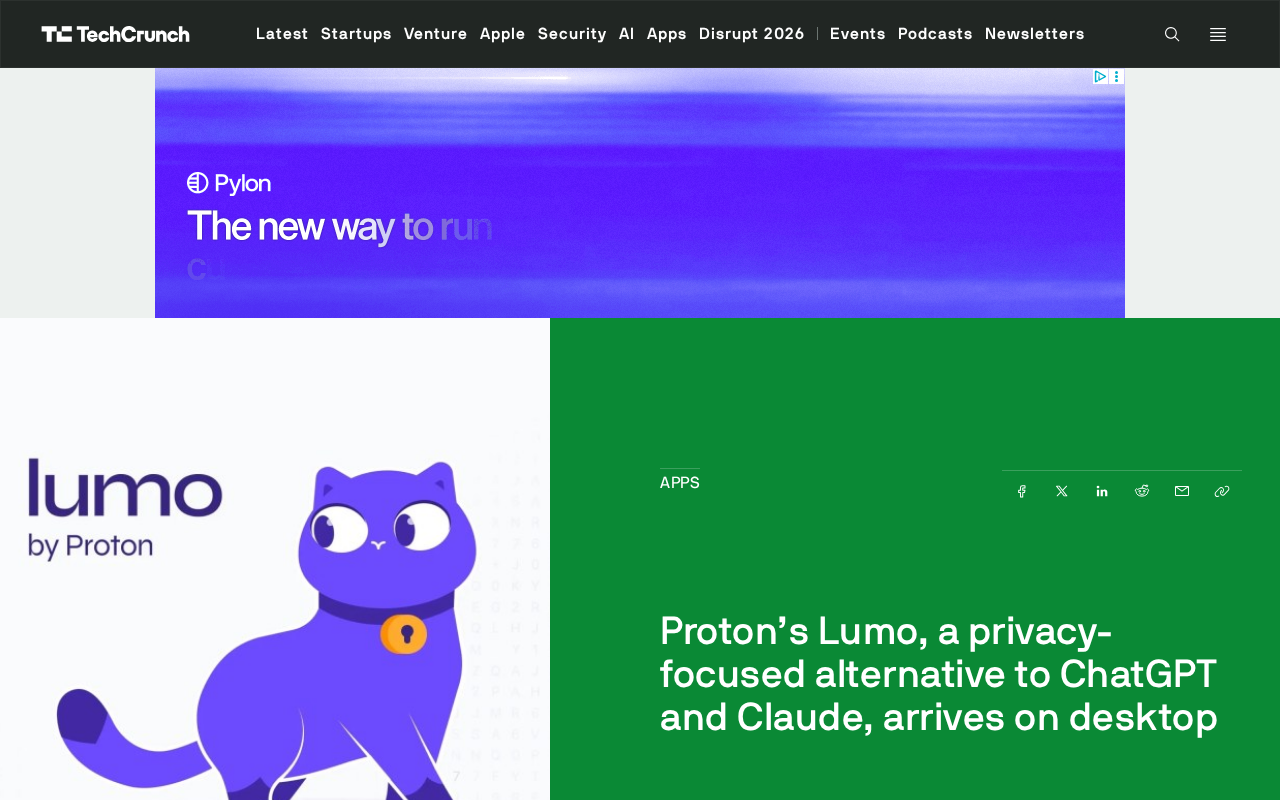
From Web to Desktop: Lumo Fills In the Use Cases
Lumo previously existed only as a web app. The desktop release means it is now entering the core interface of users' daily work. According to the official description, the desktop app lets users automate tasks across files and connected apps, while giving granular control over what the AI can access.
Combined, these two capabilities point straight at the key battleground in today's AI assistant competition: whether the assistant can actually act on your behalf within real workflows, rather than just answering questions in a chat box. File access and third-party app connections are exactly the threshold that turns an AI from a "chat tool" into an "execution tool."
Cross-app automation refers to an AI assistant using interfaces to third-party apps (such as calendars, email, documents, and project management tools) to carry out continuous, cross-system tasks on the user's behalf—for example, reading meeting notes, generating to-dos, and writing them into a task system. What distinguishes it from plain conversational Q&A is its "execution" capability, which raises the bar for permission boundaries: the more apps connected and the broader the executable actions, the larger the surface area for data leaks and accidental operations. This is why privacy-focused products must design permission controls and automation capabilities in tandem.
Privacy Isn't a Slogan—It's Permission Design
Proton has long built its brand on end-to-end encrypted email and VPN, and Lumo continues that line. The "granular controls" the company emphasizes deserve a closer look: users can decide which files the AI can see and which connected apps it can call, rather than granting access to all data at once.
This design philosophy stands in contrast to the default logic of mainstream AI assistants. Most products, when connecting to local files or third-party services, tend to trade broad authorization for convenience; Proton instead splits permissions into individually toggleable units, handing the decision of "what the AI can see" back to the user. For knowledge workers handling sensitive materials, this difference may matter more in practice than model benchmark scores.
End-to-end encryption (E2EE) is an encryption method in which only the communicating parties can decrypt the content—the service provider itself cannot read the plaintext data. Proton's email and VPN products have long made this their core selling point. But a distinction is needed: when an AI assistant calls a cloud-based large model for inference, user input and file contents typically must be read and processed by the model. Lumo's privacy promises therefore more likely apply to things like "data not used for training, controllable access scope, and encrypted transmission and storage," rather than full-chain end-to-end encryption. Understanding this boundary helps clarify what "privacy-first" actually means in an AI product.
Competition Among Desktop AI Assistants Is Shifting to the Trust Layer
Placed in the broader market context, products like ChatGPT and Claude are all strengthening desktop integration and local file capabilities. Feature lists will gradually converge, and the real differentiation may emerge at the data governance layer: where data is stored, whether it's used for training, and whether users can audit the AI's access records.
Proton's brand equity lands squarely on this dimension. It doesn't need to challenge the top model vendors head-on on reasoning capability; instead, it uses its "privacy-first" positioning to carve out a segment of users sensitive to data flows—corporate legal teams, healthcare, journalists, and researchers.
Granular controls borrow from the approach of mobile operating systems and the OAuth authorization model: splitting what was once "all-at-once, full authorization" into permission units that can be toggled independently by file, by app, and by operation type. The opposite is "all-or-nothing" broad authorization, where users are often forced to hand over far more data access than they actually need just to use a feature. The cost of granular design is increased configuration complexity—users must actively manage permissions; the benefit is that the principle of least privilege can be put into practice, with sensitive data invisible to the AI by default. Whether this mechanism works well depends on whether the default policies are sensible and whether permission prompts are clear.
A Few Questions Worth Watching
Cross-platform desktop coverage is a plus, and Linux support in particular shows attention to the developer community. But the privacy positioning also brings real challenges: how to ensure consistency in the data processing chain between local files and cloud models, and whether cross-app automation will sacrifice usability once permissions are tightened—these need real-world use to verify.
For users in China, the accessibility of Proton's services is itself a consideration. The real value of Lumo's desktop version may not lie in replacing anyone, but in proving a path: AI assistants can complete automated tasks without sacrificing user control. If this path works, it will push the entire industry's data authorization design forward.
One-line Summary
Proton's privacy-first AI assistant Lumo launches desktop clients for three platforms, entering the market with granular permission controls.
Paragraph Summary
Proton's privacy-first AI assistant Lumo has officially released desktop clients for Windows, Mac, and Linux, positioning itself as an alternative to ChatGPT and Claude. The article notes that the desktop version fills in the scenario gap from web to workflow, supports automated task execution across files and connected apps, and offers granular permission controls that let users decide which files and apps the AI can access. Its core differentiation isn't model capability but data governance and user control. The article also raises concerns: consistency of the data chain between local files and cloud models, the usability balance once permissions are tightened, and service accessibility for users in China all need real-world verification.
Related articles

Muse Officially Launches in Australia: A New Signal for AI Tools Going Global
AI product Muse officially launches in Australia, announced via Twitter. This article analyzes the market significance, the local AI tool competitive landscape, and key points to watch.

Decision Model Usage Surges: Is Customization the Next Frontier?
Sqwish Labs introduces decision models trainable on proprietary data, sparking debate on whether customization is the next frontier. This article analyzes technical paths, challenges, and market trends.

Google Extends Gemini Chat History Retention to Two Months, Raising Privacy Concerns
Google announced it will extend Gemini chat history retention from 72 hours to two months, even when history is off. The update will roll out globally, raising privacy concerns. Learn details and how to manage your data.