PyPI Project Pages Get a Redesign: Clearer Security Signals

PyPI's project page redesign is live, with the core goal of making security signals clearer and more visible.
PyPI has officially launched a redesign of its project pages. The focus is not on visual refresh but on restructuring the information hierarchy to centralize trust-related signals such as maintainers, release history, and download counts, helping developers quickly assess a package's credibility before installing dependencies. The article notes that a package management platform's interface directly determines whether the first manual review of supply chain security gets skipped: when risk signals are buried, users tend to install directly; when explicitly presented, they are more likely to be noticed. The news garnered 231 points and 99 comments on Hacker News. For developers, review efficiency improves; for maintainers, transparent release records more easily translate into trust—but interface prompts cannot replace actual auditing methods such as lock files and dependency scanning.
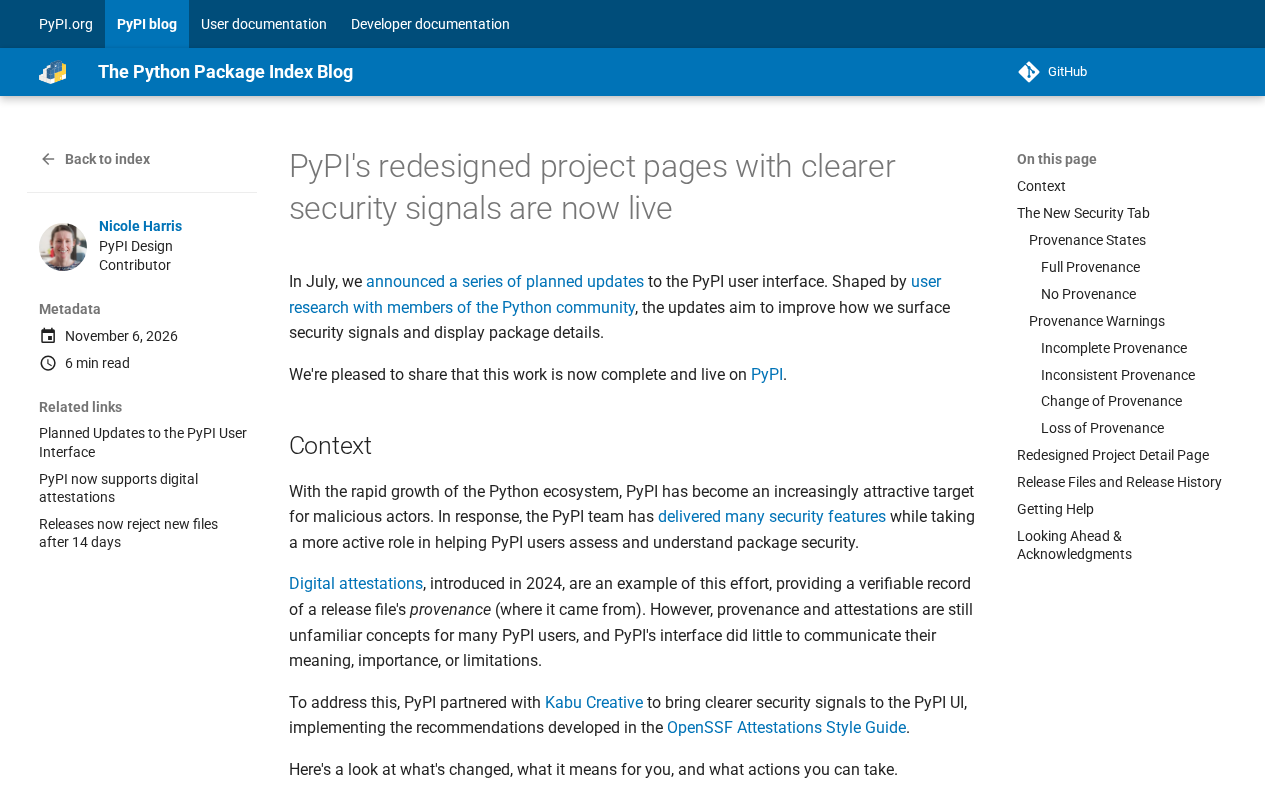
PyPI (Python Package Index), the core infrastructure of the Python ecosystem, has completed a redesign of its project pages, and the new design is now officially live. According to an announcement on the official PyPI blog, the update focuses on making security-related signals clearer and easier to read, helping developers quickly assess a package's reliability before installing dependencies. The news sparked discussion on Hacker News, garnering 231 points and 99 comments, indicating the community's strong interest in how package management platforms present security information.
The Core of the Redesign: Bringing Security Signals to the Forefront
With software supply chain attacks occurring frequently in recent years, package management platforms serve as the first line of defense. While PyPI's previous project pages already included information such as maintainers, release history, and download counts, these signals were scattered across different areas and easy for ordinary users to overlook during a quick browse.
The new design reorganizes this trust-related information, significantly increasing the visibility of security status on the page. The official announcement summarizes it as "clearer security signals," meaning the redesign is not merely a visual adjustment but a restructuring of the information hierarchy around the goal of "whether users can determine in seconds whether a package is trustworthy."
For developers who rely on PyPI, this change lowers the cognitive cost of evaluating third-party packages. Information that previously required opening multiple subpages and cross-referencing can now form an initial judgment right on the project's main page.
PyPI and the Software Supply Chain
PyPI is the official third-party package repository for Python. Nearly all Python projects pull dependencies from it via pip install, making it effectively the entry point of the Python ecosystem. A software supply chain attack refers to an attacker not directly targeting a system but instead compromising the upstream components it depends on—for example, typosquatting packages with names identical or similar to well-known packages, taking over long-unmaintained packages, or publishing new versions with malicious code through stolen maintainer accounts. Such attacks work because downstream users often assume by default that "a package on PyPI is trustworthy." For this reason, the metadata a package management platform can display—who the maintainers are, when the last release was, whether there is a Trusted Publishing record—constitutes the most direct and lowest-cost basis for users to assess risk.
Common Security Signals on PyPI
Understanding this redesign requires knowing what signals on PyPI project pages can be "front-loaded." Common ones include: the list of project maintainers and their account status; release history and version cadence (long periods of inactivity or sudden bursts of releases are both worth watching); download counts, which, while not equivalent to security, reflect the breadth of community usage; whether the project has enabled two-factor authentication and trusted publishing; and PyPI's record of removing known malicious packages. In addition, the PyPI ecosystem has independent security databases (such as OSV) that link vulnerability advisories. Integrating information scattered across multiple pages and sources into prominent positions on the project's main page is precisely what "making security signals clearer" means—it does not add new detection capabilities but lowers the barrier for users to access and interpret existing information.
Why Interface Changes Deserve Serious Attention
The UI of a package management platform may seem like just a presentation layer, but it directly affects the first manual review step of supply chain security. When security warnings are buried deep in the page, users tend to skip checks and install directly; when risk signals are explicitly presented, abnormal states are more likely to be noticed.
The buzz on Hacker News confirms this: among the 99 comments, community members discussed how security signals should be presented and which information should be prioritized. Such feedback is valuable for PyPI's subsequent iterations—how the platform designs its information architecture will substantively affect dependency selection behavior across the entire ecosystem.
From a broader perspective, PyPI's redesign echoes the overall trend in open source supply chain governance: shifting from "responding to vulnerabilities after the fact" to "presenting risks before the fact."
"Security Theater" and the Boundaries of Information Presentation
Security prompts at the interface level have a side effect worth guarding against: when a platform uses prominent badges or colors to mark something as "secure," users may misinterpret "no warning" as "has passed review." In fact, PyPI does not perform security audits on uploaded packages; the vast majority are self-published by maintainers and passively hosted by the platform. Therefore, the value of front-loading signals lies in increasing the visibility of abnormal states (for example, flagging a package that hasn't been updated in a long time or has a single maintainer), not in providing a security endorsement. This is also the concern often raised in community discussions: how to surface genuinely important risk characteristics without creating a false sense of security. This requires the information architecture to distinguish between "neutral facts" and "risk judgments" in its design, leaving the latter to users and downstream tools.
Practical Impact on Developers and Package Maintainers
For ordinary developers, the direct benefit of the redesign is improved efficiency in dependency review. When introducing a new package, security signals on the project page can serve as a quick screening criterion, reducing blind trust in unfamiliar packages.
For package maintainers, changes in how information is displayed mean that behaviors such as maintenance activity and release discipline will be seen more intuitively. Maintaining transparent release records and timely maintenance responses will more easily translate into user trust under the new interface.
It is important to note that interface presentation is only an auxiliary means; clearer security signals cannot replace actual auditing of dependencies. Developers should still make comprehensive judgments using lock files, dependency scanning tools, and other methods.
Lock Files and Dependency Scanning Tools
The article mentions that interface signals cannot replace actual auditing; the specific methods involved here deserve elaboration. Lock files (such as requirements.txt with hash pinning, poetry.lock, uv.lock) record the exact version and checksum of each dependency, preventing them from being replaced with different content during installation—this is the foundation for resisting supply chain tampering. Dependency scanning tools work on another dimension: pip-audit, Safety, and similar tools compare against known vulnerability databases, while services like Dependabot and Renovate continuously monitor dependencies and initiate updates when new versions or advisories appear. Together, they form a closed loop of "pinning known content + continuously discovering known issues." Security signals on the interface are suitable for initial screening when introducing new packages, while the aforementioned tools are responsible for continuous verification after introduction—this is the technical basis for positioning platform prompts as an "auxiliary means."
Conclusion
PyPI's project page redesign moves security signals from "queryable" to "easily visible"—an information architecture optimization aimed at real-world usage scenarios. Against the backdrop of ongoing concern about open source supply chain risks, such changes, while not involving underlying mechanisms, directly affect the daily choices of ecosystem participants.
One-line Summary
PyPI's project page redesign is live, with the core goal of making security signals clearer and more visible.
Paragraph Summary
PyPI has officially launched a redesign of its project pages. The focus is not on visual refresh but on restructuring the information hierarchy to centralize trust-related signals such as maintainers, release history, and download counts, helping developers quickly assess a package's credibility before installing dependencies. The article notes that a package management platform's interface directly determines whether the first manual review of supply chain security gets skipped: when risk signals are buried, users tend to install directly; when explicitly presented, they are more likely to be noticed. The news garnered 231 points and 99 comments on Hacker News, reflecting the community's strong interest in how security information is presented. For developers, review efficiency improves; for maintainers, transparent release records more easily translate into trust—but interface prompts cannot replace actual auditing methods such as lock files and dependency scanning.
Related articles

Why Microsoft CEO Nadella Still Backs Nvidia After Jensen Huang's Departure
Microsoft CEO Nadella publicly expresses confidence in Nvidia interim CEO Colette Kress. This article analyzes Nvidia's power transition after Jensen Huang's departure, Microsoft's compute dependency, and the trust logic of the AI supply chain.

Nadella: Critical Infrastructure Is 'Unpatchable' as AI Cybersecurity Arms Race Escalates
Microsoft CEO Nadella addresses AI cyberattack fears, saying much critical infrastructure is unpatchable, downplaying the Outlook outage, and analyzing AI's dual role in cybersecurity.

Musk Backs Jensen Huang: Firing Him Is Like Cutting Jordan
Musk says Jensen Huang is loyal to the U.S. and likens firing him to cutting Michael Jordan—highlighting politicization anxieties in the AI chip industry and defending talent value.