pytest Testing Patterns in Practice: Building a Systematic Automated Testing Framework

A practical guide to building an engineering-grade automated testing framework using pytest patterns.
This article explores how to upgrade scattered test scripts into a systematic, maintainable automated testing framework using pytest patterns. It covers layered fixture management with conftest, parameterized testing for full-scenario coverage, mock-based dependency isolation, enforced coverage gates, and seamless CI pipeline integration — grounded in testing theory and engineering best practices.
From Scattered Scripts to a Systematic Testing Architecture
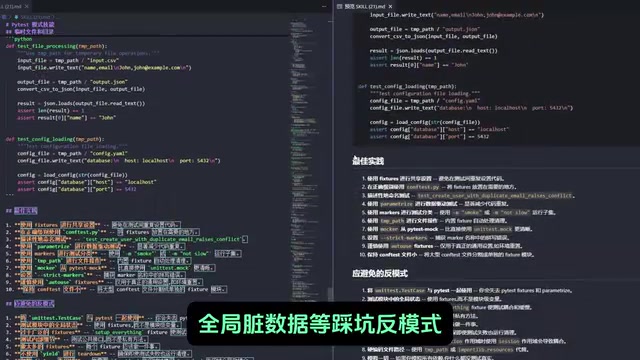
Many teams in the software testing space share a common struggle: test scripts scattered across the codebase, initialization code duplicated in every test case, unorganized test data management — all of which drive up maintenance costs and make it nearly impossible to guarantee coverage. A complete set of standardized pytest patterns is designed specifically to address these pain points in a systematic way.
The core value of this kind of template lies in upgrading ad-hoc manual tests or scattered automation scripts into a well-structured, reusable, and extensible engineering-grade testing system. Whether you're a newcomer transitioning from manual testing, a seasoned engineer specializing in API testing, or a backend developer who needs to write unit tests, there's something here for everyone.
Layered Fixture Management: Putting an End to Redundant Initialization
Centralized Management with conftest
One of pytest's core strengths is its fixture mechanism, and sound engineering practice pushes it to its full potential. By centralizing fixture definitions in conftest.py and flexibly switching between session, module, and function scopes, test resources can be reused on demand.
Deep Dive: The Dependency Injection Nature of Fixtures
pytest's fixture mechanism is fundamentally a Dependency Injection (DI) pattern. When a test function declares a fixture parameter, pytest automatically resolves the dependency graph at runtime, instantiates all dependencies in topological order, and executes cleanup logic at the appropriate lifecycle point. This is fundamentally different from
unittest'ssetUp/tearDown— fixtures are lazily evaluated: only fixtures that are actually depended upon get executed, avoiding unnecessary resource consumption. Asession-scoped fixture is instantiated only once for the entire test session (ideal for database connection pools), amodule-scoped one is shared within each file, and afunction-scoped fixture is created independently for each test function — together forming a fine-grained, multi-tier resource lifecycle management hierarchy.
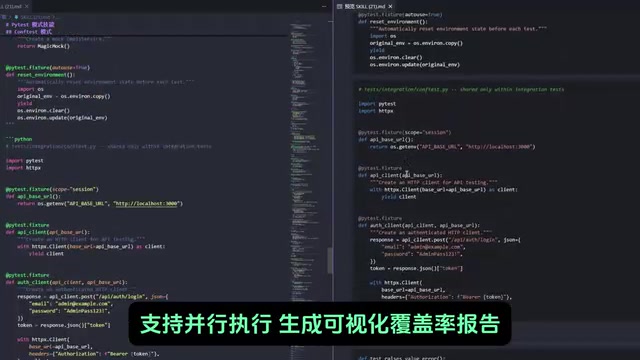
It's also worth understanding that conftest.py is not an ordinary configuration file — it's a localized entry point into pytest's plugin system. On startup, pytest automatically scans the test directory tree and loads all conftest.py files in order from the root directory down to subdirectories, building a fixture registry with hierarchical precedence. This means a subdirectory's conftest.py can override or extend a same-named fixture from the parent directory — for example, a global db_session fixture might provide a generic database connection, while a conftest.py in a specific business module directory extends it to pre-populate module-specific test data, enabling fine-grained environment customization without modifying any test function.
Resources such as database connections and API test data no longer need to be re-initialized in every test case — existing resources are reused automatically, and teardown logic runs after tests complete, cleaning up data and releasing resources to ensure zero residue and zero pollution.
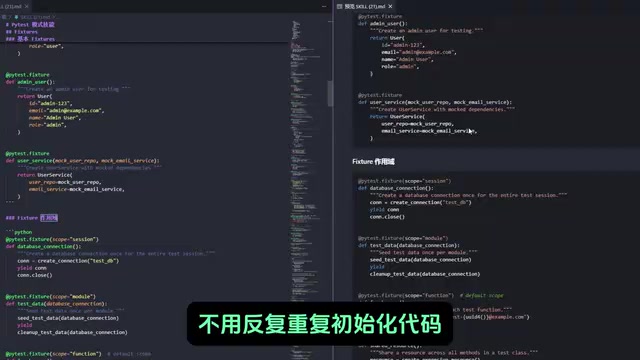
This design is especially valuable in real projects. As the test suite grows to hundreds or thousands of cases, repetitive initialization code not only slows execution but also tends to introduce hard-to-trace dirty data issues. Layered fixtures address this problem at the architectural level.
Parameterization and Markers: Full-Scenario Coverage
@parametrize for Bulk Scenario Injection
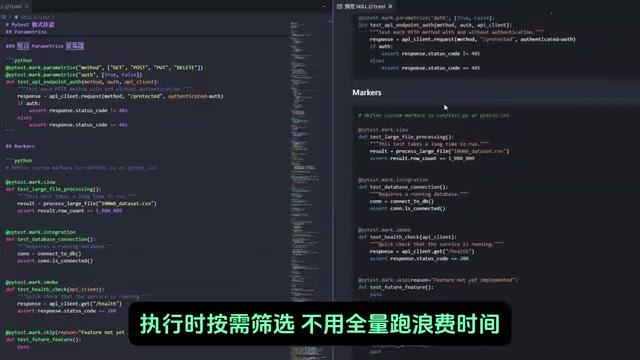
With pytest's @pytest.mark.parametrize decorator, you can inject test data — including normal values, error values, nulls, and edge cases — in bulk into the same test function. A single test case can run through the full range of scenarios, covering edge cases like 401, 500, and invalid parameters.
Deep Dive: The Theoretical Foundation of Parameterized Testing
The design philosophy behind
@pytest.mark.parametrizeis rooted in two classic test design techniques: Equivalence Partitioning and Boundary Value Analysis. Equivalence partitioning divides the input domain into several equivalent intervals and samples a representative value from each — for example, an age field might be divided into negative numbers, zero, valid range, and above-maximum; boundary value analysis focuses on extreme values at the edges of intervals (e.g., 0, 1, max-1, max). The parameterize decorator operationalizes both techniques: test engineers simply declare the dataset, and the framework automatically generates an independent test node for each data set. Each node appears separately in the test report with its own pass/fail status, precisely pinpointing failures without the need to sift through logs.
Parameterized testing also naturally aligns with the engineering evolution path of Data-Driven Testing (DDT). As the project scales and test data grows, parameters can be gradually migrated from inline code to external YAML, JSON, or CSV files, with test nodes dynamically generated using the pytest_generate_tests hook — which is called during the collection phase and allows the number of test instances to be determined at runtime based on external data sources. This architecture completely decouples test logic from test data, allowing even non-technical test analysts to maintain data files to add or modify test scenarios without touching any Python code.
This parameterization approach significantly improves test completeness. Traditional approaches write separate cases for each scenario — redundant, and prone to missing edge conditions. Parameterization fully decouples test logic from test data: adding a new scenario is as simple as appending one row of data.
Markers for Categorized, On-Demand Execution
The built-in marker classification system divides tests into categories such as smoke tests, integration tests, and slow tests, allowing selective execution at runtime without running the full suite every time.
Deep Dive: The Test Pyramid and CI Layering Strategy
The marker classification system is theoretically grounded in Mike Cohn's Test Pyramid model, which layers tests from bottom to top as unit tests, integration tests, and end-to-end tests — with higher layers being fewer in number, slower to execute, and more expensive to maintain. Markers translate this theory into engineering practice: smoke tests (
@pytest.mark.smoke) trigger on every commit, covering critical paths and typically expected to complete within 5 minutes; integration tests (@pytest.mark.integration) trigger on pull requests; and full regression runs are scheduled nightly or before releases. Thepytest-xdistplugin further supports multi-process parallel execution, compressing large test suite runtimes to 1/N (where N is the number of available CPU cores) — a key tool for speeding up CI.
In modern CI systems (GitHub Actions, GitLab CI, Jenkins), a marker-based tiered trigger strategy maps precisely to pipeline stages: the pre-commit stage runs lint checks and smoke tests (target: complete within 2 minutes) for immediate developer feedback; the Pull Request stage triggers integration tests to validate inter-module interactions (target: within 15 minutes); and after merging to main, full regression runs with complete coverage reports that are archived for audit and traceability. This strategy of staggering "fast feedback" and "comprehensive validation" along the timeline both preserves a smooth commit experience for developers and maintains the depth of overall quality assurance — it's a core principle in CI architecture for large engineering teams.
This is especially significant in CI pipelines — fast smoke tests can be triggered on every commit, while time-consuming integration tests can be scheduled for nightly batch runs.
Mock and Coverage: A Dual Quality Guarantee
Dependency Simulation and Call Logic Verification
The accompanying mock capabilities allow you to simulate external dependencies, control timing precisely, and verify that call logic behaves as expected. Using pytest's native monkeypatch for temporary file handling and runtime substitution, tests can validate core logic in a fully isolated environment, shielded from the instability of external services.
Deep Dive: Mock's Place in the Test Double Family
Mock is one member of the Test Double family of techniques, alongside Stub, Fake, and Spy. The key distinctions: a Stub simply returns preset values without caring whether it was called; a Mock not only returns preset values but also verifies interaction behavior (e.g., whether a method was called with specific arguments a specific number of times); a Fake is a simplified but functionally real alternative implementation (e.g., an in-memory database replacing a real one). In the pytest ecosystem, the most common tools are
unittest.mock(built into the standard library) andpytest-mock(which provides a more Pythonicmockerfixture). A key warning: over-mocking leads to tests that are tightly coupled to implementation details — if the internal structure is refactored, tests may break even if the external behavior remains unchanged. Mocks should only be used for genuinely uncontrollable external dependencies (third-party APIs, system clocks, random number generators), not arbitrary internal modules.
monkeypatch and unittest.mock complement each other in their use cases: monkeypatch excels at temporary substitution of module-level attributes, environment variables, and system paths, with a scope strictly limited to the current test function and automatic restoration afterward — zero side effects; pytest-mock's mocker fixture builds on unittest.mock with a more pytest-idiomatic API and automatic mock lifecycle management. For external HTTP requests, the responses library (for requests) and httpx's built-in mock transport further standardize network layer isolation, eliminating the need to manually manage mock object patch/unpatch cycles in test code.
Enforcing Coverage Gates
The template provides an easily enabled test coverage configuration that enforces an 80% code coverage standard. If the threshold isn't met, the build fails immediately — leaving no room for untested code to hide. It also supports generating visual coverage reports that clearly show which code paths have yet to be exercised.
Deep Dive: Coverage Metrics and Their Cognitive Limits
Code coverage is not a single metric but a family of measurements, listed here in increasing complexity: Statement (Line) Coverage measures the percentage of executed code lines; Branch Coverage requires every branch of
if/elsestatements to be executed; Condition Coverage further requires every sub-condition in compound boolean expressions to evaluate to both true and false; Path Coverage requires all possible execution paths to be covered (combinatorial explosion makes this impractical in full). Thepytest-covplugin is built onCoverage.pyand measures statement coverage by default. The 80% industry benchmark is the product of extensive engineering experience, but coverage is fundamentally a negative indicator — it can tell you what code wasn't executed, but it cannot guarantee that the code that was executed was correctly asserted. Coverage gates should be combined with assertion quality reviews and Mutation Testing to form a more complete quality measurement system.
The true blind spot of coverage gates lies in assertion quality — and that's exactly what Mutation Testing addresses. Mutation testing tools (the mainstream options in the Python ecosystem are mutmut and cosmic-ray) systematically inject small mutations into the source code — for example, changing the comparison operator > to >=, the arithmetic operator + to -, or the boolean literal True to False — and then re-run the test suite. If a mutant "survives" with all tests still passing, it means the assertions for the corresponding code segment are insufficient, even if the coverage report shows that line was executed. Including the mutation testing "Mutation Score" alongside coverage metrics in CI quality gates can significantly improve the actual defect-detection capability of the test suite, preventing the false sense of security that comes with "high coverage, low error-detection rate."
Coverage alone isn't always better when higher, but as a quality gate, an 80% standard strikes a reasonable balance in most engineering contexts — ensuring that core logic is thoroughly validated without falling into the trap of testing for coverage's sake.
Engineering in Practice: Standardization as Productivity
Project Structure as Living Documentation
This template standardizes the entire project directory and configuration file layout: organized by business module with a structure as clear as a continuously maintained living document. Teams can reuse the entire template directly — new members don't need to build a testing framework from scratch or reinvent the data-driven wheel.
More importantly, a unified coding standard effectively guards against common anti-patterns such as test coupling and global dirty data — these are often the root causes of gradual decay in a team's testing system. In practice, common decay paths include: test functions sharing state via module-level global variables (causing execution order dependencies), database records modified in session-scoped fixtures without rollback (contaminating subsequent tests), and large amounts of business logic inlined in test files rather than abstracted through fixtures (making tests themselves hard to maintain). A standardized directory structure and fixture layering convention naturally discourages the introduction of these anti-patterns.
Seamless CI Integration for a Closed Loop
The template fully supports unit tests, API tests, integration tests, and more, and integrates seamlessly into CI pipelines. It supports parallel execution to shorten feedback cycles and, combined with visual test reports, completes the full engineering loop of automated testing.
Closing Thoughts
Upgrading from scattered test scripts to a systematic automated testing practice is fundamentally a shift in engineering mindset around testing. The value of standardized templates like pytest patterns lies not in any single outstanding feature, but in integrating best practices — fixture layering (the engineering realization of dependency injection), parameterization (the automation of equivalence class and boundary value analysis), mocking (precise isolation of uncontrollable external dependencies), coverage gates (enforced quality floors), and CI integration (the pipeline mapping of the test pyramid) — into a single out-of-the-box methodology.
For teams looking to level up their testing engineering capabilities, it's far more effective to deeply understand a mature set of pytest patterns and evolve them around your own business context, rather than stumbling through from scratch. The ultimate goal of testing has never been the number of test cases — it's building a sustainable, trustworthy quality assurance system.
Key Takeaways
Key Takeaways
Related articles

Kimi K3 Open-Source Release: 2.8 Trillion Parameters Tops Global Programming Leaderboard
Moonshot AI's Kimi K3 launches with 2.8 trillion parameters, tops LMArena frontend coding leaderboard as world #1, completing tasks at one-third competitors' cost. Fully open-source for commercial use.

July 24 AI Daily Brief: Flux 3 Multimodal Release, Kimi K3 Lags in Testing, Qwen Tops TTS Rankings
July 24 AI news: Black Forest Labs launches Flux 3 multimodal model, Kimi K3 lags in US-UK gov tests, Alibaba Qwen tops TTS rankings, Etched raises $300M, AMD unveils MI430X.

Kimi K3 Real-World Testing in 3D Modeling & Game Development: Can Open-Source Models Overtake Closed-Source Giants?
In-depth testing of Kimi K3 in 3D modeling, physics simulation, animation rigging, and game development vs Fable 5 and GPT Solve 5.6. Open-source model delivers top-tier results at one-quarter the price.