Python+AI Zero-Basics Tutorial: Syntax, Crawlers, and Data Analysis in Practice

A 600-episode Python+AI tutorial in three stages—fundamentals, advanced, hands-on—broad coverage but watch for fragmentation and limited AI content.
This 600-episode "2026 Latest Python+AI Zero-Basics Tutorial" is organized into fundamentals (environment setup, variables, control structures, functions, modules), advanced topics (OOP, regex, file I/O, exception handling), and hands-on practice (crawlers, data analysis, office automation, AI-assisted decision-making). The article praises its beginner-friendliness and supporting study plan materials, but notes that the 600-episode volume may fragment knowledge and that the AI content in the title is actually limited. Learners should skim the basics, focus on functions and regex, and reproduce hands-on projects rather than mechanically finishing every episode.
Search for "Python tutorial" on Bilibili and you'll likely run into choice paralysis: high-view-count courses tend to be scattered and unsystematic, while collections billed as "full-stack" often drag on excessively in the basic syntax section. Recently, a 600-episode collection titled "2026 Latest Python+AI Zero-Basics Tutorial" came onto our radar. The uploader claims to have spent three months and over 2,000 hours polishing it, aiming to solve the scarcity of courses that are "both easy to understand and rich in exercises."
Course Positioning: A Three-Part Design from Zero Basics to Project Practice
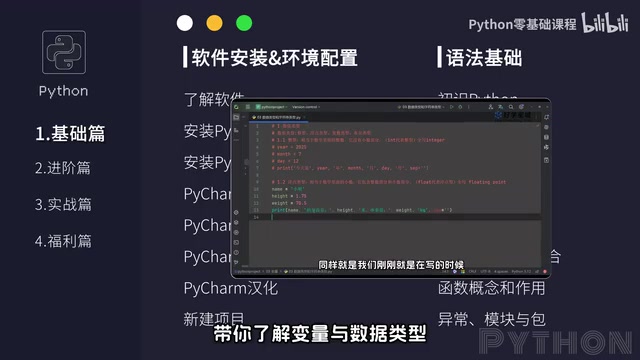
The clearest design choice in this course is dividing the 600 episodes into three major sections: fundamentals, advanced topics, and hands-on practice. The fundamentals section starts with setting up the Python environment and covers variables and data types, control structures, function definitions, and the use of modules and packages. The goal at this stage is clear: enable users with no programming experience at all to independently write structurally complete scripts.
The advanced section turns to Python's intermediate and advanced features, including inheritance and polymorphism in object-oriented programming, regex matching and substitution, file read/write operations, and exception handling. These topics are exactly the watershed between "being able to write code" and "being able to write good code"—many free tutorials stop at basic syntax, yet in real projects, regex and exception handling are used extremely frequently.
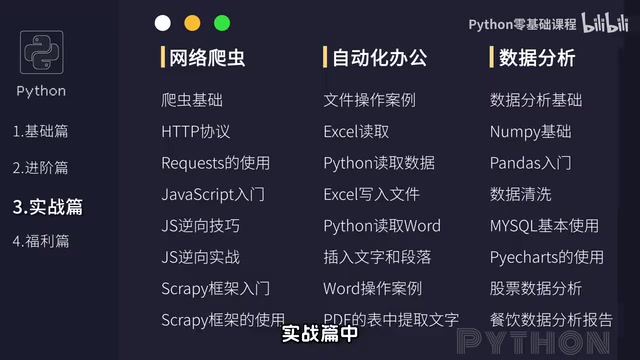
The hands-on section is the core selling point that distinguishes this course from similar content. According to the uploader, the projects cover crawling images and videos, data storage and analysis/mining, office automation, and AI-assisted decision-making. From a learning-path perspective, this arrangement follows the cognitive pattern of "syntax → tools → scenarios," and especially by linking crawlers with data analysis, it lets learners complete the closed loop from data acquisition to value extraction within the same tech stack.
Object-Oriented Programming (OOP) is one of the core topics in the advanced section. It encapsulates data and the methods that operate on that data into "classes," achieves code reuse through inheritance, and lets the same interface adapt to different implementations through polymorphism. In Python, everything is an object. Understanding concepts such as classes and instances, self, the constructor __init__, and method overriding is a key step from "writing scripts" toward "writing maintainable programs." In real projects, crawler frameworks and data analysis pipelines are often organized as classes, so this part is worth slowing down for and practicing repeatedly with small projects.
Regular expressions are a mini-language for describing string-matching patterns. Python supports them through the built-in re module, with commonly used functions including re.match, re.search, re.findall, and re.sub. In crawlers, they are used to extract structured information such as links, prices, and dates from web page source code; in data cleaning, they are used for batch replacement and format validation. When learning, it's recommended to first master a few core concepts—character classes, quantifiers, grouping, and greedy/non-greedy matching—then use an online debugging tool to write and verify as you go, rather than memorizing syntax by rote.
Highlights and Potential Weaknesses: A Calm Assessment
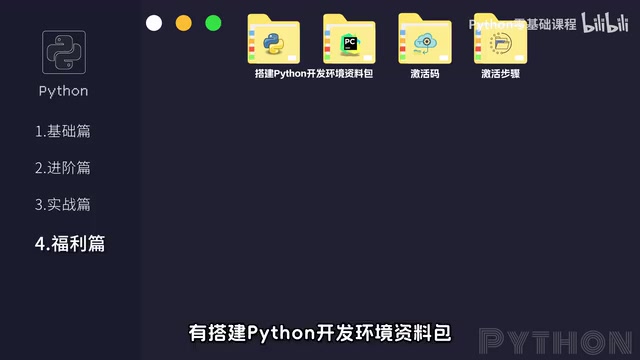
Judging from the course outline, this tutorial is quite friendly to zero-basics users. The uploader emphasizes designing the content "from the perspective of a zero-basics beginner" and provides supporting materials such as a development environment resource pack, a study plan table, an e-book, and courseware. For learners with average self-study ability who need external pacing, a ready-made study plan can significantly reduce the probability of giving up midway.
That said, the sheer size of 600 episodes is itself a double-edged sword. On one hand, it means the content coverage is comprehensive enough; on the other hand, it tests the course's information density—if individual episodes are too short and knowledge points are broken down too finely, learners can easily feel fragmented, as if they've "learned a lot but can't string it together." In addition, the actual proportion of the "AI" part mentioned in the title is not fully elaborated in the original introduction; AI-assisted decision-making is mentioned more as one direction within the hands-on section rather than as a main thread running through the entire course. For learners drawn in by "AI," it's advisable to first confirm the actual distribution of AI-related content before deciding whether to invest time.
Exception handling refers to catching and handling errors during program execution to avoid crashing the entire process. Python uses the try / except / else / finally structure, along with raise to actively throw exceptions. Good exception handling allows crawlers to keep running when timeouts or page structure changes occur, and allows data processing scripts to skip rather than halt when individual dirty data appears. A common beginner mistake is catching too broadly (directly using except: to swallow all errors); it's recommended to explicitly catch specific exception types and log them, which is also the foundation of stability in hands-on projects.
Who It's For, and How to Learn It
The target audience for this course is fairly clear: self-learners with no programming foundation who want a single tutorial covering everything from beginner to hands-on practice; working professionals who need to systematically build up crawler or data analysis skills; and students who prefer Chinese-language instruction and are accustomed to Bilibili's learning rhythm.
As for learning strategy, it's recommended not to mechanically progress in episode order. The fundamentals section can be skimmed quickly, with emphasis on functions and modules; for the advanced section's regex and exception handling, it's best to practice repeatedly with small exercises; and the hands-on section is suitable after completing the first two stages, when you can pick the projects closest to your own goals and reproduce them yourself. The accompanying materials mentioned by the uploader (study plan table, courseware, e-book) are best downloaded and organized before you start, to avoid disrupting your rhythm by hunting for resources midway.
The course's monetization orientation is also worth noting—the uploader explicitly mentions "achieving rapid monetization of programming skills," which has a realistic basis in the crawler and data analysis directions. But what beginners need to be wary of is that monetization ability depends on the depth of project experience rather than course completion. Actually getting the hands-on projects running and transforming them into your own version is more valuable than grinding through all 600 episodes.
Overall, this tutorial's structural design does address the core pain points of zero-basics learners, but the 600-episode volume demands strong执行力 and filtering ability from learners. Treating it as a route with a map rather than a self-driving car will yield much better results.
One-line Summary
A 600-episode Python+AI tutorial designed in three stages—fundamentals, advanced, and hands-on—with broad coverage, but watch out for fragmentation and the limited share of AI content.
Paragraph Summary
This "2026 Latest Python+AI Zero-Basics Tutorial" consists of 600 episodes organized in three stages: fundamentals (environment setup, variables, control structures, functions, and modules), advanced topics (OOP, regex, file I/O, and exception handling), and hands-on practice (crawlers, data analysis, office automation, and AI-assisted decision-making). The article acknowledges its friendliness to zero-basics users and the value of supporting materials like the study plan, while noting that the 600-episode volume may fragment knowledge points and that the AI content promised in the title is actually limited. Learners are advised to skim the fundamentals, focus on polishing functions and regex, and pick hands-on projects to reproduce rather than mechanically grinding through every episode.
Related articles

VICE: Concept-Level Video Similarity Estimation via Video-Language Entailment
VICE proposes a dual-branch video-language entailment framework that leverages LMMs' single-video understanding to estimate concept-level video similarity, outperforming models that process two videos simultaneously on ConViS-Bench and StepDiff.

UniAVC: A Unified Audio-Video Generation Paradigm with Asynchronous Scheduling to Solve Cross-Modal Challenges
UniAVC introduces progressive training and a modality-decoupled scheduler to solve scarce paired data and unified noise scheduling in joint audio-video generation, covering multiple tasks with a single set of weights.

DaFISH: Spherical Harmonic Rotation Decouples Lighting to Improve Novel View Synthesis Quality
DaFISH proposes spherical harmonic rotation to decouple lighting, decomposing each point's color into albedo and SH lighting factors to solve appearance inconsistency in neural rendering under active light sources, achieving best metrics including PSNR 38.91 dB across five scenes.