Python for Absolute Beginners: A Complete Breakdown of a 10-Hour Systematic Course

A complete breakdown of a structured 10-hour Python course designed for absolute beginners.
This article deconstructs a beginner-focused Python course built around three stages: foundational syntax, intermediate OOP and functional programming, and hands-on projects in web scraping and automation. It also examines the supporting mind maps and exercises, and offers a realistic look at what "learning Python in 10 hours" actually means.
Why Yet Another Python Beginner Course?
Python was first released in 1991 by Dutch programmer Guido van Rossum, with a design philosophy centered on code readability and simplicity. The famous "Zen of Python," written by Tim Peters and collected in Python Enhancement Proposal PEP 20, contains 19 aphorisms that can be viewed in full by typing import this in the Python interpreter. Among them: "Beautiful is better than ugly. Explicit is better than implicit." These aphorisms are not just style guidelines — they represent the Python community's engineering culture: reject over-engineering, prioritize readability above all. This philosophy has profoundly shaped Python's syntax choices — for example, Python uses indentation rather than curly braces to define code blocks, enforcing a uniform visual structure that allows developers from different backgrounds to quickly understand each other's code.
After more than three decades of evolution, Python has secured a place in the top three of the TIOBE Programming Language Index. Published monthly by a Dutch software quality company, the TIOBE index aggregates data from search engines, technical forums, online courses, and other sources, making it one of the key indicators of programming language popularity. Python has ranked first since 2021, surpassing Java and C — a reflection of the explosive demand driven by the AI and data science boom. In data science, artificial intelligence, web development, and automation, Python has built an irreplaceable ecosystem advantage. PyPI (the Python Package Index) currently hosts over 500,000 third-party libraries covering virtually every use case — which is precisely why "why learn Python" is a question so many people ask and so many people answer.
Search "Python tutorial" on Bilibili and you'll get thousands of results — some with millions of views, others with just a few hundred. There's no shortage of content, but very few can genuinely keep an absolute beginner engaged from start to finish without getting lost.
This newly produced Python course takes an approach worth noting: its creator set out to re-examine teaching content from the perspective of a true beginner. According to the creator, he spent a month researching various Python tutorials on Bilibili and identified a recurring problem — they lack structure and completeness. Fragmented knowledge, no post-lesson exercises, and a disconnect between theory and practice are the common flaws of most beginner tutorials.

The result is a course three months in the making, designed to address three core pain points: making content accessible to absolute beginners, providing ample practice after each lesson, and tightly integrating knowledge with hands-on application. For anyone looking to systematically learn programming, this design philosophy alone is worth studying.
Three-Part Course Structure: Fundamentals, Intermediate, and Practical
This Python course adopts a clear three-part structure — widely recognized as one of the more effective approaches to learning programming.

Part 1: From Environment Setup to Core Syntax
The fundamentals section starts with an introduction to Python and environment setup, then gradually covers core concepts like variables, data types, control flow, and functions. The goal is straightforward — make the onboarding experience as accessible as possible.
For absolute beginners, setting up the environment is often the first hurdle that sends people running. Python may be known for simplicity, but installing the interpreter, configuring an editor (such as choosing between VS Code and PyCharm), setting PATH variables, and dealing with differences between Windows and macOS can still trip up newcomers. It's worth knowing that Python comes in several distributions: CPython is the official reference implementation written in C, and the standard choice for most production environments; PyPy uses JIT compilation for speedups of 3–10x over CPython; and Anaconda is an integrated distribution bundled for data science, pre-installed with hundreds of scientific libraries like NumPy, pandas, and Jupyter Notebook — but its large footprint (~3 GB) and the conceptual confusion introduced by the coexistence of conda and pip can add unnecessary cognitive load for beginners. As a result, beginners are typically advised to start with the lightweight combination of official CPython and VS Code, switching to an Anaconda environment later if they move into data science. Treating environment setup as the very first step in the course reflects a genuine understanding of the real challenges beginners face.
Part 2: Object-Oriented and Functional Programming
The intermediate section focuses on two major programming paradigms: Object-Oriented Programming (OOP) and Functional Programming. Learners will master advanced features and techniques that enable them to write more efficient, elegant, and reusable code.
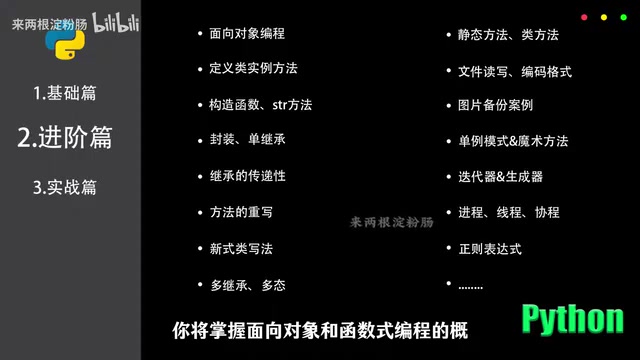
Object-Oriented Programming (OOP) originated in the 1960s with the Simula language and was popularized by Smalltalk. It encapsulates data and behavior into objects and organizes code through four core pillars — Classes, Inheritance, Encapsulation, and Polymorphism — making it the dominant architectural approach for large-scale modern software. For example, when developing an e-commerce system, "Product," "User," and "Order" can each be abstracted as classes that manage their own data and behavior, significantly reducing code coupling. Functional Programming, rooted in the lambda calculus developed by mathematician Alonzo Church in the 1930s, treats computation as the evaluation of mathematical functions, emphasizing immutability and the absence of side effects. Python's lambda expressions, map/filter/reduce, decorators, and generators all draw from this paradigm — decorators are essentially higher-order functions (functions that accept other functions as arguments and return new functions), while generators use the yield keyword to implement lazy evaluation, dramatically reducing memory usage when processing large datasets. The two paradigms are not mutually exclusive — Python, as a multi-paradigm language, allows developers to combine them flexibly depending on the situation: OOP suits large systems with complex state management, while FP suits data transformation pipelines. This flexibility is a key reason Python is more pragmatic than Java (strongly OOP) or Haskell (purely functional).
This section represents the critical leap from "being able to write code" to "writing code well." Many people remain stuck at the scripting level precisely because they never truly internalized these intermediate concepts.
Part 3: Applying Skills to Real-World Scenarios
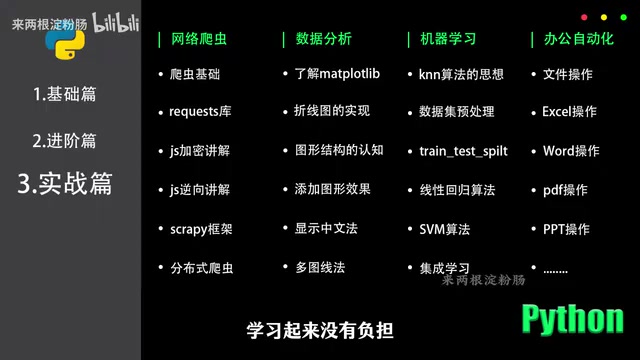
The practical section is the most compelling part of the course. The creator promises hands-on project walkthroughs across three areas:
- Web scraping: Crawling images, videos, and other online resources
- Office automation: Using code to replace repetitive manual tasks
- Data processing: Storing, analyzing, and mining data
These three directions cover Python's most essential real-world use cases, each backed by a mature ecosystem of tools. In web scraping, the requests library wraps the complex details of HTTP/HTTPS into a clean API — the go-to choice for scraping static pages; BeautifulSoup builds a DOM tree using lxml or html.parser and supports CSS selectors and XPath queries; for dynamic pages rendered by React, Vue, or other front-end frameworks, Selenium controls a real browser via the WebDriver protocol to execute JavaScript, while Playwright has emerged as a higher-performance alternative in recent years. It's important to note that scraping must comply with target websites' robots.txt protocols and applicable laws — large-scale unauthorized scraping can carry legal risks. Office automation is typically handled with openpyxl (Excel), python-docx (Word), and pyautogui (simulating mouse and keyboard input); pyautogui uses screenshot recognition and pixel coordinates to control input devices, making it suitable for legacy systems with no API, compressing repetitive administrative work into just a few lines of code. The data processing stack centers on pandas (structured data analysis) and NumPy (high-performance numerical computing), complemented by Matplotlib and Seaborn for visualization — a tech stack that also serves as the essential foundation for data science and machine learning. The ability to apply skills directly in real work scenarios is a core competitive advantage Python holds over many languages where beginners often find themselves struggling to bridge theory and practice.
Supporting Resources: Mind Maps and Practice System
Beyond the videos themselves, this Python course comes with a fairly comprehensive set of supplementary materials.
The materials include a learning mind map, video assets, software installers, slides and notes, and beginner-friendly e-books — all available by leaving a comment.
The mind map deserves special attention. Mind mapping was proposed by British psychologist Tony Buzan in the 1960s, grounded in the "Schema Theory" from cognitive psychology — the human brain does not store information linearly, but constructs long-term memory as a network of semantic associations. Visualizing knowledge as a radial tree structure simultaneously activates left-brain (logic, language) and right-brain (image, spatial) processing, improving memory encoding efficiency. In programming, syntax systems are complex and concepts have intricate dependencies — for example, understanding "decorators" requires first grasping "closures," and understanding "closures" requires understanding "scope chains" and "functions as first-class citizens." A mind map makes these implicit dependencies explicit, helping learners quickly locate knowledge gaps when they hit a difficult concept, clarify which topics are core trunk nodes (data types, control flow, functions) and which are extended branches (exception handling, module import system), thereby reducing cognitive load and avoiding the fragmented experience of "forgetting what came before."
The accompanying exercises address the course's stated goal of "sufficient post-lesson practice." Programming is a practical discipline, and the "Testing Effect" — quantified by Roediger and Karpicke in a 2006 study published in Science — shows that active retrieval (doing exercises, writing from memory, explaining to others) improves long-term retention by approximately 50% compared to re-reading material. From a learning science perspective, practice exercises are not an optional add-on — they are central to whether learning actually sticks.
A Realistic Take on "10-Hour Mastery"
"Learn Python in 10 hours" is largely a marketing hook. Real programming learning has never been a sprint — it demands sustained effort over time. Ten hours may be enough to watch through the videos once, but truly mastering Python still requires extensive hands-on practice, repeated debugging, and project experience.
From a learning science perspective, the development of programming ability follows the principle of "Deliberate Practice" proposed by psychologist Anders Ericsson through extensive empirical studies of musicians and athletes: effective skill acquisition requires sustained practice in the "learning zone" (slightly beyond one's current ability) with immediate feedback, not repetitive rehearsal of familiar content in the "comfort zone." In programming, there is a significant ability gap between "understanding code" and "being able to write code independently" — cognitive psychology calls the former "Recognition" and the latter "Recall," and it is the latter that real-world work demands. Watching example code may activate the brain's comprehension circuits, but only by writing code from a blank file yourself — facing error messages and troubleshooting independently — can you build genuine muscle memory and problem-solving ability. That is precisely why coding along with project walkthroughs yields far greater returns than passively watching videos, even for the same 10 hours.
The real value of this course lies in providing a clearly structured learning path: the fundamentals section builds a solid syntax foundation, the intermediate section elevates code quality, and the practical section validates what has been learned. For self-learners, the biggest challenge is often not a lack of resources, but not knowing "what to learn first and what to learn next." A carefully curated, logically coherent course is exactly the solution to that path-planning problem.
Conclusion
Regardless of which Python tutorial you ultimately choose, the teaching philosophy behind this course is worth referencing for any beginner:
Start from the perspective of an absolute beginner. Build a complete loop of "Fundamentals → Intermediate → Practical." Supplement with mind maps and exercises to connect abstract syntax learning with real-world application. Python's vast ecosystem, clean syntax design, and central role in automation and data make it the best entry point into programming for most people without a computer science background — but the language is only a tool. What truly determines learning outcomes is always the path you can commit to walking — all the way through, with your hands on the keyboard.
Related articles

WebMCP in Practice: How MakeMyTrip Is Reshaping the Travel Booking Experience
India's largest OTA platform MakeMyTrip uses WebMCP to standardize AI Agent interactions with web apps, replacing fragile DOM scraping with natural language-driven test automation and simplified complex booking scenarios.

Deep Dive into the EYG Programming Language: A New Portable Programming Paradigm Designed for Humans
Deep analysis of the EYG programming language's core design, including algebraic effects, program state persistence, and cross-platform portability, exploring how it addresses modern software fragmentation.

WebMCP in Practice: How MakeMyTrip Is Reshaping the Travel Booking Experience
India's largest OTA platform MakeMyTrip uses WebMCP to standardize AI Agent interaction with web apps, solving DOM scraping fragility, enabling natural language test automation, and simplifying complex international flight bookings.