Python for Absolute Beginners: A Complete Guide to Language Features and Applications

A complete beginner's guide to Python's history, core features, applications, and version selection
This article introduces Python, created by Guido van Rossum in 1991 and evolved from the ABC language. It highlights Python's three core strengths: high readability, concise syntax, and open-source extensibility. Python is widely used in AI, web development, data analysis, web scraping, and more, making it one of the most valuable programming languages to learn in the AI era. Beginners are advised to start directly with Python 3.
The Birth and Evolution of Python
In 1991, Dutch programmer Guido van Rossum created the Python language during the Christmas holiday, purely out of personal interest. This legendary figure—affectionately nicknamed "Uncle Turtle" by Chinese programmers (because the first three letters of his name, GUI, sound like the Chinese word for turtle)—probably never imagined that his "hobby project" would become one of the most popular programming languages in the world.
Notably, Python didn't emerge from thin air—it was built on the shoulders of its predecessors. While working at the National Research Institute for Mathematics and Computer Science (CWI) in the Netherlands, Guido was deeply involved in developing a teaching language called ABC. ABC was conceptually advanced, designed specifically for non-professional programmers, and highly readable. However, it failed to gain traction because it couldn't be extended or access low-level systems. Guido learned from ABC's shortcomings and designed Python—retaining ABC's readability while adding practical features like exception handling and extensible modules, thereby overcoming ABC's fatal weaknesses.
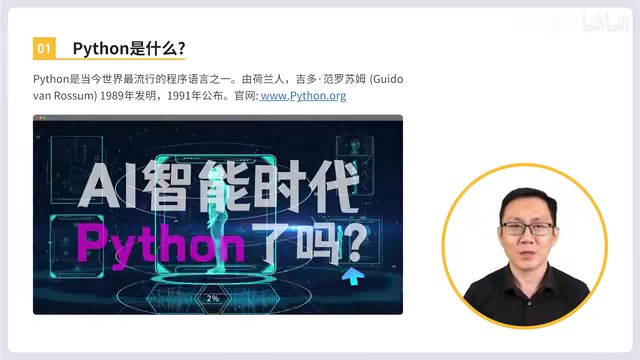
Over more than three decades of development, Python has grown from a niche scripting language into the "lingua franca" of the internet age—especially the AI era. Some people even use Python as a verb: "Have you Pythoned yet?" meaning "Have you started programming? Have you entered the age of artificial intelligence?"
Core Features of Python
High Readability: Syntax Close to Natural Language
Python's syntax is designed to be extremely clean and intuitive, nearly approaching natural language expression. This design philosophy allows absolute beginners to learn and memorize syntax rules more easily, freeing them to focus on solving real problems rather than wrestling with complex syntax details.
This design philosophy is well-documented. Python has a famous built-in design guide—The Zen of Python—written by core developer Tim Peters. You can view the full text by typing import this in the Python interpreter. Its core tenets include: "Beautiful is better than ugly," "Explicit is better than implicit," and "Simple is better than complex." This philosophy directly influenced Python's syntax decisions—for example, using mandatory indentation instead of curly braces to denote code blocks. This reduces visual noise and enforces good coding style at the language level, keeping code visually consistent across different programmers.
Concise and Efficient: Life Is Short, Use Python
To accomplish the same functionality, Python code typically requires only about half the lines of other languages like Java or C++. The popular saying among programmers—"Life is short, use Python"—perfectly captures its development efficiency. Programmers no longer need to worry about complex syntax and can focus on the task at hand.
Open Source and Extensible: A Rich Third-Party Library Ecosystem
Python is a purely open-source language, meaning it can be easily ported to various platforms. Additionally, Python boasts an incredibly rich ecosystem of third-party libraries and can conveniently interface with code written in other languages like C and Java, offering exceptional extensibility.

These features—simplicity, readability, and extensibility—have given Python a prominent position across numerous fields including data science, artificial intelligence, big data, cloud computing, graphics processing, and internet applications.
Typical Application Scenarios for Python
There's a well-known saying in the industry: "Python can do everything except have babies." While somewhat exaggerated, it genuinely reflects the breadth of Python's applications. Here are some of the most typical use cases:
Artificial Intelligence (AI)
In the field of artificial intelligence, Python is the undisputed king. Whether it's machine learning, deep learning, natural language processing, or computer vision, virtually all AI scenarios rely on Python. The three most mainstream AI frameworks all use Python as their primary interface: TensorFlow, open-sourced by the Google Brain team in 2015, is the most widely deployed deep learning framework in industry; PyTorch, released by Facebook AI Research in 2016, is favored by academia for its dynamic computation graph mechanism and has rapidly caught up with TensorFlow in industrial adoption in recent years; scikit-learn focuses on traditional machine learning algorithms, providing a complete toolchain from data preprocessing to model evaluation. Together, these three frameworks form Python's unshakeable ecosystem moat in the AI domain.
Web Application Development
Using frameworks like Django and Flask, Python can efficiently build websites and web systems. Many well-known websites (such as Instagram and Pinterest) have their backends built with Python.
Server Operations and System Administration
Python excels in the field of automated operations and is an indispensable tool for DevOps engineers. Writing automation scripts, managing server configurations, monitoring system status—Python handles it all.
Scientific Computing and Data Analysis
For researchers, Python is practically a must-learn language. Libraries like NumPy, Pandas, and Matplotlib form a powerful scientific computing ecosystem, making data processing and visualization effortless.
Web Scraping
Python is the go-to language for web scraping engineers. Tools like Scrapy, BeautifulSoup, and Selenium make data collection simple and efficient.
Game Development
Many game projects use C++ for high-performance modules while writing game logic and scripting modules in Python. This combination balances performance with development efficiency.
Python Version Selection Guide
Python has two major versions: Python 2 and Python 3. Here's what you need to know:
- Python 2: Officially reached end-of-life in 2020; not recommended for new projects
- Python 3: Released in 2008 with significant performance improvements; the current mainstream version
It's important to emphasize that Python 3 and Python 2 are completely incompatible. This wasn't a technical mistake but a deliberate "clean surgery." Python 2 had accumulated substantial technical debt—for example, default strings were ASCII rather than Unicode (which easily caused errors when handling Chinese and other non-English characters), and integer division automatically truncated decimals. To thoroughly fix these issues, Guido van Rossum decided to make breaking, non-backward-compatible changes in Python 3. This decision led to over a decade of painful version fragmentation in the community, with many projects dependent on Python 2 unable to migrate for years. It wasn't until Python 2 officially reached end-of-life in 2020 that this migration was largely completed. This chapter in history has become a classic case study in programming language design about the trade-off between "technical debt" and "backward compatibility." If you occasionally encounter legacy Python 2 code, you can use the official 2to3 tool for code migration.

For beginners, it's strongly recommended to start directly with Python 3. As for minor versions of Python 3 (3.10, 3.11, 3.12, etc.), the differences are minimal—any 3.x version will work. Currently, version 3.10 or above is recommended to access the latest syntax features and performance optimizations.
Summary
With its clean syntax, powerful ecosystem, and wide range of applications, Python has become one of the most worthwhile programming languages to learn today. Whether you want to enter the field of artificial intelligence, pursue web development, do data analysis, or simply improve your work efficiency, Python is an excellent starting point. In today's world where the AI wave is sweeping the globe, mastering Python is not only a fundamental skill for programmers but also an important competency for professionals in all industries to enhance their competitiveness.
Key Takeaways
- Python was created by Guido van Rossum in 1991, evolved from the ABC language, and features three core strengths: high readability, concise syntax, and open-source extensibility
- Python's design philosophy is distilled in The Zen of Python, emphasizing beauty, explicitness, and simplicity, enforcing good coding style at the language level through mechanisms like mandatory indentation
- Python reigns supreme in artificial intelligence—TensorFlow, PyTorch, and scikit-learn all use Python as their primary interface—while also being widely applied in web development, data analysis, web scraping, game development, and more
- Python 2 reached end-of-life in 2020; beginners should start directly with Python 3
- Python 3's incompatibility with Python 2 was a deliberate choice to fix historical design flaws; legacy code can be migrated using the 2to3 tool
- Python's conciseness means its code is typically half the length of other languages, dramatically improving development efficiency
Related articles
 Tutorials
ChatGPT Plus Subscription Guide: Are GPT-5.5, image-2, and Codex Worth the Upgrade?
A detailed look at ChatGPT Plus features — GPT-5.5, image-2, and Codex — with a Plus vs Pro comparison and a complete step-by-step subscription guide for users outside the US.
 Tutorials
Harness AI Engineering in Practice: Using Claude Code to Master Enterprise-Level E-Commerce Development
Deep dive into Harness AI Engineering: master enterprise e-commerce development with Claude Code using the Rules, Skills, Wiki, and Changes framework.
 Tutorials
Cursor + Codex Dual-IDE Collaboration: A Practical Methodology for Open-Source Project Customization
A complete methodology for open-source project customization based on real-world experience, detailing the Cursor+Codex dual-IDE workflow, seven-stage process, MVP validation, and AI source code reading techniques.