Python Learning Roadmap for Beginners: 9 Weeks, 16 Hands-On Projects from Zero to Computational Thinking

A structured 9-week Python learning roadmap for absolute beginners with 16 hands-on projects
This article presents a 9-week Python learning roadmap refined through five years of teaching practice, designed for absolute beginners. It's divided into three parts: Weeks 1-2 for quick start (ten lines of code and turtle graphics to build intuitive understanding), Weeks 3-7 for systematic core syntax learning (data types, control structures, functions, etc.), and Weeks 8-9 for developing computational thinking. Each week includes hands-on projects following a progressive learning design.
Why Beginners Need a Structured Python Learning Roadmap
For those with zero programming experience, Python is undoubtedly one of the most beginner-friendly languages. Created by Dutch programmer Guido van Rossum and released in 1991, Python's design philosophy emphasizes code readability and simplicity. Compared to languages like C and Java, Python requires no variable type declarations, no manual memory management, and its syntax closely resembles natural English — significantly reducing cognitive load. According to the TIOBE Programming Language Index, Python has consistently held the top position as the world's most popular programming language since 2021. More importantly, Python boasts an incredibly rich third-party library ecosystem, covering everything from data analysis (pandas, numpy) to artificial intelligence (TensorFlow, PyTorch), making the growth path after getting started remarkably broad.
But when faced with an overwhelming flood of learning resources, figuring out how to plan a scientific and efficient learning path is often more daunting than the learning itself.
This article is based on a Python fundamentals curriculum refined through five years of teaching practice, presenting a clear 9-week Python learning roadmap. The curriculum is designed around the complete system of procedural programming Python syntax, divided into three major parts and nine chapters, accompanied by 16 carefully selected hands-on projects covering the full journey from basic syntax to computational thinking.
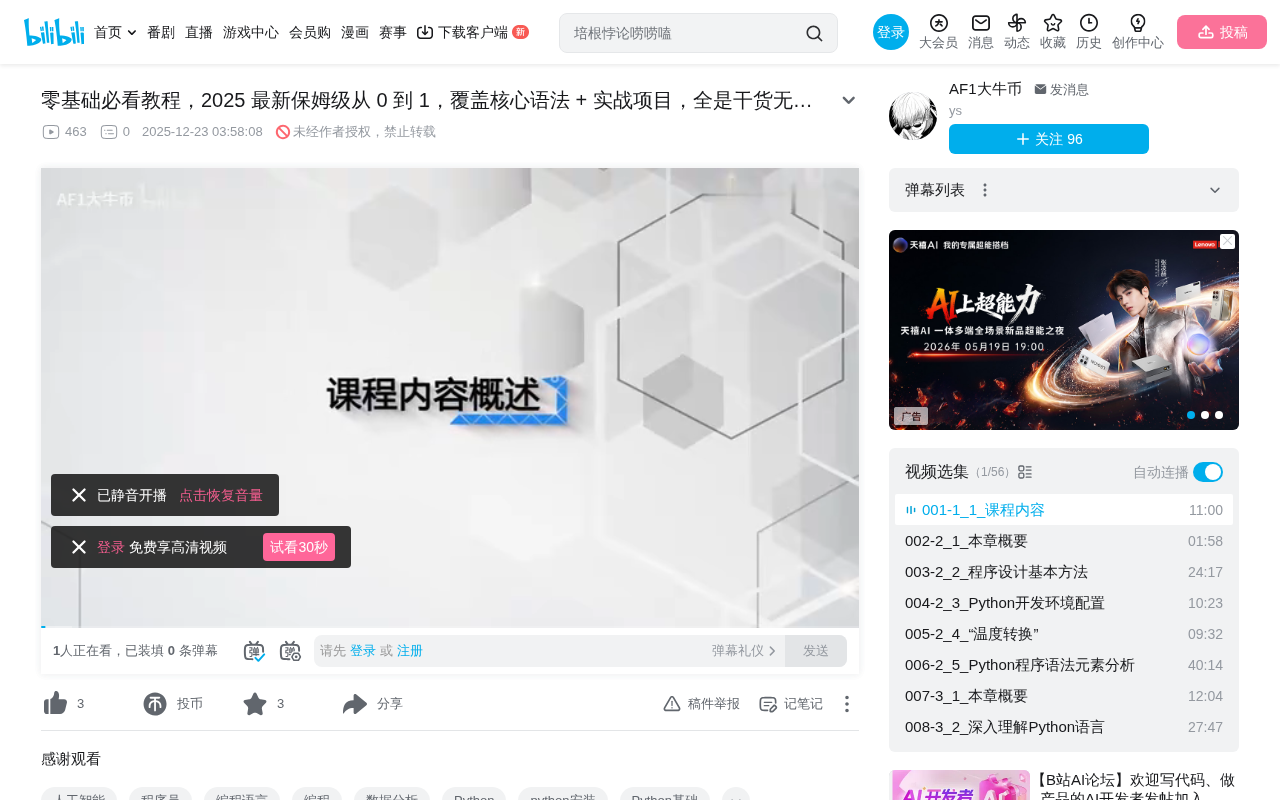
The overall structure is very clear:
- Part 1 (Weeks 1-2): Python Quick Start — building intuitive understanding
- Part 2 (Weeks 3-7): Python Core Syntax — systematic and methodical learning
- Part 3 (Weeks 8-9): Python Computational Thinking — developing deeper skills
Each week includes 1-2 hands-on projects, following a "learn a little, practice a little" approach — a progressive learning design aligned with cognitive principles.
Part 1: Python Quick Start (Weeks 1-2)
Week 1: Ten Lines of Code to Open the Door to Programming
Many beginners have a natural fear of programming, thinking it's incredibly complex. But this Python learning roadmap only asks you to understand ten lines of Python code in the first week — a simple temperature conversion program.
Though brief, these ten lines cover the most essential elements of Python programming: variables, input/output, basic arithmetic, and program flow. By observing the code style, understanding the basic logic, and figuring out the meaning of each word and line, you can write and run your first Python program.
As the course puts it: "It's only ten lines of code — you could memorize it if you wanted to." This low-barrier starting approach greatly reduces the psychological burden on absolute beginners.
Week 2: Drawing a Snake with the Turtle Library
Week two builds on the first week by implementing Python graphics drawing with just over ten lines of code. Learners use the turtle library to draw a lifelike, animated snake.
The turtle library's history traces back to the Logo programming language developed at MIT in 1967, originally designed specifically for children's programming education. Its core concept involves a "turtle" crawling across the screen to draw graphics, generating various patterns by controlling the turtle's movement direction and distance. Python's built-in turtle module carries on this tradition, making abstract code logic visually intuitive. In teaching practice, visual feedback significantly boosts learners' intrinsic motivation — when code execution results appear as graphics, learners more easily establish the "code → result" causal understanding, which is a crucial foundation for developing computational thinking.
The brilliance of this project lies in the fact that it not only reinforces Week 1's syntax knowledge but also introduces the concept of graphical programming, making code execution results "visible." When you see a snake slowly slithering across the screen, a sense of programming accomplishment naturally arises. More importantly, you can modify parameters to change the snake's shape — this process of "tweaking code and seeing results" is the very seed of computational thinking.
Part 2: Python Core Syntax System (Weeks 3-7)
Week 3: Data Types — The Power of Daily Improvement
Entering the Python core syntax phase, the first topic is basic data types, including numeric types (integers, floats) and string types, along with introducing the time module for getting system time.
This week's classic project, "The Power of Daily Improvement"
Related articles
 Tutorials
ChatGPT Plus Subscription Guide: Are GPT-5.5, image-2, and Codex Worth the Upgrade?
A detailed look at ChatGPT Plus features — GPT-5.5, image-2, and Codex — with a Plus vs Pro comparison and a complete step-by-step subscription guide for users outside the US.
 Tutorials
Harness AI Engineering in Practice: Using Claude Code to Master Enterprise-Level E-Commerce Development
Deep dive into Harness AI Engineering: master enterprise e-commerce development with Claude Code using the Rules, Skills, Wiki, and Changes framework.
 Tutorials
Cursor + Codex Dual-IDE Collaboration: A Practical Methodology for Open-Source Project Customization
A complete methodology for open-source project customization based on real-world experience, detailing the Cursor+Codex dual-IDE workflow, seven-stage process, MVP validation, and AI source code reading techniques.