Python Machine Learning in Practice: A Complete Guide from Algorithm Derivation to Code Implementation

Three-stage framework for mastering ML: principle derivation, code implementation, and experimental analysis.
This article introduces a Python machine learning training course built around three core modules: algorithm principle derivation uses plain language to build mathematical intuition covering gradients, loss functions, and classic algorithms; code implementation translates formulas into Python line by line, using logistic regression to demonstrate the full workflow from coding to decision boundary visualization with advanced techniques like regularization; and experimental analysis uses comparative experiments to validate different strategies in real-world contexts.
Course Overview: Three Core Modules for a Complete Machine Learning Learning Path
For developers who want to learn machine learning systematically, the biggest challenge is often not what to learn, but how to learn it. Tutorials out there tend to fall into one of two traps: either they're so heavy on theoretical derivations that beginners feel overwhelmed, or they only cover API calls without explaining the underlying reasoning. This Python machine learning training course proposes a clear three-stage learning framework: Algorithm Principle Derivation → Code Implementation → Experimental Analysis — striking a balance between theoretical depth and practical ability.
This "principle–implementation–validation" learning path is also the standard workflow used by both industry practitioners and academic researchers when studying machine learning algorithms. Let's break down the core content and key learning points of each module.
Algorithm Principle Derivation: From Mathematical Intuition to Formula Derivation
The first module focuses on the mathematical foundations of algorithms. The instructor walks through how an algorithm is derived from scratch, step by step, building it up from nothing.
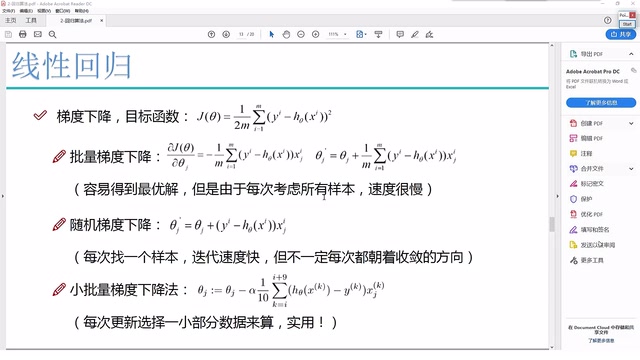
Many beginners have a natural fear of mathematics, but the core of machine learning is genuinely built on mathematical foundations. Linear algebra, probability theory, calculus, and optimization theory are four interconnected pillars — linear algebra provides tools for data representation (matrices, vectors) and transformations; probability theory underpins statistical learning methods like Bayesian inference and maximum likelihood estimation; the concept of gradients from calculus is central to backpropagation and parameter updates; and optimization theory studies how to efficiently find the minimum of a loss function. These four areas are deeply intertwined — gradient descent, for instance, is essentially a combination of calculus and optimization, while parameter estimation in logistic regression relies simultaneously on probability theory (likelihood functions) and calculus (differentiation). The course takes a pragmatic approach: rather than pursuing mathematical rigor, it uses plain language and concrete small examples to help learners build intuition.
This teaching style has a clear advantage — it lowers the barrier to entry and allows more developers with programming backgrounds to understand the why behind algorithms. That said, it's worth noting that if you plan to deeply research or improve algorithms in the future, intuitive understanding alone won't be enough — you'll also need rigorous mathematical training.
Key Topics Covered in Principle Derivation
This module covers:
- Foundational mathematical concepts: gradients, loss functions, probability distributions, and other core ideas
- Derivation of classic algorithms: such as logistic regression, decision trees, and ensemble learning
- Common optimization strategies: gradient descent, regularization, and related solutions
The value of understanding algorithm principles is that when a model underperforms in a real project, you can analyze the problem from a foundational level rather than blindly tuning hyperparameters.
Code Implementation: Reproducing the Complete Logic of Machine Learning Algorithms Line by Line
The second module is about translating mathematical formulas into runnable Python code. The course goes through the implementation module by module, line by line, explaining what each line of code does.
The instructor uses Eclipse as the IDE (learners are free to use PyCharm, VS Code, Jupyter, or any Python development environment of their choice), guiding learners through a complete algorithm implementation from scratch.
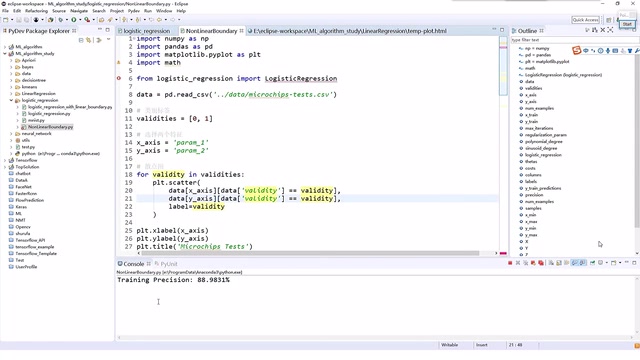
Core Workflow for Code Implementation
Based on the logistic regression example shown in the course, code implementation follows these steps:
- Define the algorithm's core workflow and steps: clarify which functional modules need to be implemented
- Implement each module: translate each mathematical step into the corresponding Python code
- Assemble the modules: combine all functional components into a complete algorithm
- Test and validate on a dataset: run the model on real data and observe its performance
Taking logistic regression as an example — it's one of the most classic binary classification algorithms in machine learning. Despite having "regression" in its name, it's actually a classification model. Its core idea is to use the Sigmoid function to compress the output of a linear combination into the (0, 1) range, representing the probability that a sample belongs to a given class. Logistic regression parameters are estimated by maximizing the log-likelihood function (equivalent to minimizing cross-entropy loss), typically using gradient descent or its variants. Due to its strong interpretability and computational efficiency, logistic regression remains a widely used baseline model in industry — particularly in scenarios like ad click-through rate prediction and credit scoring. The course presents a compelling example: after implementing the logistic regression algorithm, it visualizes the dataset distribution, how the model improves across iterations, and the final decision boundary.
A decision boundary is the dividing line (in 2D) or hyperplane (in higher dimensions) that a classification model uses to separate different class regions in feature space. By visualizing the decision boundary, learners can intuitively assess the model's fit: an overly complex, jagged boundary often indicates overfitting (the model has memorized noise in the training data), while an overly simple linear boundary may indicate underfitting. This "implement and test immediately" approach gives learners instant feedback and reinforces a sense of accomplishment.
From Basic Implementation to Advanced Optimization
The course goes beyond basic implementation and guides learners to think about how to optimize algorithms:
- Adding nonlinear transformations to handle linearly inseparable data
- Introducing feature engineering and regularization to improve model performance
- Comparing the effects of different strategies to understand when each optimization technique applies
Among these, regularization is a core technique for preventing overfitting — its essence is adding a penalty term for model complexity to the loss function. L1 regularization (Lasso) produces sparse solutions with an automatic feature selection effect, making it suitable for high-dimensional sparse data; L2 regularization (Ridge) tends to shrink all parameters uniformly and is more robust to collinear features. From a Bayesian perspective, L1 corresponds to a Laplace prior on the parameters, while L2 corresponds to a Gaussian prior. In practice, the regularization strength needs to be selected via cross-validation — too large leads to underfitting, while too small makes the regularization effect negligible.
This incremental code-building approach helps learners understand the internal mechanics of algorithms far better than simply calling APIs from libraries like sklearn.
Experimental Analysis: Comparative Validation and Strategy Selection
The third module is experimental analysis — the part most closely tied to real-world applications. The course provides detailed coverage of key concepts in classic machine learning algorithms and uses extensive comparative experiments to demonstrate the performance differences between various strategies.
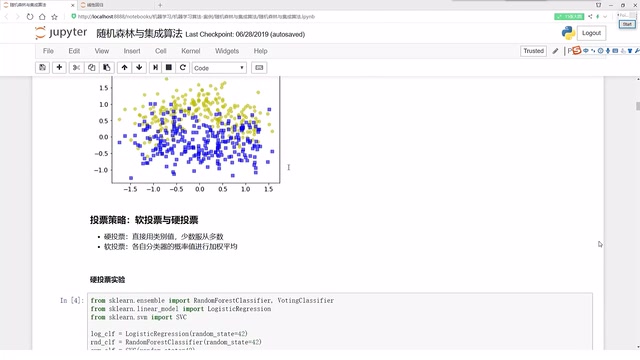
Ensemble Learning as an Example
Ensemble Learning improves overall predictive performance by combining multiple base learners. Its core idea is
Related articles
 Tutorials
ChatGPT Plus Subscription Guide: Are GPT-5.5, image-2, and Codex Worth the Upgrade?
A detailed look at ChatGPT Plus features — GPT-5.5, image-2, and Codex — with a Plus vs Pro comparison and a complete step-by-step subscription guide for users outside the US.
 Tutorials
Harness AI Engineering in Practice: Using Claude Code to Master Enterprise-Level E-Commerce Development
Deep dive into Harness AI Engineering: master enterprise e-commerce development with Claude Code using the Rules, Skills, Wiki, and Changes framework.
 Tutorials
Cursor + Codex Dual-IDE Collaboration: A Practical Methodology for Open-Source Project Customization
A complete methodology for open-source project customization based on real-world experience, detailing the Cursor+Codex dual-IDE workflow, seven-stage process, MVP validation, and AI source code reading techniques.