PyTorch Day China 2026 Call for Proposals Closing Soon

PyTorch Day China 2026 CFP closes Nov 10; event is Dec 12 in Beijing.
PyTorch Day China 2026's Call for Proposals closes November 10 at 23:59 CST, with the event on December 12 in Beijing for the PyTorch developer community. With only about a month between deadline and event, speakers face a tight prep window. The article covers key dates, why to participate, and proposal tips, recommending submissions around framework features, training/inference experience, ecosystem tools, and community projects.
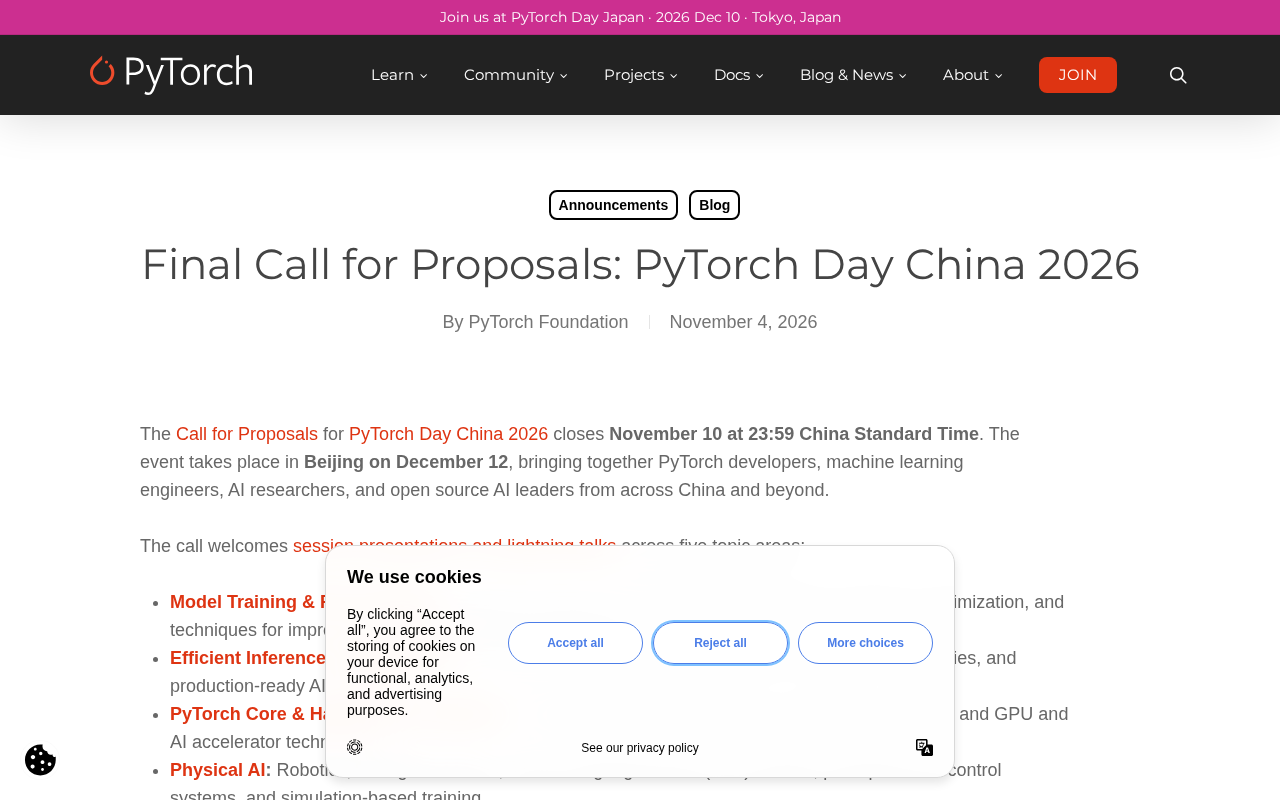
PyTorch Day China 2026's Call for Proposals (CFP) is entering its final stretch—the deadline is November 10 at 23:59 (China Standard Time). The event will take place on December 12 in Beijing and is open to the PyTorch developer community.
Key Dates and How to Participate
According to information published on the official PyTorch blog, the CFP deadline is very clear: November 10 at 23:59 CST. This means developers have limited time left to prepare and submit proposals. The event itself is scheduled for December 12 in Beijing, leaving roughly one month between the deadline and the event—a relatively tight window for accepted speakers to prepare their presentation materials.
PyTorch Day is a community event organized by the PyTorch Foundation, typically featuring technical talks, tutorial sessions, and developer networking. The Beijing event will bring together PyTorch developers, with the full agenda and speaker lineup to be announced gradually after the CFP closes.
The PyTorch Foundation is a nonprofit organization under the Linux Foundation, established in 2022 to oversee neutral governance and ecosystem development for the PyTorch framework. Its governance structure includes a Technical Advisory Council (TAC) and multiple working groups covering areas such as compilation, distributed training, and mobile. The Foundation's main responsibilities include: maintaining PyTorch's open-source governance processes, organizing community events worldwide (such as PyTorch Day and PyTorch Conference), coordinating collaboration between industry and academic institutions, and driving standardization of PyTorch across multiple hardware backends. The PyTorch Day series is the Foundation's regional community event format, typically smaller than the annual conference and more focused on local developers' hands-on sharing and exchange. Understanding the Foundation's governance background helps proposers grasp the event's positioning—it is not merely a framework presentation session, but an entry point for community members to participate in ecosystem building.
Why It's Worth Your Attention
As one of the mainstream frameworks in deep learning today, PyTorch's community events have long been an important occasion for developers to learn about the latest framework developments and exchange practical experience. For Chinese PyTorch developers, PyTorch Day China offers an opportunity to engage face-to-face with the core team and fellow community members.
From a CFP perspective, submitting a proposal is not only a way to share your work but also a way to participate in community building. Whether it's framework usage experience, performance optimization practices, or project case studies built on PyTorch, these are all common content directions for this type of event.
CFP (Call for Proposals) is the standard mechanism by which technical conferences openly solicit speaking topics from the community. A complete CFP typically includes: a proposal submission form (title, abstract, speaker bio, topic category), review process and timeline, notification date, and material preparation requirements upon acceptance. CFP review is generally handled by a Program Committee, which scores proposals based on topic relevance, technical depth, novelty, and speaker presentation ability. For regional community events like PyTorch Day, review tends to prioritize practical value and community contribution over academic novelty. What proposers need to understand is that the CFP deadline is usually followed by review, notification, and agenda scheduling—so the one-month window from deadline to event actually encompasses the entire review and preparation cycle, which is why the article emphasizes the "tight window."
Advice for Proposers
Although the official announcement does not disclose the specific range of proposal topics, based on the conventions of the PyTorch Day series, proposals typically fall into the following directions: application practices of new framework features, engineering experience in model training and inference, insights from using ecosystem tools, and community project showcases. Proposers should finalize their topics and complete submissions as early as possible to avoid rushing before the deadline.
It's worth noting that the announcement only provides the deadline and event date. For specific proposal format requirements, review criteria, notification times, and other details, it's recommended to consult the full announcement on the official PyTorch blog or the event page.
Summary
The CFP for PyTorch Day China 2026 closes on November 10 at 23:59 CST, with the event taking place on December 12 in Beijing. Developers interested in participating should make the most of the remaining window to complete their proposal submissions.
One-line Summary
PyTorch Day China 2026 CFP closes November 10; event takes place December 12 in Beijing.
Paragraph Summary
PyTorch Day China 2026's Call for Proposals (CFP) closes on November 10 at 23:59 (China Standard Time), with the event itself scheduled for December 12 in Beijing, open to the PyTorch developer community. With only about one month between the deadline and the event, accepted speakers face a tight preparation window. PyTorch Day is organized by the PyTorch Foundation and typically features technical talks, tutorial sessions, and developer networking. The article suggests proposers prepare content around new framework feature applications, training and inference engineering experience, ecosystem tool usage, and community project showcases, and submit early. The announcement does not disclose specific proposal formats, review criteria, or notification times—consult the full official blog page for details.
Related articles

Jensen Huang Returns to Nvidia: The Power Game Behind an "Aggro Reset"
Nvidia's board reappointed Jensen Huang as CEO less than two weeks after his scandal-driven resignation. This analysis explores the board's decision-making, Trump's political intervention, media power failure, and market reaction behind the dramatic return.

Why Voice AI Can't Understand Kenyans' Everyday Conversations
Swahili speech recognition hits 3.24% error on read text, but everyday Kenyan speech mixes English, Sheng slang, and accents—leaving mainstream voice AI struggling.

Data Centers Build Their Own Natural Gas Plants: AI Compute's Breakout Around a Decade-Long Grid Wait
Grid interconnection approvals can take a decade, so xAI and others are building off-grid natural gas plants to power AI clusters. This article analyzes the drivers, costs, and impact of behind-the-meter generation on AI infrastructure.