Quantum Hamiltonian Embeddings: A New Framework for Quantum Machine Learning
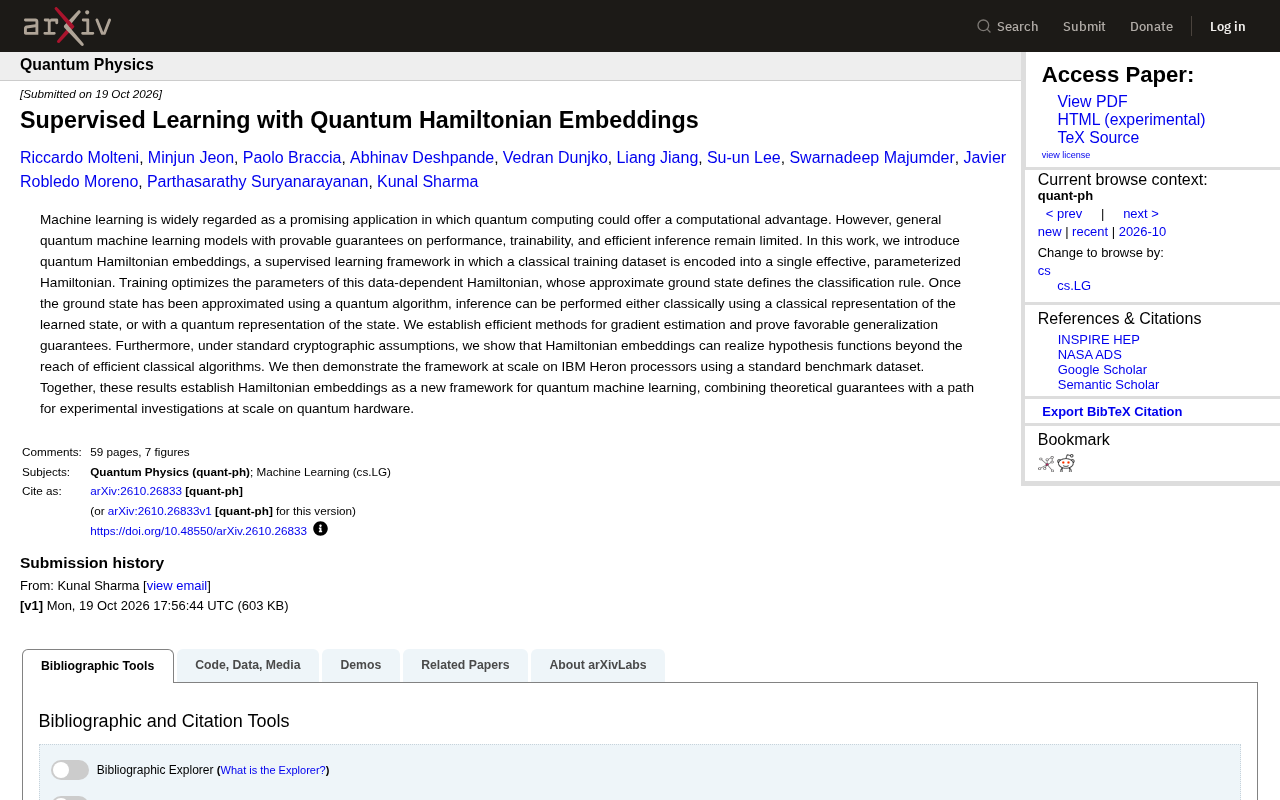
Quantum Hamiltonian embeddings encode the training set as a parameterized Hamiltonian, combining theoretical guarantees with hardware demonstrations.
The article introduces a paper on Quantum Hamiltonian Embeddings that encodes a classical training dataset into a parameterized effective Hamiltonian, optimizing parameters so the approximate ground state defines the classification rule, bypassing training difficulties of traditional parameterized quantum circuits. It proves efficient gradient estimation and generalization guarantees, argues under cryptographic assumptions for capabilities beyond efficient classical algorithms, supports both classical and quantum inference, and demonstrates scaled-up runs on IBM Heron, though real advantages need further validation.
Quantum computing is often seen as a potential path to a leap in compute power for machine learning, yet general-purpose quantum machine learning models have consistently lacked rigorous proof in terms of performance guarantees, trainability, and efficient inference. A recent paper proposes the Quantum Hamiltonian Embeddings framework, which attempts to bridge this path from theory to experiment. The work encodes a classical training dataset into a parameterized effective Hamiltonian, optimizes its parameters so that the approximate ground state defines the classification rule, and demonstrates it at scale on an IBM Heron processor.
Framework Core: Turning a Dataset into a Hamiltonian
Traditional quantum machine learning typically encodes data into quantum states and then processes them through parameterized quantum circuits. The Hamiltonian embedding approach is different: it compresses the entire classical training set into a single, data-dependent effective Hamiltonian. Training consists of adjusting the parameters of this Hamiltonian so that its approximate ground state reflects the classification boundary.
The cleverness of this design lies in the fact that the classification rule no longer depends on a particular quantum circuit structure, but is determined by the ground state itself. Once the ground state is approximated via a quantum algorithm, the inference stage offers two options: classical inference using a classical representation of the learned state, or quantum inference directly using the quantum representation. This provides flexibility for deployment under different hardware conditions.
A Hamiltonian is the operator in quantum mechanics that describes the total energy of a system; its eigenvalues and eigenstates determine the system's energy-level structure and dynamical evolution. In the context of quantum computing, finding the ground state (the lowest-energy eigenstate) of a given Hamiltonian is a core task in quantum simulation, chemistry, and combinatorial optimization, typically achieved via variational quantum algorithms (such as VQE) or quantum phase estimation. Mapping a machine learning dataset to a Hamiltonian means the classification problem can be transformed into a problem of finding the ground state: the training process tunes the Hamiltonian parameters, and the inference process solves for the ground state. This perspective is in line with the approach of quantum annealing and Ising-model solving of combinatorial optimization problems, but Hamiltonian embeddings systematize it for supervised learning and emphasize that the approximate ground state itself can serve as the classifier, without needing to reconstruct the original data.
Theoretical Guarantees: Gradient Estimation and Generalization Bounds
The paper establishes an efficient gradient estimation method and proves favorable generalization guarantees. This means the framework can efficiently compute gradients during training, and its generalization error has a theoretical upper bound. For quantum machine learning, these two points are crucial—the feasibility of gradient estimation determines whether the model is trainable, and the generalization guarantee determines whether the model's performance on unseen data is reliable.
More strikingly, the authors prove, under standard cryptographic assumptions, that Hamiltonian embeddings can realize hypothesis functions beyond the reach of efficient classical algorithms. This provides a formal argument for the computational advantage of quantum machine learning over classical machine learning, although the conclusion depends on the validity of the cryptographic assumptions.
A generalization bound is a core concept in statistical learning theory, referring to a rigorous upper bound on the gap between a model's performance on the training set and its expected performance on unseen data, typically determined jointly by model complexity (such as VC dimension, Rademacher complexity, or the size of the hypothesis space) and sample size. For quantum machine learning models, proving non-trivial generalization bounds is particularly difficult, because the hypothesis space of quantum circuits is often hard to characterize with classical tools. The generalization guarantee given in the paper means that the prediction error of Hamiltonian embeddings can converge at a controllable rate as the number of training samples increases, which provides a theoretical basis for the trustworthy deployment of quantum models and distinguishes it from many quantum machine learning schemes that claim advantages based solely on experimental performance.
Standard cryptographic assumptions (such as the hardness of integer factorization, the hardness of lattice problems, or the existence of one-way functions) are the foundation of modern cryptographic security and an important tool in complexity theory for delineating computational hardness. In quantum machine learning, proving "quantum advantage" via cryptographic assumptions is a common strategy: if one can prove that no efficient classical algorithm exists for a learning task when the assumption holds, while a quantum framework can accomplish it, this constitutes a conditional argument for computational advantage. The limitation of this approach is that the strength of the conclusion depends entirely on whether the assumption holds; once the assumption is refuted or a more efficient classical algorithm is discovered, the advantage argument no longer holds. Therefore, the paper's claim of being "beyond the reach of efficient classical algorithms" should be understood as a formal statement under specific assumptions, not an unconditional advantage.
Experimental Demonstration: Scaled-Up Runs on the IBM Heron Processor
Beyond theory, the research team conducted scaled-up demonstrations on the IBM Heron processor using standard benchmark datasets. This shows that Hamiltonian embeddings are not a purely theoretical construct but have a practical path to running on current quantum hardware. The paper positions this framework as a new direction for quantum machine learning, combining theoretical guarantees with the feasibility of scaled-up experimental research on quantum hardware.
IBM Heron is a new-generation superconducting quantum processor released by IBM in late 2023. It adopts a tunable-coupler architecture, improving two-qubit gate fidelity and crosstalk suppression, and is a key piece of hardware in IBM's quantum roadmap for the transition from noisy intermediate-scale quantum (NISQ) to error-corrected quantum computing. Completing a scaled-up demonstration on Heron means the experimental scale exceeds that of many previous quantum machine learning works validated only on small-scale circuits or simulators. It should be noted that current superconducting hardware is still limited by gate error rates and coherence times, so the paper's experiments are more about demonstrating a feasible path for the framework rather than achieving quantum advantage on practically sized problems; the circuit depth and number of qubits required for ground-state approximation remain the key bottlenecks determining whether the framework can scale to larger datasets.
Significance and Open Questions
The value of Hamiltonian embeddings lies in its attempt to bridge the gap between quantum machine learning theory and experiment. By encoding data as a Hamiltonian, it bypasses some of the inherent training difficulties in parameterized quantum circuit design while providing a fallback to classical inference. However, the framework's practical advantages still need to be validated on more datasets and hardware platforms, and the scale of quantum resources required for gradient estimation and ground-state approximation is also a question that subsequent research needs to answer.
Paper information: Supervised Learning with Quantum Hamiltonian Embeddings, source: arXiv preprint.
One-line Summary
Quantum Hamiltonian embeddings encode the training set into a parameterized Hamiltonian, combining theoretical guarantees with hardware demonstrations.
Paragraph Summary
The article introduces a paper on Quantum Hamiltonian Embeddings. The framework encodes a classical training dataset into a parameterized effective Hamiltonian, optimizing its parameters so that the approximate ground state defines the classification rule, thereby bypassing the training difficulties of traditional parameterized quantum circuits. The paper establishes an efficient gradient estimation method and proves generalization guarantees, and under standard cryptographic assumptions argues that the framework can realize hypothesis functions beyond the reach of efficient classical algorithms. The inference stage supports both classical and quantum representations, providing flexibility for different hardware conditions. The research team completed a scaled-up demonstration on the IBM Heron processor using standard benchmark datasets, showing that the framework has a practical path to running, though its true advantages still need validation on more datasets and hardware platforms.
Related articles

AgentCore in Practice: Connecting Custom Tools and MCP Servers to Agents
DebuggerCafe tutorial shows how to connect custom tools and MCP servers to Amazon Bedrock AgentCore agents, covering tool contract design, MCP reuse, and production concerns.

816B Parameters Scores Only 39? The Real Cost-Effectiveness of the Open-Source LLM Parameter Race
Meta's 816B Muse Spark Open scores just 39 on Artificial Analysis, while 180B Qwen3.8-Flash-Next scores 40. This article analyzes 11 open-weight models' parameters vs. scores, exploring the real impact of activated parameters, quantized size, and deployment cost.

Aerial Manipulators: The Next Step for Drones from 'Seeing' to 'Changing'
Starting from a Reddit discussion, this article analyzes the technical challenges, potential applications, and deployment bottlenecks of aerial manipulators, exploring the key challenges for drones moving from environmental perception to physical manipulation.