Qwen 3.8 27B Hands-On Review: An Opus-Level Open-Source LLM You Can Run Locally
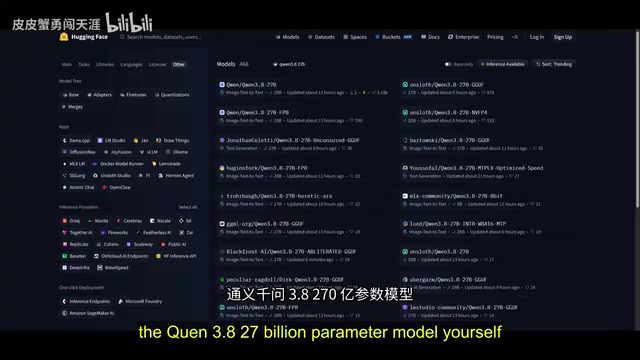
Qwen 3.8 27B runs locally on an RTX 4090 and approaches Claude Opus-level coding performance.
Alibaba's Qwen 3.8 27B is a natively multimodal dense model that runs on consumer GPUs via 4-bit quantization (~17GB). Tested on an RTX 4090, it demonstrated near-Claude Opus performance in Three.js game generation, frontend cloning, SVG creation, and visual reasoning. Released under Apache 2.0 with a 262K native context window, it sets a new standard for open-source local LLMs.
Alibaba's Qwen team has officially open-sourced the model weights for the Qwen 3.8 series, with the 27-billion-parameter dense model drawing the most attention. A YouTube tech creator ran an in-depth test on a local setup with an RTX 4090, and the verdict was remarkably straightforward: this may be the most worthwhile local LLM for everyday users right now. It approaches Claude Opus-level intelligence across multiple coding tasks — and it's completely free to run locally.
A Natively Multimodal Coding Model Breaks Through for Local Deployment
Unlike many large models, Qwen 3.8 27B is not a text-only model — it's a natively multimodal dense model. A "dense model" means all 27 billion parameters participate in every inference pass. This contrasts with MoE (Mixture of Experts) architectures, which may have trillions of total parameters but only activate a small subset of "expert" networks per inference, using a gating mechanism to route inputs to the relevant experts. Dense models have a clear advantage for local deployment: simpler inference logic and better hardware compatibility. MoE models, despite activating fewer parameters during inference, still require loading all weights into memory, which paradoxically demands more from hardware. Despite having only 27 billion parameters, Alibaba claims Qwen 3.8 27B outperforms Qwen 3.7 Plus overall, particularly excelling in real-world coding, agentic tasks, and office workflows.
Another major highlight is its native 262K context window, extendable to 1 million tokens via YaRN technology. YaRN (Yet another RoPE extensioN) is an extension method for Rotary Position Embedding (RoPE), proposed by Bowen Peng et al. in 2023. RoPE is the dominant positional encoding scheme in current mainstream LLMs, embedding positional information into attention computations through rotation matrices. However, the context length used during training is finite, and model performance degrades sharply when inference sequences exceed that training length. YaRN applies differentiated scaling strategies to different frequency components in RoPE (rather than simple linear interpolation), enabling models to extend their effective context length by several times or even orders of magnitude with no retraining or only minimal fine-tuning. This means Qwen 3.8 27B can code, reason, analyze visual information, and process extremely long documents, all while staying compact enough to run on consumer hardware.
More importantly, it's released under the Apache 2.0 license. This is one of the most permissive mainstream licenses in the current AI open-source ecosystem. Unlike more restrictive licenses — such as the community license previously used by Meta's Llama series, which imposed additional restrictions on companies with over 700 million monthly active users — Apache 2.0 allows users to freely use, modify, distribute, and commercialize the model. The only major requirement is preserving the original copyright notice and license text. This means enterprises can directly integrate Qwen 3.8 into commercial products, and research institutions can fine-tune and redistribute it without worrying about licensing disputes. At a time when the definition of "open source" in AI is increasingly blurred, Apache 2.0 represents genuinely open access — and it's a key reason the Qwen series has earned widespread recognition in the open-source community.
Beyond the 27B model, Alibaba also released the much larger Qwen 3.8 2.4-trillion-parameter MoE model as its top-tier open-weight offering. Whether you want a practical small model for local use or are building large-scale agentic systems, the Qwen 3.8 open-source lineup provides comprehensive options.
Runs on Consumer Hardware: Deployment Guide
For most users, the creator recommends the 4-bit quantized version, which compresses the model to roughly 17GB. Quantization is the core technology behind local LLM deployment today: it compresses model weights from high-precision floating point (e.g., 16-bit FP16 or 32-bit FP32) to low-precision representations (e.g., 4-bit INT4). For Qwen 3.8 27B, the FP16 version requires about 54GB of VRAM, while the 4-bit quantized version needs only about 17GB — a roughly two-thirds reduction. This means a single mainstream gaming GPU, or even some laptops and Apple Silicon Macs with sufficient unified memory, can run it. If you have even less VRAM, smaller versions as low as 9GB are available on Hugging Face, though with some quality trade-offs.
In the test, the creator used the Unsloth dynamic 4-bit quantized version running on an RTX 4090 (24GB VRAM), with the model fitting entirely in GPU memory. Unsloth's dynamic quantization scheme assigns different quantization precisions based on each layer's importance — critical layers retain higher precision while redundant layers use lower precision — achieving a better balance between overall size and inference quality. The creator interacted with the model through Open WebUI, an open-source, self-hosted web interface that provides a ChatGPT-like conversational experience. It supports multiple backend inference engines (such as Ollama, llama.cpp, vLLM, etc.), allowing users to interact with locally running models in a browser while keeping all data processed entirely on-premises, without passing through any third-party servers — no API needed, no per-use charges. The maturity of such tools signals that the local LLM ecosystem has evolved from command-line geek tools into a product form accessible to everyday technical users.
Regarding speed, according to data cited by the creator, the model achieves approximately 206 tokens/sec on a single RTX 5090 using the NVFP4 scheme, and about 38 tokens/sec on DGX Spark. NVFP4 is NVIDIA's 4-bit floating-point quantization format, optimized specifically for its latest GPU architectures. It fully leverages the hardware's low-precision compute units to accelerate inference, offering advantages in both speed and accuracy over generic INT4 quantization. For a model that excels at both agentic planning and long-horizon tasks, these local inference speeds are quite impressive. On quantization choices, the creator recommends Q5 (5-bit quantization) as the best balance, noting that Q4 approaches Q8 quality and the difference is negligible in most scenarios.
Real-World Coding Tests: From 3D Games to Frontend Clones
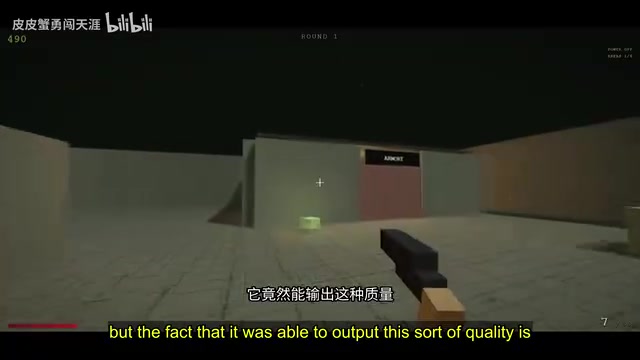
The creator conducted extensive hands-on tests. First, continuing a previous test benchmark from GLM 5.3, a simple prompt asked the model to create a Call of Duty Zombies game using Three.js. Three.js is a WebGL-based JavaScript 3D graphics library created by Ricardo Cabello in 2010. It abstracts the complexity of the low-level WebGL API, enabling developers to create 3D scenes, animations, and interactive applications in the browser with relatively concise code. In LLM coding benchmarks, Three.js has become a de facto standard: it requires the model to simultaneously understand 3D spatial geometry, physics simulation, event handling, resource management, and game logic — several orders of magnitude more difficult than generating ordinary web page code.
The result left the creator quite stunned: the model produced a game with complete functional components, including different weapons, waves of attacking zombies, unlockable areas, mystery box purchase mechanics, and even power-ups like "Instant Kill" from the original game. This demonstrates that the model not only masters the Three.js API but also possesses the comprehensive ability to translate complex game design logic into runnable code.
On the frontend design front, Qwen 3.8 27B shows significant improvement over the previous Qwen 3.6 27B model. The creator tested with a frequently used "NVIDIA GPU landing page" prompt, and the model successfully output a page with 3D design elements, scroll-triggered effects, and animations — though some minor glitches appeared (such as a highlight effect incorrectly covering the entire page).
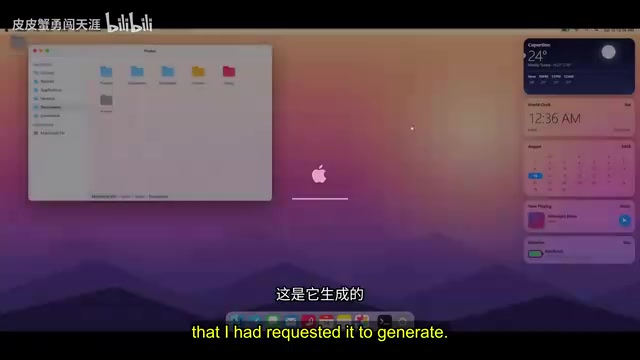
The creator also asked the model to generate a macOS clone interface, reproducing the new Tahoe-style update. Even with the 32K context window limitation imposed by quantization, the model still produced weather widgets with subtle animations, a clock, a schedule, SVG icons for various apps, and even support for background switching and dark mode. However, some features (like the music player, battery indicator, and Finder) weren't fully implemented. The creator speculated this was related to context window constraints — the quantization process reduced the context window from the native 262K to 32K, severely limiting the amount of code the model can generate in a single pass. This is a common trade-off in current local deployments.
Multimodal Capabilities Verified: Visual Understanding and SVG Generation
As a multimodal model, Qwen 3.8 27B can directly process visual input — meaning its architecture integrates a vision encoder (typically based on Vision Transformer), enabling joint processing and reasoning over image and text information within a single model, rather than relying on external vision modules for independent preprocessing as in earlier approaches. The creator tested having the model clone an Airbnb website from a screenshot, and the model successfully reproduced the main structure, top navigation bar, and logo, though SVG details still required multiple iterations to refine.
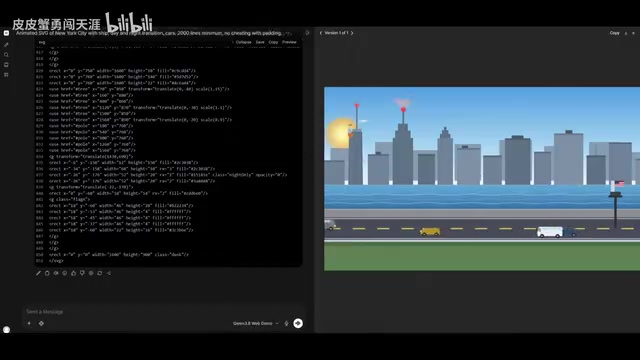
In SVG generation tests, the model demonstrated solid visual depth. SVG (Scalable Vector Graphics) is an XML-based vector graphics format that, unlike bitmaps, defines graphics through mathematical descriptions (paths, shapes, color gradients, etc.), allowing infinite scaling without loss of quality. For LLMs, generating high-quality SVGs requires spatial reasoning ability — understanding relative positions, size proportions, occlusion relationships, and lighting effects, then translating these visual concepts into precise coordinates and path data. Qwen 3.8 27B produced paintings with rich textures; in a simulated New York City scene, cars had headlights, skyscrapers featured aviation safety red lights, and day-to-night transitions were natural — details many models tend to miss. Of course, there were failures too, such as a "flying boat" appearing in one scene, and a mediocre 3D environment in an F1 drift simulation (the creator gave it a 2/10 score).
Notably, in an aquarium simulation test, the model successfully kept all creatures contained within the fish tank environment, while DeepSeek V4 Flash and Gemini both failed on the same prompt with "fish swimming outside the tank" — a seemingly simple spatial constraint that actually serves as a rigorous test of a model's understanding of physical common sense. Additionally, other users have built a complete GTA clone game based on this model, featuring shooting, car theft, police chases, a wanted star system, and sound effects.
Final Verdict: A New Benchmark for Open-Source Local Models
The creator's final assessment was unequivocal: this is the most impressive local model he has ever tested. In many scenarios, it delivers intelligence approaching Claude Opus 4.6, and in some cases reaching 4.8-level performance, spanning coding, agentic reasoning, visual understanding, and instruction following.
To be fair, the creator acknowledged that this model isn't meant to beat frontier closed-source models across the board, and quite a few glitches and failures did appear during testing. But its real value lies here: a model that runs locally on consumer hardware, is free to use, and is open-source and fine-tunable, yet delivers this level of comprehensive capability — that's a rare breakthrough in the local LLM space. The entire local inference toolchain — from model quantization (Unsloth, GGUF format) to inference engines (llama.cpp, vLLM) to interaction interfaces (Open WebUI) — has formed a complete and increasingly mature open-source ecosystem, and Qwen 3.8 27B hits the sweet spot of performance and accessibility within that ecosystem.
For developers and enthusiasts with the right hardware, Qwen 3.8 27B is undoubtedly worth trying. It represents a new equilibrium between accessibility and performance for open-source models, and once again confirms the important position of Alibaba's Qwen series in the open-source ecosystem.
Related articles
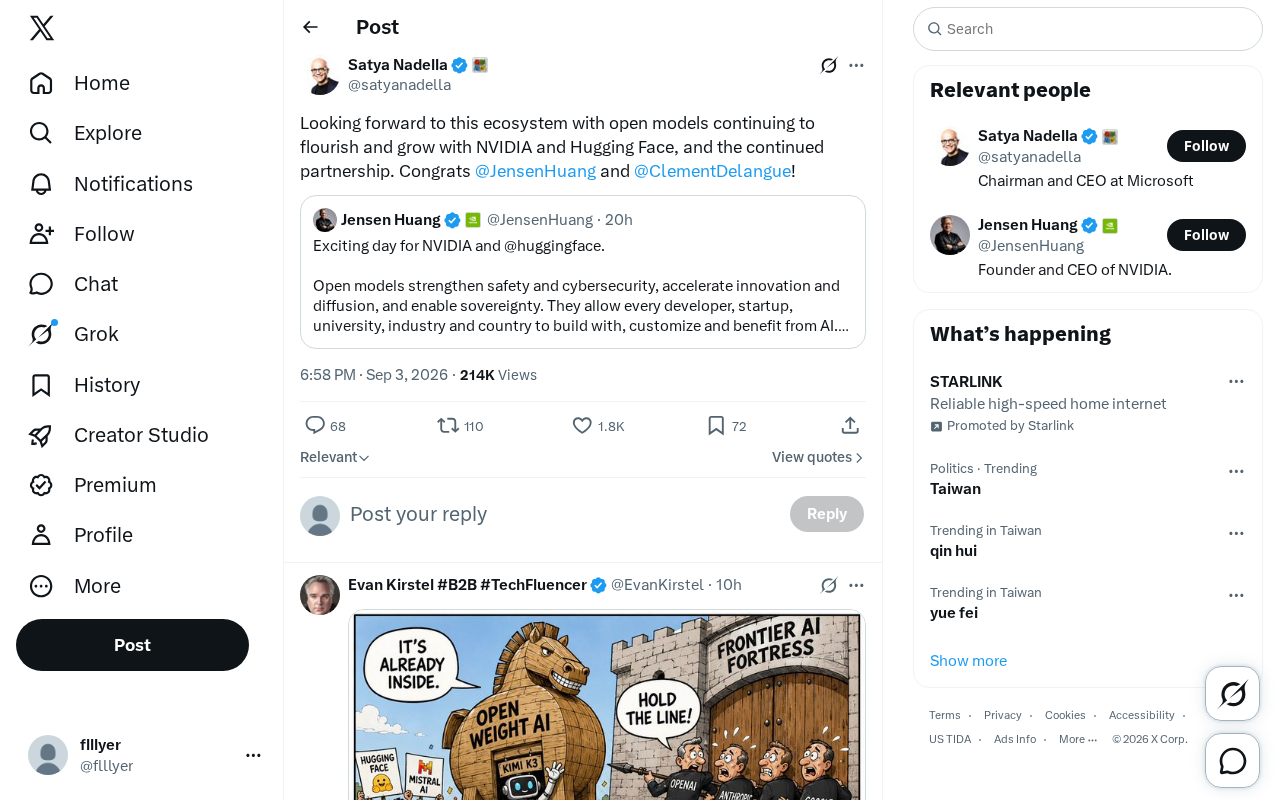
NVIDIA and Hugging Face Deepen Partnership: New Opportunities for the Open-Source AI Ecosystem
NVIDIA and Hugging Face deepen their partnership to boost open-source AI through performance optimization, better toolchains, and ecosystem expansion for developers and enterprises.
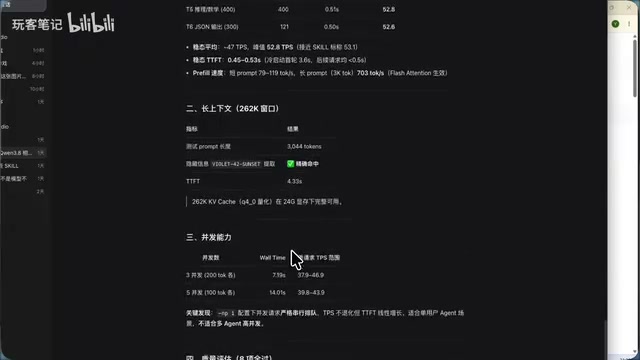
7900XTX Local Deployment of Qwen3 in Practice: 53 TPS Inference Speed Optimization Guide
Complete guide to deploying Qwen3 27B model on AMD RX 7900XTX 24GB: achieve 53 TPS inference through KV Cache Q4 quantization, 262K ultra-long context, and MTP speculative sampling, with installation tutorial and quantization precision comparison.
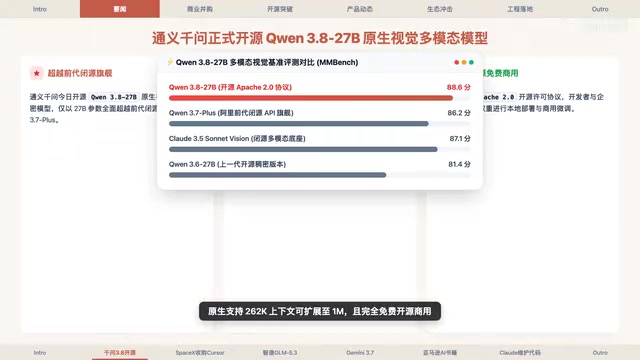
AI Daily Briefing: Alibaba Open-Sources Qwen3.8 Vision Flagship, Zhipu's GLM-5.3 Tops Coding Benchmarks, SpaceX Acquires Cursor
Alibaba open-sources Qwen3.8-27B vision model surpassing its closed-source predecessor; Zhipu GLM-5.3 tops open-source coding with 50% gains; SpaceX acquires Cursor; Google Gemini 3.7 Flash debuts.