Qwen 3.8 27B Released: Analysis of the Strongest Dense Open-Source Model for Local Deployment

Qwen 3.8 27B emerges as the top open-weight dense model for local AI deployment.
Alibaba's Qwen team released Qwen 3.8 27B with open weights, quickly earning recognition as the best locally deployable dense model. The 27B parameter count hits a sweet spot—powerful enough for complex tasks yet fitting on consumer GPUs after 4-bit quantization. The article analyzes dense vs. MoE architectures, quantization techniques, fine-tuning with LoRA/QLoRA, and the model's position in the competitive open-source landscape alongside Llama and Mistral.
Introduction: A New Benchmark for Open-Source LLMs
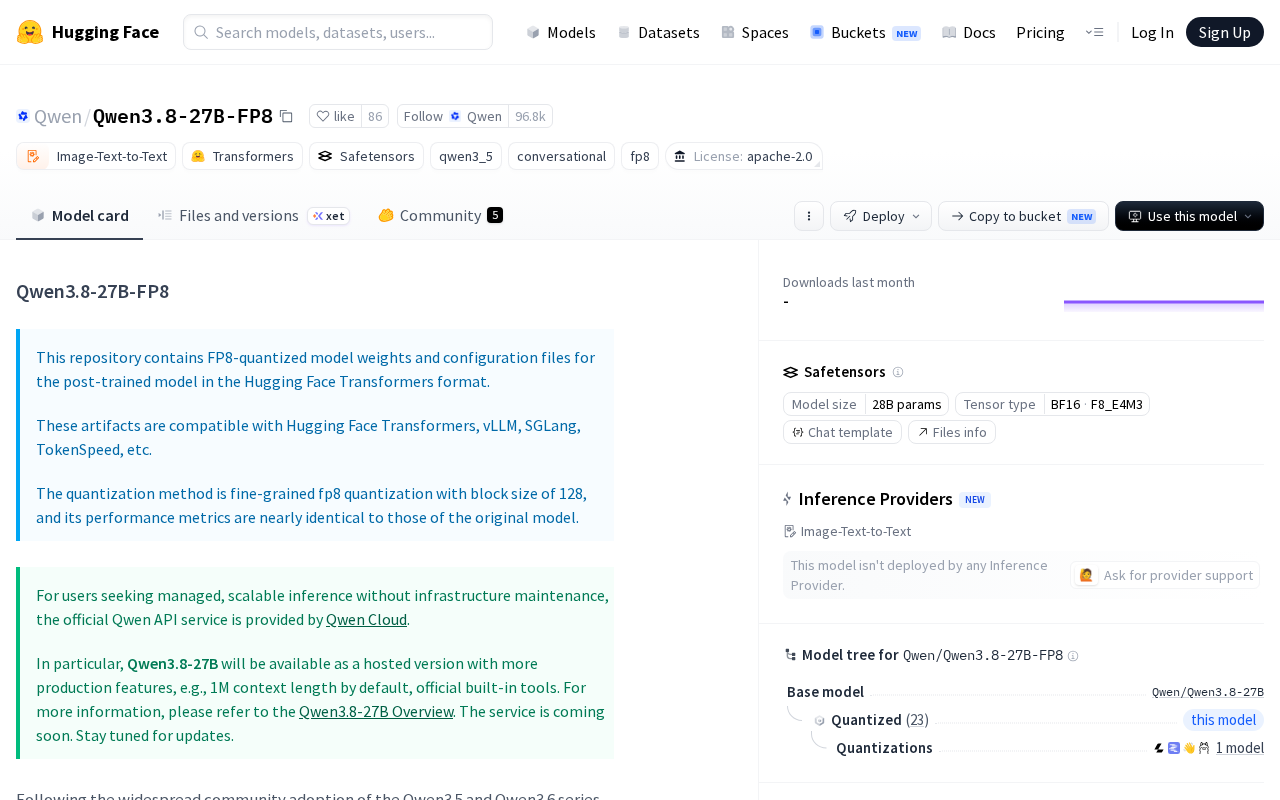
Recently, the Alibaba Qwen team released the Qwen 3.8 27B model with open weights. The news quickly gained traction in the tech community, with many developers calling it "the best locally deployable dense model available today." For practitioners who have been following the open-source LLM ecosystem, this represents not just another parameter iteration, but a further maturation of local AI deployment capabilities.
This article combines community discussions to analyze the model's technical positioning, practical value, and its significance within the current open-source ecosystem.
What Is a Dense Model, and Why Does It Matter for Local Deployment
Before understanding the value of Qwen 3.8 27B, it's necessary to clarify the concept of a "dense model."
Core Differences Between Dense Models and Mixture-of-Experts Models
Current mainstream large model architectures can be broadly divided into two categories:
- Dense Models: All parameters are activated and participate in computation during every inference pass. The structure is relatively simple, behavior is predictable, and deployment and fine-tuning are more straightforward.
- Mixture of Experts (MoE): Only a subset of "expert" sub-networks is activated, thereby reducing per-inference computational cost while maintaining a large total parameter count.
To understand the differences between these two architectures in depth, we need to return to the fundamental structure of current large language models—the Transformer. The Transformer architecture consists of alternating layers of attention mechanisms and feed-forward neural networks (FFN). In dense models, all FFN parameters in every layer participate in computation; in MoE architectures, the FFN layers are replaced with multiple parallel "expert networks," and a gating network dynamically selects only a few of them (typically 2) to activate based on the input. For example, an MoE model with 140B total parameters might only activate about 20-30B parameters per inference pass, achieving computational efficiency close to a smaller dense model, but with more knowledge encoded due to the larger total parameter count. However, the MoE gating mechanism also introduces additional complexity: load balancing between different experts, routing stability, and the issue of some experts potentially being insufficiently trained during fine-tuning all increase engineering difficulty. Dense models, because their computation path is completely consistent every time, exhibit more predictable behavior and simpler debugging, making them particularly suitable for local scenarios that require precise control over model behavior.
Over the past year, the industry has increasingly shifted toward MoE architectures in pursuit of better cost-performance ratios. However, MoE models often face challenges in local deployment, including high VRAM usage (since all expert parameters need to be loaded into VRAM) and complex inference scheduling. Therefore, a high-quality 27B dense model holds unique appeal for local developers—it achieves a good balance between controllability and hardware-friendliness.
Why 27B Parameters Is the Sweet Spot for Local Deployment
27B (27 billion parameters) sits in a particularly practical range. Compared to flagship models with hundreds of billions or even trillions of parameters, a 27B model after quantization (e.g., 4-bit quantization) can typically run on a single consumer-grade or professional GPU. This means small teams, individual developers, and researchers can maintain full control over the model in a local environment without relying on cloud APIs.
Quantization mentioned here is one of the key technologies for local LLM deployment. Models are typically trained using FP32 (32-bit floating point) or BF16 (16-bit brain floating point) to store parameters, while quantization techniques compress these high-precision values into lower bit-width representations (such as INT8 8-bit integers or INT4 4-bit integers), dramatically reducing VRAM usage and computational overhead while preserving inference quality as much as possible. Taking the 27B model as an example, BF16 precision requires approximately 54GB of VRAM, exceeding the capacity of most consumer GPUs; but after 4-bit quantization, VRAM requirements drop to approximately 14-16GB, fitting nicely on mainstream high-end consumer GPUs like the NVIDIA RTX 4090 (24GB) or RTX 3090 (24GB), and even marginally runnable on the 16GB RTX 4080. In contrast, 70B-class models still require approximately 35-40GB of VRAM even after 4-bit quantization, typically necessitating multi-GPU setups or professional GPUs (like the A100 80GB), significantly raising the deployment threshold and cost. Meanwhile, 7B-14B class models, though lighter, often show noticeable gaps compared to 27B in complex reasoning, long-context understanding, and multilingual capabilities. Thus, 27B sits precisely in the sweet spot of "strong enough performance, acceptable hardware requirements."
The Strategic Significance of Open Weights
The most critical aspect of this release is "open weights"—the model weights are fully open.
Data Sovereignty and Flexibility Through Local Deployment
Open weights mean developers can:
- Run the model entirely on their own hardware, keeping data local to satisfy privacy and compliance requirements;
- Fine-tune for specific domains to create specialized models for vertical scenarios;
- Free themselves from dependence on third-party API pricing fluctuations and rate limits.
Regarding fine-tuning, parameter-efficient fine-tuning techniques (PEFT) that have emerged in recent years have significantly lowered the barrier to model customization. The most representative is LoRA (Low-Rank Adaptation): it doesn't modify the model's original weights but instead injects low-rank matrices alongside specific layers for training. The fine-tuning parameters typically account for less than 1% of total model parameters, and training VRAM requirements are dramatically reduced. The more advanced QLoRA technique combines quantization with LoRA, allowing developers to fine-tune on top of quantized models, making it possible to adapt a 27B model for specific domains on a single consumer GPU with 24GB VRAM. This is an extremely practical capability for small teams looking to build specialized AI for vertical scenarios such as medical consultation, legal advisory, or code generation.
For data-sensitive industries like finance, healthcare, and government, locally deployable high-quality models are often more attractive than cloud services that may perform slightly better but require data uploads. This demand comes not only from competitive business considerations but also from clear regulatory drivers. The EU's General Data Protection Regulation (GDPR) imposes strict restrictions on cross-border transfer of personal data, and China's Data Security Law and Personal Information Protection Law similarly set explicit requirements for data export. Under these regulatory frameworks, sending sensitive data to third-party cloud APIs may pose compliance risks, while locally deployed open-weight models architecturally eliminate the possibility of data leakage, providing inherent compliance guarantees.
Qwen Series' Open-Source Roadmap
The Qwen series has been consistently pushing forward in the open-source space in recent years, gradually building its reputation in the open-source community from early versions to the current 3.x series. Looking back at its development: Qwen 1.0 was first open-sourced in August 2023, offering 7B and 14B sizes; Qwen 1.5 launched in early 2024, significantly expanding parameter specifications (from 0.5B to 110B) and notably improving multilingual capabilities and conversation quality; Qwen 2 series further optimized architecture and training data, introducing efficiency improvements like GQA (Grouped Query Attention); and the Qwen 3.x series continues to iterate on this foundation, with the 3.8 27B being an important version targeting local deployment scenarios.
In the global open-source LLM landscape, the Qwen series forms a three-way competition with Meta's Llama series (represented by Llama 3.1's 8B/70B/405B) and Mistral AI's Mistral/Mixtral series. The Llama series dominates English-language scenarios through Meta's resource advantages and broad community ecosystem; Mistral gains recognition through elegant model design and unique European market positioning; while the Qwen series holds significant advantages in Chinese language capabilities and cost-performance at medium parameter scales. The community's assessment of Qwen 3.8 27B as "the best local dense model to date" partially validates this differentiated approach and indicates that open-source LLM competition has shifted from pure parameter scale races toward more specialized scenario adaptation.
Community Response and Rational Assessment
Based on Hacker News discussions, this news received moderate attention (13 upvotes, 2 comments), with a steady rather than explosive response. This also reminds us to view such releases with a rational perspective.
The "Best" Label Needs Benchmark Validation
The claim of "best locally deployable dense model" carries some subjectivity. A model's true capabilities need repeated verification through standard benchmarks (such as MMLU, HumanEval, mathematical reasoning) and real-world usage. Performance may vary across different tasks and language environments. When selecting models, developers should conduct their own testing based on their specific scenarios rather than relying solely on release announcements.
It's worth elaborating on several common benchmarks and their evaluation dimensions. MMLU (Massive Multitask Language Understanding) covers multiple-choice questions across 57 subjects spanning humanities, social sciences, and STEM, designed to measure a model's broad knowledge base and comprehension ability—it's one of the most commonly cited metrics for evaluating general intelligence. HumanEval, proposed by OpenAI, contains 164 Python programming problems used to evaluate code generation capabilities, requiring models to not only write syntactically correct code but also pass functional test cases. For mathematical reasoning, GSM8K (elementary math word problems) and MATH (high school to competition-level math problems) are two commonly used benchmarks that test multi-step reasoning and numerical computation abilities. However, benchmarks themselves have limitations: models may have encountered test questions in their training data (data contamination), or perform excellently on specific benchmarks while falling short on actual open-ended tasks. Therefore, the industry increasingly emphasizes combining benchmark scores with real user scenario "vibes checks" (subjective experience evaluations) to obtain comprehensive assessments of model capabilities.
Inference Ecosystem and Toolchain Are Equally Critical
Whether a model can truly be deployed in practice depends not only on performance itself but also on its supporting ecosystem: whether mature inference frameworks support it (such as vLLM, llama.cpp, Ollama), whether quantization solutions are complete, and whether community documentation and fine-tuning tools are comprehensive. The Qwen series has already built good foundations in these areas, which is an important reason why it can be rapidly adopted by local developers.
Understanding the positioning of these inference frameworks helps grasp the full picture of local deployment. vLLM is a high-performance inference engine designed specifically for large language models, with its core innovation being PagedAttention technology, which manages KV Cache through a mechanism similar to operating system virtual memory paging, dramatically improving VRAM utilization and throughput—particularly suited for production environments serving multiple users simultaneously. llama.cpp takes a different approach—it's a pure C/C++ inference framework that can run large language models on CPU without GPU dependencies (though it also supports GPU acceleration). Its GGUF quantization format has become the de facto standard for local deployment, making it extremely friendly for individual developers with limited hardware. Ollama provides a more user-friendly wrapper on top of llama.cpp, allowing users to download, run, and manage various open-source models through simple command-line operations—similar to what Docker does for containerized deployment—greatly lowering the entry barrier. Additionally, the Hugging Face Transformers library and quantization tools like GPTQ/AWQ also constitute indispensable ecosystem components. The Qwen series' broad compatibility with these mainstream frameworks and formats is the key technical foundation enabling rapid community adoption after release.
Conclusion: The Ongoing Evolution of Local AI Deployment
The release of Qwen 3.8 27B is a microcosm of the ongoing evolution of the open-source LLM ecosystem. While cloud-based large model capabilities continue to advance, locally deployable, controllable, and fine-tunable models are also making steady progress, providing diverse options for users with different needs.
For developers pursuing data sovereignty and cost control, high-quality dense models at the 27B level are gradually becoming an option worth serious evaluation. In the future, as hardware costs decline and quantization techniques mature, the barrier to local AI will continue to lower—something worth our continued attention.
Related articles

Trump's Request to Rename the Atlantic Rejected by Google; 1Password Lets AI Agents Log In Securely
The Vergecast roundup: Trump's request to rename the Atlantic the 'Trump Ocean' was politely declined by Google's CEO; 1Password's new feature lets AI agents log into accounts without touching passwords; OPPO launches the world's first 200-megapixel phone, the Find X10 Pro Max. All three point to the boundaries of tech authorization and trust.

The Truth About American College Party Culture: The Risks Schools Won't Admit
Behind American college party culture, the administration's "don't ask, don't tell" attitude is amplifying freshman risks. This article analyzes how the pandemic strengthened Greek dominance, freshmen's difficulty accessing safety information, and the chain reactions caused by a culture of denial.

OpenAI Reportedly Raising $30B at $1.25T Valuation Ahead of IPO
OpenAI is planning a $30B funding round at a possible $1.25T valuation, paving the way for an IPO. If completed, it would set a private company valuation record. This article analyzes the funding size, pre-IPO logic, and industry signals.