Qwen Image 2.1 Face-Swap LoRA in Practice: A First Look at bestfaceswap
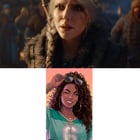
A Qwen Image 2.1 LoRA that swaps faces across images using plain natural-language instructions.
bestfaceswap is a face-swap LoRA shared on Reddit, built on Qwen Image 2.1. It uses a "reference image + target image + natural language instruction" multi-image input paradigm to perform head and face replacement without manual keypoint alignment. The LoRA fine-tuning approach keeps the model lightweight and training costs low while preserving the base model's semantic understanding — theoretically improving lighting, skin tone, and hairline blending. However, only a model name and a single example prompt are publicly available, so real-world quality, stability, and use cases still need further testing. Deepfake-related portrait rights and compliance risks also apply.
What Is the Qwen Image Face-Swap LoRA
A face-swap LoRA model built on Qwen Image 2.1 has recently surfaced in the Reddit community. Its author named it bestfaceswap (abbreviated bfs). The core purpose of this type of model is to replace the face or head of a person in one image with that of a person in another — a long-standing, high-demand use case in the image editing and generation space.
Based on the original post, the invocation logic the author demonstrated is remarkably straightforward: a single natural-language instruction such as "Swap the woman's head in <image1> with the woman in <image2>" is enough for the model to perform the head swap between two images. This interaction style — text-instruction-driven, multi-image input — is precisely what sets multimodal generative models like Qwen Image apart from traditional face-swap tools.
It's worth noting that the source material for this article is limited, consisting mainly of the model name, version, and a single example prompt. This piece is therefore more of a contextual overview of the tool's positioning and technical background than a comprehensive performance evaluation.
The Technical Context Behind LoRA-Based Face Swapping
Why LoRA Instead of Full Fine-Tuning
LoRA (Low-Rank Adaptation) is one of the most widely used methods in the community for extending the capabilities of diffusion models. Compared to full fine-tuning of an entire base model, LoRA only trains a small set of low-rank weight matrices, resulting in file sizes typically ranging from tens to hundreds of MB — with dramatically lower training costs and VRAM requirements. This is precisely why task-specific capabilities like face swapping are often released as LoRA adapters rather than as entirely new models.
LoRA works by introducing the product of two small matrices alongside the original weight matrix to approximate weight updates. Because the "rank" of these two matrices is far lower than the original dimensionality, parameter count can be compressed to roughly 0.1%–1% of the base model. For a task like face swapping, the required capability isn't learned from scratch — it's a fine-grained refinement on top of the base model's existing face-understanding ability. That's exactly the scenario where LoRA excels: injecting specific behaviors with minimal data and compute, without degrading the model's general capabilities. The large number of style, character, and action LoRAs in the community all follow the same logic; bestfaceswap simply redirects the target task from "style transfer" to "face replacement."
Why Qwen Image as the Base Model Matters
Qwen Image 2.1 as a base model brings strong vision-language understanding and image generation capabilities to the table. Stacking a face-swap LoRA on top of it theoretically allows the system to better interpret semantic instructions like "whose face" and "onto which image" compared to traditional GAN-based face-swap tools — while maintaining overall visual coherence, including lighting, skin tone transitions, and hairline blending.
The Qwen Image series is the multimodal branch of Alibaba's Qwen large model family. Its 2.x versions deeply integrate visual understanding and image generation into a unified pipeline. Unlike earlier vision-language models that could only "describe images," Qwen Image 2.1 can feed its understanding results directly back into the generation side, completing both "identify the person in the image" and "redraw that person in a new image" within a single forward pass. This unified architecture is what makes LoRA-based face swapping operable via plain text instructions — the model has already established correspondences between facial features and spatial positions during pretraining, and the LoRA only needs to further reinforce the cross-image transfer behavior.
Multi-Image Editing via Natural Language Instructions
The <image1> and <image2> placeholders in the original example indicate that the workflow supports multi-image input with text-described editing intent. This "reference image + target image + natural language instruction" paradigm is far more aligned with the expectations of modern generative tools than the manual selection and keypoint alignment required by traditional face-swap software.

Practical Considerations When Using It
Beyond output quality, face-swap models come with several unavoidable real-world concerns.
On the quality side, the most common failure points in head replacement are edge blending, skin tone mismatches, hairline artifacts, and inconsistent lighting direction. A LoRA built on a strong base model has a potential advantage on these details, but actual performance still needs to be validated across different resolutions and shooting angles. A single example prompt isn't enough to draw conclusions.
On the compliance side, face-swap technology inherently touches on portrait rights, deepfakes, and privacy risks. When using models of this kind, you should ensure proper authorization from the person whose likeness is being replaced and avoid generating misleading or infringing content. These are boundaries the community needs to consistently emphasize when sharing such tools.
The term deepfake originated around 2017 from community experiments using GAN technology to synthesize celebrity faces, and has since become the umbrella term for all techniques that replace or composite real human faces onto another person's body or video. Multiple jurisdictions have already enacted legislation targeting unauthorized deepfake content. For example, the EU AI Act classifies face-swap generative output as high-risk content requiring mandatory disclosure, and some regions carry criminal provisions for deepfakes created with intent to deceive or harm. Even test-level usage involving the faces of real public figures carries portrait rights dispute risks. Both developers and users should familiarize themselves with the relevant regulations in their jurisdiction before proceeding.
Conclusion
bestfaceswap represents the continued evolution of face-swap capability toward a "large model + LoRA extension" approach: using lightweight fine-tuning to graft a specialized task onto a powerful multimodal base, with natural language instructions lowering the barrier to entry. For users interested in generative image editing, it's worth tracking as a new option to test. That said, given the limited information currently available, the true face-swap quality, stability, and applicable scenarios still require more real-world testing before any firm conclusions can be drawn.
Related articles

Gemini 4 Argon Hands-On: AI Builds Board Games, Constructs Temples, and Trains Robots Autonomously
Gemini 4 Argon hands-on roundup: AI autonomously builds a desk racetrack and temple in Blender, writes a ray tracing engine, trains a humanoid robot to sink 7 shots, plus API pricing and developer access.

The Magic Octagonal Coin: Why Only 9% of People Can Predict Its Flip?
Only 9% of people can correctly predict the Magic Octagon coin flip. This article explains its spatial rotation mechanism, common cognitive pitfalls, and a new hypothesis based on Relevance Theory, exploring the limits of human spatial reasoning.

Sam Altman: AI Is Entering the Era of Scientific Discovery — Math Breakthroughs Will Replicate in Biology and Energy
Sam Altman says AI is entering the era of scientific discovery — math breakthroughs will replicate in biology, materials science, and energy to help develop new drugs and energy sources.