Qwen3-27B Arrives on Nebius: How Dense Models Serve Agentic Development

Alibaba's 27B dense model Qwen3-27B launches on Nebius, targeting agent building and multi-step workflows.
Alibaba's Qwen3-27B, a 27-billion-parameter dense model, is now accessible via API through the Nebius cloud platform. Unlike the MoE sparse architectures popular among frontier models, Qwen3-27B activates all its parameters at inference time, delivering more predictable behavior and more stable fine-tuning. Alibaba positions it for agent building and deep research — scenarios that demand strong logical consistency and context tracking across multiple steps. Its 27B parameter scale balances capability and deployment cost, while cloud hosting on Nebius lowers the barrier to entry. Key details like benchmarks, context window length, and pricing have yet to be published.
Qwen3-27B Goes Live on Nebius
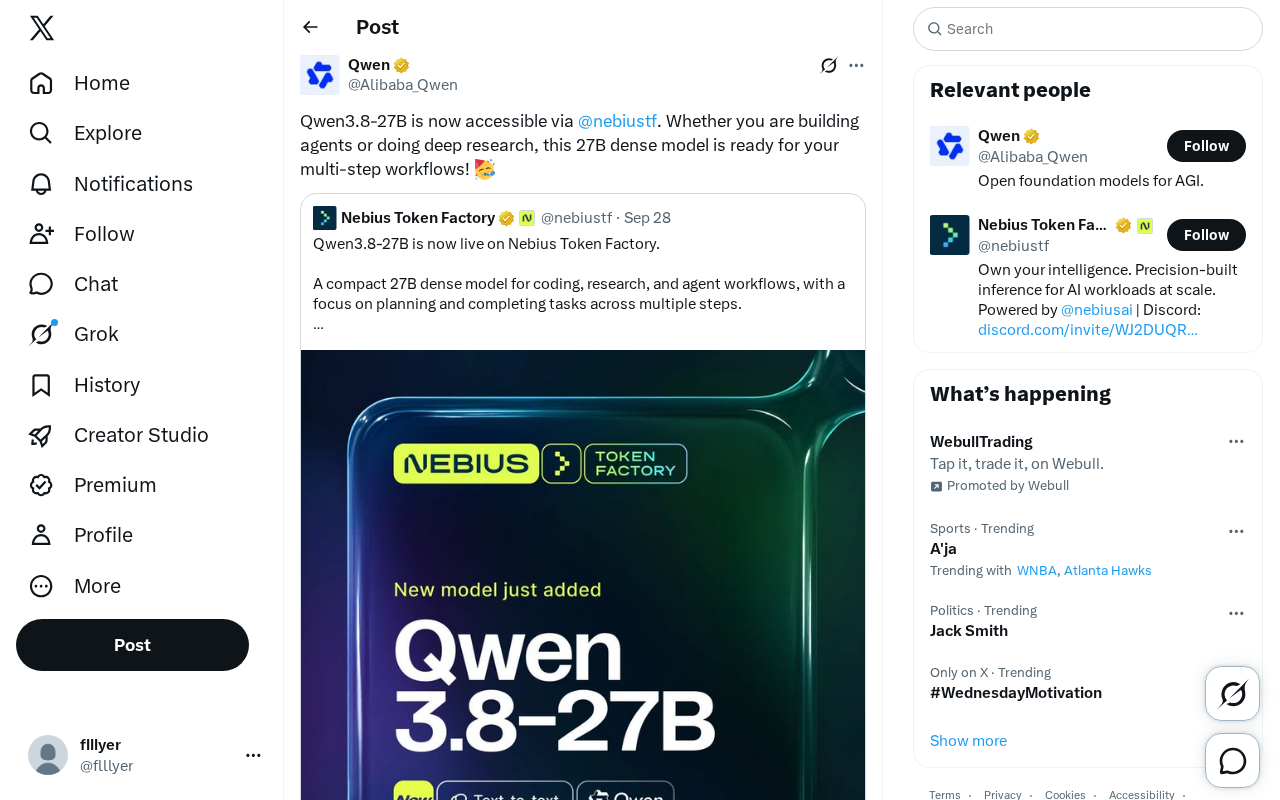
Qwen3-27B, the latest addition to Alibaba's Qwen model family, is now available through the Nebius platform. According to the official announcement, this is a 27-billion-parameter dense model positioned as a productivity tool for agent building and deep research use cases, with particular emphasis on multi-step workflow support.
For developers evaluating mid-to-large open-source models, this is worth paying attention to. The 27B parameter count occupies a nuanced middle ground — it offers stronger reasoning and long-chain task capabilities than lightweight 7B or 8B models, while avoiding the steep deployment costs associated with 70B+ giants. This positioning makes it a compelling candidate for teams seeking a balance between capability and cost.
What Dense Architecture Actually Means
Many frontier models have shifted toward MoE (Mixture of Experts) architectures, using sparse activation to reduce inference overhead. Qwen3-27B continues down the dense path, meaning all of the model's parameters participate in every inference pass.
The advantage of a dense architecture is more predictable behavior, more straightforward fine-tuning, and generally more stable performance when adapting to specific domains. For agentic systems that require fine-grained control over model behavior, this predictability often matters more than peak benchmark performance. The tradeoff is that compute requirements are relatively fixed at inference time — unlike MoE, there's no sparse activation to save on computation.
Alibaba has explicitly recommended this model for two audiences: "building agents" and "deep research." Both scenarios depend heavily on the model maintaining logical consistency and context tracking across multiple rounds of interaction — exactly where dense models tend to shine.
A note on MoE architecture: MoE works by splitting a model into multiple "expert" sub-networks, activating only a small subset of them for any given input while the rest remain dormant. This means a nominally large MoE model may only activate a fraction of its parameters per inference pass — sometimes as little as 1/4 of the total — dramatically reducing compute costs. Notable examples include Mixtral 8x7B (which activates roughly 13B parameters) and DeepSeekAd-V3 (671B total, ~37B activated). The tradeoff is greater training complexity, harder load balancing, and less behavioral stability in certain fine-tuning scenarios compared to dense models. Understanding this context helps clarify the engineering tradeoffs behind Qwen3-27B's decision to stay dense.
The Value of Multi-Step Workflow Readiness
The announcement specifically highlights readiness for "multi-step workflows." This points directly to a core pain point in modern AI application development: single-turn Q&A is no longer sufficient for complex use cases. Genuinely useful applications increasingly require a model to plan tasks, invoke tools, evaluate intermediate results, and dynamically adjust its strategy.
In these chained tasks, any mistake at a single step can cascade through subsequent steps and cause the entire pipeline to collapse. A model's reasoning stability, instruction-following accuracy, and coherent understanding of context directly determine whether an agentic application is actually usable. Qwen3-27B's positioning toward this scenario reflects a broader industry shift — from "stronger single-point capability" toward "more reliable process execution."
What Nebius Access Means
Making the model available through a cloud platform like Nebius lowers the barrier to entry for developers. Users don't need to provision their own GPU clusters or deal with complex deployment operations — they can call the model directly via API for prototyping and production integration.
For teams looking to quickly evaluate the model's capabilities, this kind of instant-on access significantly shortens the cycle from idea to validation. Cloud hosting also allows teams of all sizes to pay as they go, without upfront infrastructure investment.
About Nebius: Nebius is a cloud computing company that emerged from Russian internet giant Yandex, completing an independent spin-off in 2023 to focus on AI infrastructure services, primarily targeting European and international developer markets. Its core business is GPU compute rental and API hosting for popular open-source models — similar in positioning to Together AI and Replicate — aimed at giving teams without their own compute clusters access to production-grade models. For the Qwen model family, launching on Nebius also means gaining a formal cloud access channel for the international developer community outside mainland China, reducing friction around compliance and network access for global users.
Watch Closely or Wait and See?
It's worth noting that publicly available information is still limited. The official announcement covers model positioning and availability, but hasn't yet included detailed benchmark results, context window length, pricing, or other key parameters. How it actually performs relative to comparable models on real-world tasks remains to be seen — either through more comprehensive evaluations or hands-on testing.
For developers choosing a foundation model for an agentic project, Qwen3-27B is another option worth adding to the comparison list. Dense architecture + mid-to-large parameter scale + a clear focus on multi-step workflows add up to a well-defined product profile. Whether it fits your specific needs ultimately comes down to how it performs in your actual workflows.
Related articles

Gemini 4 Argon Hands-On: AI Builds Board Games, Constructs Temples, and Trains Robots Autonomously
Gemini 4 Argon hands-on roundup: AI autonomously builds a desk racetrack and temple in Blender, writes a ray tracing engine, trains a humanoid robot to sink 7 shots, plus API pricing and developer access.

The Magic Octagonal Coin: Why Only 9% of People Can Predict Its Flip?
Only 9% of people can correctly predict the Magic Octagon coin flip. This article explains its spatial rotation mechanism, common cognitive pitfalls, and a new hypothesis based on Relevance Theory, exploring the limits of human spatial reasoning.

Sam Altman: AI Is Entering the Era of Scientific Discovery — Math Breakthroughs Will Replicate in Biology and Energy
Sam Altman says AI is entering the era of scientific discovery — math breakthroughs will replicate in biology, materials science, and energy to help develop new drugs and energy sources.