Qwen3.5-Omni Released: SOTA on 215 Tasks, Alibaba's Omni-Modal Model Takes on Gemini Head-On

Alibaba releases Qwen3.5-Omni omni-modal model, achieving SOTA on 215 tasks and systematically surpassing Gemini 3.1 Pro.
Alibaba released its next-generation omni-modal model Qwen3.5-Omni, featuring a hybrid attention MOE architecture and native multimodal pretraining on over 100 million hours of audio-visual data. It achieved SOTA on 215 tasks, systematically surpassing Google's Gemini 3.1 Pro on multiple metrics. The model demonstrates breakthrough commercial capabilities including audio-visual Web Coding (generating code from sketches and voice) and second-level analysis of long audio and video content.
Overview: A Complete Evolution of the LLM's Sensory System
Alibaba has officially released its next-generation omni-modal model, Qwen3.5-Omni. This isn't a simple version iteration — it's a complete evolution of the large model's sensory system. The model adopts a hybrid attention MOE architecture, one of the most important efficiency breakthroughs in the current LLM landscape. MOE (Mixture of Experts) introduces a "gating network" that activates only a small subset of "expert" sub-networks for each input token, dramatically reducing per-inference computation while maintaining a massive total parameter count. The hybrid attention mechanism flexibly switches between global and local attention across different layers, enabling the model to capture long-range semantic dependencies while efficiently handling heterogeneous requirements such as spatial locality in images and temporal continuity in audio.
Based on over 100 million hours of audio-visual data, Qwen3.5-Omni underwent native multimodal pretraining. This is fundamentally different from earlier "perception module + language model" cascading approaches: first-generation multimodal solutions fed output vectors from visual or audio encoders directly into a language model, with cross-modal semantic alignment happening at inference time — the model never truly "saw" a multimodal world during pretraining. Native multimodal pretraining mixes images, audio, video, and text from the data construction phase, allowing the model to form a unified cross-modal representation space and develop genuine cross-modal reasoning capabilities — for example, simultaneously inferring emotional states from a person's facial expressions and tone changes in a video, rather than processing them separately and doing simple addition.

Across 215 tasks in audio-visual understanding, interaction, and more, Qwen3.5-Omni achieved SOTA (State of the Art) results, with multiple key metrics surpassing Google's Gemini 3.1 Pro. This means Chinese-developed large models now have the capability to compete head-to-head with the world's top players in omni-modal abilities.
Performance Benchmarks: SOTA on 215 Tasks, Systematically Surpassing Gemini 3.1 Pro
Based on the published benchmark data, Qwen3.5-Omni demonstrates strong competitiveness across multiple dimensions. Compared to previous versions, the new model shows significant improvements in three core directions: visual understanding, audio processing, and cross-modal reasoning.
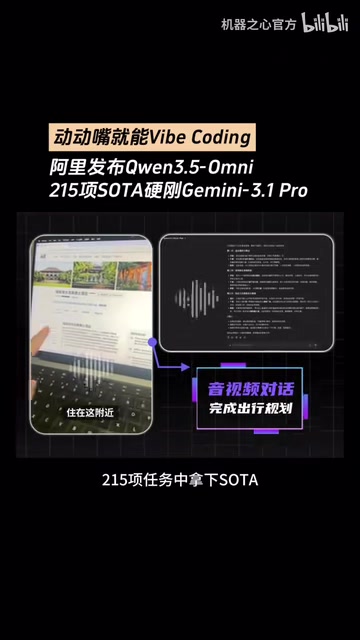
It's worth noting that the SOTA evaluation system in the multimodal domain is far more complex than for pure language models, typically covering dozens of subtasks including Visual Question Answering (VQA), Optical Character Recognition (OCR), video caption generation, speech recognition Word Error Rate (WER), and sentiment analysis. Achieving SOTA on 215 tasks means Qwen3.5-Omni maintains comprehensive leadership across a highly diversified evaluation matrix — fundamentally different from "benchmark gaming," which typically involves targeted optimization on a few high-weight metrics while neglecting balance across other dimensions. The claim of "surpassing Gemini 3.1 Pro" here isn't about winning on a single metric, but systematic leadership across multiple key evaluations, indicating that Qwen3.5-Omni's architectural design and training strategy possess structural advantages in omni-modal scenarios rather than relying on a single breakthrough to game the benchmarks.
Commercial Applications: A Capability Leap from Chat Boxes to Audio-Visual Interaction
Audio-Visual Web Coding: Draw a Sketch, Speak Your Requirements, Get Code
The most exciting aspect is the commercial deployment capabilities that have emerged in Qwen3.5-Omni. Take audio-visual Web Coding as an example: users don't need to write any prompts — they simply hold up a sketch to the camera and speak their requirements, and the model autonomously generates complex app or webpage code.
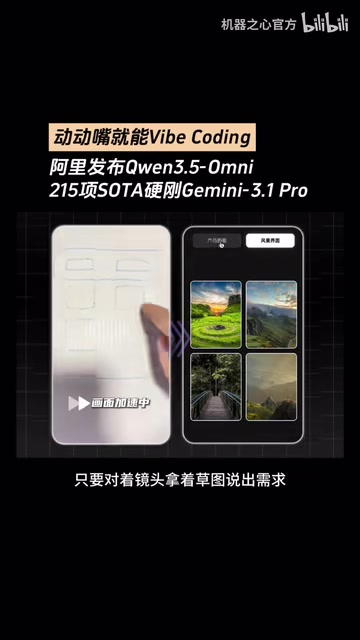
The technical challenge here lies in "intent alignment": a rectangle in a sketch could be a button, an input field, or a card container. The model needs to leverage contextual semantics from the voice description for disambiguation while fusing visual spatial information (layout, UI component types) with voice semantic information (functional requirements, interaction logic) and mapping them to code generation tasks. This requires powerful vision-language-code tri-modal alignment capabilities and deep understanding of mainstream frontend frameworks. The transformative significance of this interaction paradigm is profound — it advances AI programming from "describing requirements in text" to "expressing requirements through audio-visual multimodality," signaling that "natural language programming" is evolving toward "multimodal intent programming." For non-technical users, being able to draw a sketch and say a few words to generate usable code dramatically lowers the barrier to software development.
Long Audio Analysis and Video Understanding: Processing 10 Hours of Content in Seconds
Qwen3.5-Omni can also perform detailed analysis of audio up to 10 hours long, even interpreting character relationships and emotional arcs in videos, reducing tedious video post-production work to seconds.
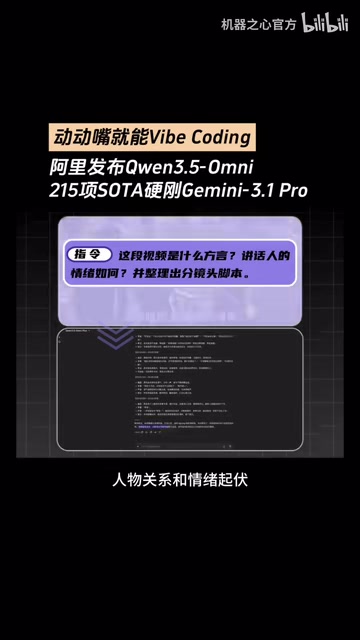
Processing 10-hour audio is an extremely challenging task for large models, with the core difficulty lying in "long context modeling
Related articles
 Tech Frontiers
A Rare Quiet Day in AI: Recursive Self-Improvement Stirs Beneath the Surface
A rare quiet day in AI sees multiple sources go silent simultaneously. Behind the calm, Recursive Self-Improvement (RSI) research continues. What this means for the industry.
 Tech Frontiers
Reve 2 vs. Ideogram 4: A Deep Dive into Layout Control in AI Image Generation
A deep comparison of Reve 2 and Ideogram 4's layout control capabilities, covering technical approaches, real-world use cases, and industry trends for designers and creators.
 Tech Frontiers
In the Weights: Check Your Influence Score in the AI World
In the Weights is an AI influence search engine that quantifies your presence in the AI world with a score. Explore how it evaluates practitioners and what it means for digital identity.