Qwen3.8-27B Local Deployment Tested: Can a 27B Model Really Rival Claude Opus?
Qwen3.8-27B tested locally: a 27B model approaching Claude Opus-level coding on consumer hardware.
A hands-on test of Alibaba's Qwen3.8-27B shows this 27B dense model matching or exceeding Claude Opus 4.6 on key coding benchmarks like SWE-Bench Pro, while running on a single RTX 3090. The article covers benchmark analysis, deployment via llama.cpp with Codex assistance, and a real-world reverse engineering demo using an uncensored community version.
A Top-Tier Coding Model That Fits on Your Own Computer?
When a 27-billion-parameter open-source model that runs directly on a personal computer scores higher than Claude Opus 4.6 on Alibaba's published coding benchmarks, your first reaction might be: is this just another benchmark marketing stunt?
That's exactly the starting point of this hands-on test by a Bilibili creator. Rather than stopping at leaderboard numbers, they downloaded the model locally, chose a community-made uncensored version, and used a cloud-based Coding Agent (Codex) to handle the entire deployment process. They then ran a real-world software license analysis and crack demonstration (in an authorized test environment).
The real question worth asking is: what can a 27B model running entirely locally — no cloud API, no per-token billing — actually accomplish? That's far more interesting than raw benchmark numbers.
Qwen3.8-27B Benchmark Comparison: 27B Begins Touching Top-Tier Closed-Source Territory
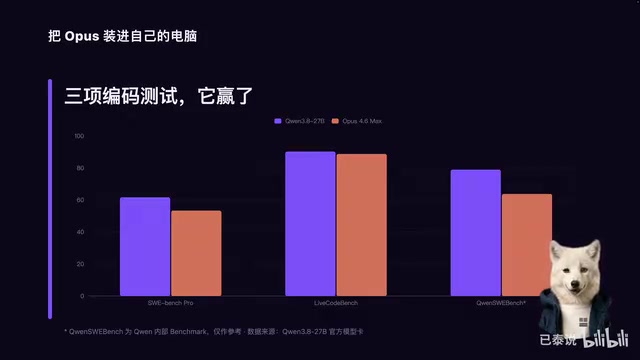
Let's look at some key numbers. On SWE-Bench Pro, a test that requires understanding real codebases, locating bugs, and modifying code:
- Qwen3.8-27B: 61.7
- Claude Opus 4.6: 53.4
SWE-Bench Pro was released by a Princeton University research team. Its core approach extracts historical bug fix records from real GitHub open-source projects and asks models to locate problems and submit patches within a complete codebase environment. Unlike traditional single-function programming problems, SWE-Bench requires models to understand project architecture, cross-file dependencies, testing frameworks, and other engineering-level complexities — which is why the industry considers it one of the most practically relevant third-party benchmarks for measuring AI coding agent capabilities. Qwen3.8-27B's performance on this test is particularly noteworthy because it means a locally deployable model can already handle reasonably complex real-world engineering tasks.
On Live Code Bench, which leans more toward practical programming, Qwen3.8-27B scored 90.3 versus Opus 4.6's 88.8 — again slightly higher.
To be fair, another test called Qwen SWE-Bench (79 vs 63.8) is Alibaba's own internal benchmark and can't serve as third-party evidence. But taken together, these numbers reveal a clear trend: a downloadable 27B model has entered the discussion range of Opus-tier models on certain coding and agent tasks.
This is why the international local LLM community quickly coined an exaggerated label — "Local Opus 4.6" — meaning you can put Opus-level capability inside your own computer.
But Qwen3.8-27B Doesn't Comprehensively Surpass Claude Opus
Marketing is marketing; facts need balanced presentation. Looking further, Qwen3.8-27B doesn't dominate across the board:
- Terminal Bench (continuous complex terminal tasks): 73 vs 78.2 — Opus is stronger
- GPQA Diamond (reasoning): 89.2 vs 91.3 — Opus is stronger
- HLE (Humanity's Last Exam): 30.8 vs 40 — a significant gap
So the claim of "comprehensively surpassing Opus 4.6" doesn't hold up. HLE (Humanity's Last Exam) is an extremely difficult test with questions created by top experts across multiple fields — covering cutting-edge problems in mathematics, physics, biology, philosophy, and more — designed to push models to their limits on the hardest knowledge reasoning tasks. The 30.8 vs 40 gap shows that in the deepest general reasoning capabilities, Qwen3.8-27B still has a perceptible distance from top-tier closed-source models.
The Real Story: Capability Density and the AI Agent Direction
Why does the 27B parameter scale deserve special attention? Because Qwen3.8-27B is a dense model — every single one of its 27 billion parameters participates in computation for each generated token, unlike MoE models that have massive total parameters but only activate a small subset each time. This means its "capability density" is extremely high.
To understand this, you need to distinguish between two mainstream architectures. A Dense Model activates all parameters during every inference — every layer, every neuron is working. A Mixture of Experts (MoE) model may have total parameters in the hundreds of billions or even over a trillion, but each inference only activates a small subset of "expert" sub-networks — for example, DeepSeek-V3 has 671 billion total parameters but only activates about 37 billion per inference. MoE's advantage is achieving large-model expressiveness at lower computational cost, but its large total parameter count means bigger model files and higher VRAM usage. By contrast, a 27B dense model has smaller files and lower deployment barriers, but demands that every parameter "earns its keep" — this is the core meaning of the "capability density" concept.
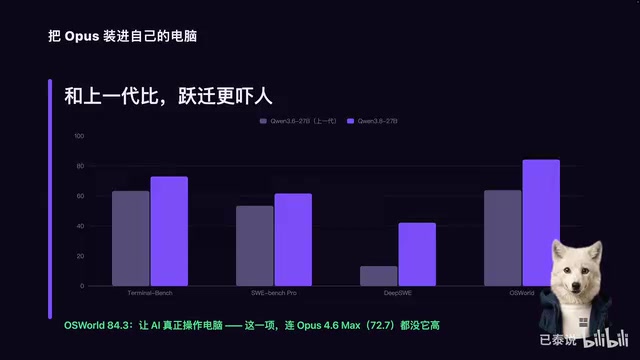
Comparing with the previous generation Qwen3.6-27B makes the improvement even clearer:
- Terminal Bench: 63.4 → 73
- SWE-Bench Pro: 53.5 → 61.7
- Deep SWE (software engineering agent): 13.3 → 42.2 — nearly a 3x improvement
- OS World (computer operation): 63.9 → 84.3 — even surpassing Opus 4.6's 72.7 in the official comparison table

This reveals a clear direction: Qwen3.8-27B is no longer content being a "you ask, I answer" chatbot — it's clearly moving toward the Agent paradigm: understanding goals autonomously, planning steps, invoking tools, self-correcting on errors, and continuously executing dozens or even hundreds of steps to complete a task.
Traditional LLM interaction is single-turn or multi-turn conversation — the user asks, the model answers. Under the AI Agent paradigm, the model is given tool-calling capabilities (such as executing shell commands, reading/writing files, calling APIs) and can autonomously plan task steps, execute operations, observe results, and adjust strategies based on feedback, forming a closed "think-act-observe" loop. Benchmarks like SWE-Bench, Terminal Bench, and OS World are specifically designed for this kind of agent capability: the model doesn't just generate code text but must complete end-to-end tasks in real environments. Qwen3.8's dramatic improvements on these agent-oriented benchmarks indicate that its training strategy has clearly tilted toward autonomous execution and long-chain reasoning.
Two Practical Engineering Features
First, native multimodality + ultra-long context. Qwen3.8-27B is a natively multimodal model that understands text, images, and video. It natively supports 260K token context, extensible to 1 million tokens. For programming, this is especially critical — the biggest pain point of local models used to be limited context windows, where even moderately sized projects would "overflow." With 260K tokens, you can feed in a substantial amount of code, documentation, and logs all at once. For reference, 260K tokens is roughly equivalent to a 500-page technical book, or the core code files plus complete documentation of a medium-sized open-source project. This allows the model to "see" multiple modules of a project simultaneously in a single conversation, understanding cross-file dependencies, rather than only processing fragments as before.
Second, controllable reasoning depth. Thinking mode is enabled by default but can be set to Low/Medium/X-High levels. Simple tasks get less thinking; complex tasks get more — far more practical than the old approach of burning thousands of tokens on deep thinking regardless of question difficulty. This design directly impacts inference speed and resource consumption. In local deployment scenarios where VRAM and compute are hard constraints, dynamically adjusting thinking depth based on task complexity means users get faster response times for everyday simple coding Q&A while reserving full reasoning power for deep analysis when needed.
Why Local Open-Source Models Change the Game
The creator summarized three conditions converging clearly for the first time:
- Capability is strong enough — entering the discussion range of top-tier models
- Only 27B — high-end consumer hardware (like an RTX 3090 + 32GB RAM) can actually run it
- Open weights + Apache 2.0 license
Apache 2.0 is one of the most permissive licenses in the open-source community, allowing users to freely use, modify, and distribute software (including for commercial purposes), with the only major constraint being retention of the original copyright notice and license text. For AI models, this means individual developers and enterprises can build commercial products based on the model without paying fees or seeking additional authorization from the model publisher. This stands in stark contrast to Meta's LLaMA series, which uses a custom license with additional restrictions for companies with over 700 million monthly active users, and is one of the key reasons the Qwen model series has gained broad support in the open-source community.
When these three conditions appear simultaneously, the logic fundamentally changes. In the past, getting a top-tier coding experience required relying on the cloud: the model runs on someone else's servers, and how much you use per day, when upgrades happen, how much 1 million tokens costs, and which questions can be answered are all decided by the platform.
Local models operate on a completely different logic: the model file sits on your hard drive, the API runs on localhost, code never needs to be uploaded to third-party servers, and the quantization method, context length, system prompts, and even community-remade versions are all your decision.
Hands-On Tutorial: Deploying Qwen3.8-27B Locally with Codex
The deployment follows an interesting hybrid approach — using a cloud AI to help install another local AI.
Model downloading, llama.cpp configuration, server startup parameters, startup script writing — the creator delegated almost everything to Codex, minimizing the need to manually type dozens of commands.
llama.cpp is an open-source project initiated by developer Georgi Gerganov, originally aimed at running Meta's LLaMA models in a CPU-only environment. It reimplements the model inference engine in C/C++ and supports various quantization formats (such as Q4_K_M, Q5_K_S, etc.), compressing original FP16 models to one-quarter or even less of their original size while maintaining relatively high output quality. Today, llama.cpp has become one of the de facto standards for local LLM deployment, supporting NVIDIA GPU acceleration (via CUDA), Apple Silicon's Metal acceleration, Vulkan, and various other backends. Virtually all mainstream open-source models are adapted to the GGUF format for llama.cpp loading as a first priority.
After deployment, the cloud AI was swapped out and the local model took over.
Specific workflow: download model → update llama.cpp to latest version → use Codex to rewrite the startup script based on a template → double-click to run and load the model. Regarding hardware requirements, a 27B parameter model at FP16 precision requires approximately 54GB of VRAM — far exceeding consumer GPU capacity. But after 4-bit quantization, model size compresses to roughly 15-17GB, fitting neatly into an RTX 3090's 24GB VRAM with room left for KV Cache (the cache storing context information). Quantization inevitably introduces some precision loss, but modern quantization algorithms (such as GPTQ, AWQ, and GGUF's K-Quant series) use group quantization, importance-aware strategies, and other techniques to keep the loss within acceptable bounds. Pairing with 32GB of physical RAM is recommended for smooth operation.
Next, they connected the recently popular Workbody tool, configured the local IP and port, an arbitrary API key, and the model name — sent "hi" and verified a normal response.
Sensitive Test: Real-World Software License Reverse Engineering
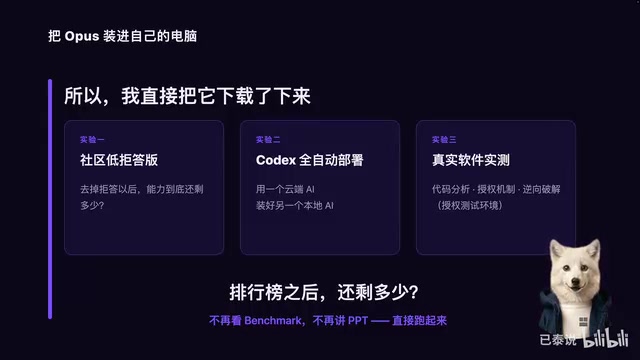
Instead of a "build Tetris" demo, the creator prepared a more practical and sensitive test: using the community uncensored version to analyze a real piece of software, understand the program logic and licensing mechanism, perform reverse engineering analysis, and demonstrate a crack.
Mainstream LLMs undergo alignment training such as RLHF (Reinforcement Learning from Human Feedback) or DPO (Direct Preference Optimization) before release, causing models to refuse responses involving malicious code, reverse engineering, weapons manufacturing, and other sensitive topics. Community-made "uncensored" versions typically remove these safety restrictions through abliteration (reverse fine-tuning) or retraining with specific datasets. Specifically, the abliteration technique identifies the direction vectors within the model responsible for "refusal responses," then subtracts this direction in weight space, removing the model's refusal behavior while largely preserving other capabilities. Such versions have legitimate uses in security research, penetration testing, and red team exercises, but they also significantly lower the barrier to misuse.
Since the uncensored version was used, the model didn't refuse most queries. The final test showed the software's registration information changed to "Registered" — crack successful.
Important reminder: Such tests are conducted only in authorized environments. Please always purchase legitimate software for actual use. While uncensored versions expand the model's capability boundaries, they also carry significant compliance and security risks.
Conclusion: The Tipping Point for Local AI Coding Capability
The true significance of Qwen3.8-27B isn't that it beats someone on any particular benchmark — it's that it marks a tipping point where top-tier coding capability, consumer-hardware-friendly size, and fully open permissions have converged in a meaningfully visible way for the first time.
It doesn't comprehensively surpass Claude Opus 4.6, but in terms of capability density and local controllability, it delivers an answer that was previously hard to imagine: you really can install a near-top-tier coding agent inside your own computer.
From a broader perspective, this also confirms an important trend in the AI industry: the "democratization" of model capabilities is happening far faster than expected. Two years ago, GPT-4-level capability seemed to belong exclusively to the few companies with billion-dollar compute budgets. A year ago, open-source models began matching GPT-4 on some tasks. Now, a model that fits inside a consumer GPU is touching the capability boundaries of the latest top-tier closed-source models in the coding agent domain. If this pace continues, "local-first" could very well shift from a geek's preference to a developer's daily default.
Related articles
Accessibility-Themed CAD Hackathon: A Complete Guide to the 3-Day Design Challenge
A deep dive into The CAD Challenge accessibility hackathon, covering rules, prep tips, CAD tools, and 3D printing design essentials for this 3-day modeling competition.
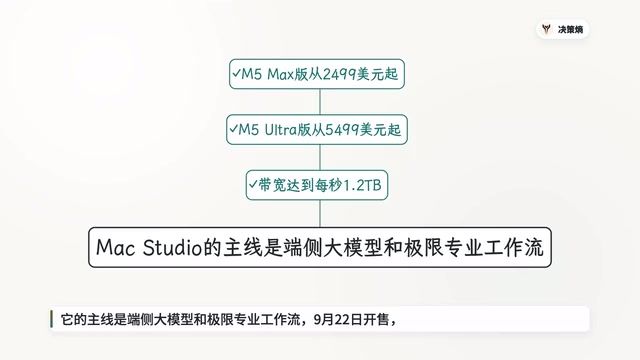
Apple's Four New Macs Decoded: From Desktop Agents to Local LLM Workstations
Apple launches four new Macs from $899 to $5,499+, building a full local AI price ladder. We break down memory budgets, performance bottlenecks, and which Mac runs which model size.
DeepSeek V4's First Multimodal Model Goes Open Source: 305B Weights Fully Released Under MIT License
DeepSeek open-sources V4-Flash-Vision-Exp, a 305B multimodal vision model under MIT license. Built on V4-Flash, it surpasses Opus 4.8 on three benchmarks including Agent's Last Exam.