Qwen4-Max Tops HN Front Page, 200 Lines of JAX Reproduces DeepSeek V3

Five AI stories this week: Qwen4-Max tops HN, 200 lines of JAX reproduce DeepSeek V3, competition shifts to engineering.
Five AI stories this week show industry competition getting thicker. Alibaba's Qwen4-Max shot to #1 on Hacker News the day it launched, seen as unprecedented attention for a Chinese model in the global developer community. Anthropic's Claude continues filling out enterprise features, while Harmonic added Rust support to formal verification and Enslope updated Qwen3.8 dynamic quantization—dense toolchain updates pointing to engineering support as the main battleground for differentiation. A developer reproduced DeepSeek V3's core in 200 lines of JAX and open-sourced it, praised as the best textbook for understanding LLMs. Steve Blank's post on NVIDIA's next move drew 500+ comments debating the AI market, with the divergence itself being an important signal. Overall, beyond single-point model capabilities, the weight of community ecosystems, cost efficiency, and supporting capabilities is rising.
Qwen4-Max Tops HN Front Page, 200 Lines of JAX Reproduces DeepSeek V3
Five things in the AI world this week, each with sources, compiled from Bilibili's "GuluMi Weekly". There's a historic breakthrough for a Chinese model, a hardcore teardown of underlying principles by the open-source community, and a heated debate about where the AI market is heading.
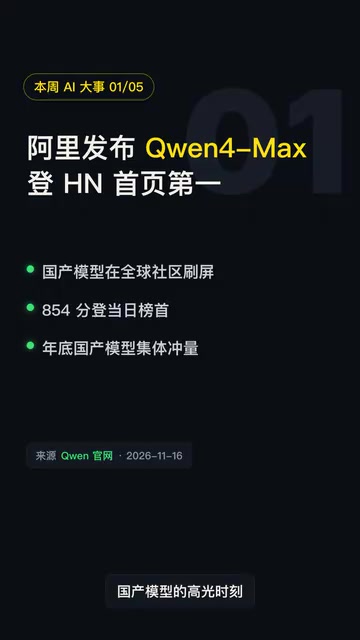
A Chinese Model Tops the HN Front Page for the First Time: Qwen4-Max's Viral Moment
Alibaba released Qwen4-Max, which shot to #1 on the Hacker News front page the same day. According to "GuluMi Weekly" citing Qwen's official website info from November 16, this is the first time a Chinese model has sparked discussion of this scale in the global developer community.
The #1 spot on HN has long been occupied by new models from overseas teams like OpenAI, Anthropic, and Google. For a Chinese model to reach this position in a community that gathers the world's top developers, the significance isn't in the ranking itself but in the quality and breadth of the discussion—overseas developers are willing to spend time trying it out, reviewing it, and debating it, which means the model has entered the range of being taken seriously.
For domestic AI practitioners, this signal is more valuable as a reference than the model's parameters: the competitiveness of Chinese models is migrating from "an option" to "the default option."
Hacker News (HN) is operated by the incubator Y Combinator and is one of the most influential tech news aggregators in the global developer community. Its front-page ranking is determined entirely by user votes and discussion heat, with no editorial recommendation mechanism, so it's regarded as a barometer of "genuine reputation" in the tech world. A project reaching #1 on the front page usually means it has received a large number of high-quality votes and comments in a short time, rather than mere marketing exposure. For AI models, the #1 spot on HN is often accompanied by hands-on feedback, architecture discussions, and competitor comparisons from overseas developers—this spontaneous technical scrutiny reflects a model's real acceptance better than any launch event. That's precisely why a Chinese model topping the HN front page is seen as a landmark signal.
Anthropic Fills Out Enterprise Features and a Dense Wave of Toolchain Updates
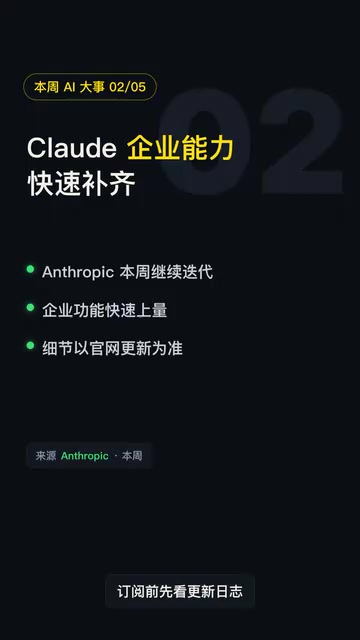
Anthropic's Claude continued updating this week, with a focus on enterprise features—details are available on the official website. Enterprise features may sound less flashy than model capabilities, but they're a key part of commercialization—permission management, compliance auditing, and team collaboration determine how much enterprise customers are willing to pay for AI.
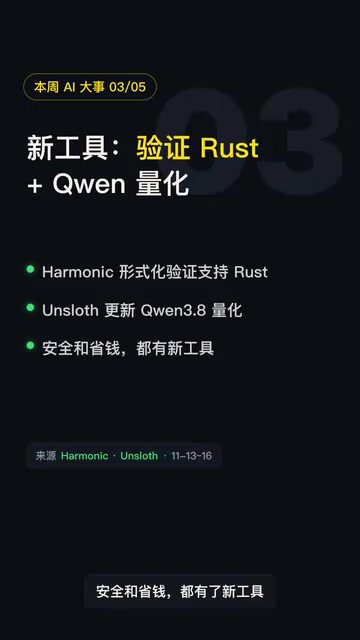
That said, there were also two pieces of news at the toolchain level. According to "GuluMi Weekly" citing info from Harmonic and Enslope's official websites between November 13 and 16, Harmonic's formal verification system has begun supporting the Rust language; Enslope updated Qwen3.8's dynamic quantization capabilities, offering new tools for both security and cost control.
Looking at these three together reveals a common direction this week: the focus of AI competition is spreading from "whose model is stronger" to "whose engineering support is more complete." Formal verification addresses correctness, dynamic quantization addresses deployment cost, and enterprise features address organizational adoption. Infrastructure beyond model capabilities is becoming the main battleground for differentiated competition.
200 Lines of JAX Reproduce DeepSeek V3's Core: The Best LLM Textbook
According to an open-source repository on GitHub dated November 14, a developer reproduced the core of DeepSeekAd V3 with 200 lines of JAX code. The repository is open-sourced.
The value of this news needs to be understood against the industry backdrop. DeepSeek V3's architecture contains many engineering clevernesses, and no matter how detailed the official paper is, it's less intuitive than a lean implementation that actually runs. What does 200 lines of code mean? It means a developer with basic deep learning experience can read through it in an afternoon and start modifying it—this kind of accessibility is rare in LLM research.
"GuluMi Weekly" put it bluntly: for anyone who wants to understand how LLMs work, this is the best textbook. That's not an exaggeration. Reproduction is the shortest path to understanding, and compressing the reproduction to 200 lines lowers the barrier of that path as much as possible.
For domestic developers, there's an additional benefit to doing teaching-level reproductions around Chinese models: DeepSeek's architectural design and engineering trade-offs are closest to domestic deployment realities, so the path to migrating what you learn into actual projects is shorter.
JAX is an open-source numerical computing library developed by Google, combining Autograd's automatic differentiation with XLA's compiler optimizations. It supports efficient execution on CPU, GPU, and TPU, and is especially suited to research scenarios that require flexible control over the computation graph. Compared with PyTorch, JAX adopts a functional programming paradigm, making code more concise and easier to compose, so it's often used for teaching-level implementations and algorithm prototyping. Reproducing an LLM's core with JAX means the code can be highly condensed while remaining readable and modifiable. The fact that 200 lines of JAX can run DeepSeek V3's core logic is thanks to JAX's abstractions in automatic differentiation and parallel computing, letting developers focus on understanding the architecture itself without handling a lot of engineering details.
DeepSeek V3's core architecture includes innovations such as Multi-head Latent Attention (MLA) and DeepSeekMoE. MLA dramatically reduces memory usage during inference by compressing the key-value cache with low-rank compression; DeepSeekMoE adopts fine-grained expert partitioning and a shared-expert mechanism to control compute costs while maintaining model capacity. These designs have detailed formulas in the official paper, but the trade-offs in engineering implementation—such as how to balance expert load and how to organize residual connections—are often only implicitly understood. A lean 200-line reproduction presents these trade-offs as executable code, letting learners directly observe and modify every key piece of logic. This is exactly why it's called "the best LLM textbook": it turns the paper's abstract descriptions into a runnable, debuggable concrete implementation.
Steve Blank Debates NVIDIA's Next Move: Divergence in 500+ Comments
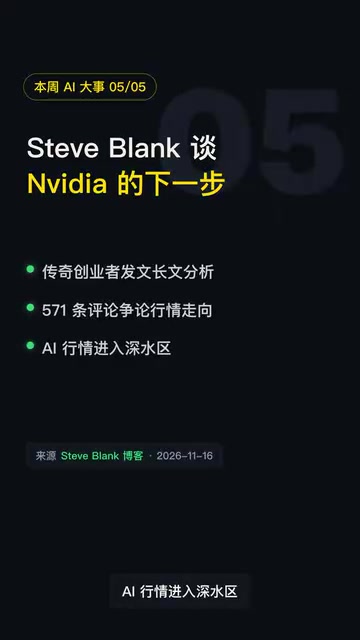
According to an article on Steve Blank's blog dated November 16, he wrote about NVIDIA's next move, and the article drew over 500 comments, with the debate centering on where the AI market is heading.
This discussion is worth paying attention to, not just because of the comment count. Steve Blank is a representative figure of Silicon Valley's startup methodology, and his involvement means the question of the AI market has moved beyond the tech circle into the scrutiny of business and investment perspectives. Among the 500+ comments there are inevitably both bullish and bearish voices: one side believes the structural growth in compute demand is far from over, while the other questions whether the current scale of investment can be absorbed by real application revenue.
The divergence itself is information. "GuluMi Weekly" didn't offer a conclusion, which is precisely the honest approach—on the question of NVIDIA's valuation, no one holds a complete answer at this point in time.
Weekly Observation: Signals Are Accumulating
Looking at the five items together, this week's AI world presents signals on three levels. At the product level, Chinese models have gained unprecedented attention in the global developer community; at the engineering level, "less sexy" capabilities like verification, quantization, and enterprise features are being densely filled out; at the cognitive level, open-source reproductions are lowering the barrier to understanding underlying principles, while debate around the compute market is heating up.
All three levels point to the same judgment: competition in this industry is getting thicker. Single-point breakthroughs are increasingly hard to turn into long-term advantages, and the weight of factors like supporting capabilities, community ecosystems, and cost efficiency is rising.
That's this week's AI news. Follow "GuluMi Weekly": three minutes a week, only real news with sources.
Related articles

Gemini 4 Neon Leak: A Potential Strong Contender Against Opus 5.5
A Hacker News thread suggests Gemini 4 Neon looks like an Opus 5.5 competitor. This article unpacks the product positioning behind this community signal, shifts in the top-model competitive landscape, and what it means for developers' model selection strategy.

Claude Fable 5.2's Self-Authored Short Film 'Fable' Sparks Discussion
A short film 'Fable,' credited to Claude Fable 5.2 for script, visuals, and directing, appears on Hacker News. This article analyzes the significance of full-pipeline AI creation, community reactions, and what it means for content creators.

Anthropic IPO Pricing: A Signal of AI Giants Going Public
Anthropic's IPO pricing draws attention. This article analyzes its potential impact on AI industry valuation, commercialization paths, and the competitive landscape, and highlights public-market expectations and challenges for AI companies.