Qwen4 Unveils Four Models: Max, Flash, Plus, and the Locally-Runnable 27B

Alibaba previews Qwen4's four models at Yunqi — Max, Flash, Plus, and an open-source 27B — with no release date yet.
At the 2025 Yunqi Conference, Alibaba unveiled four next-generation Qwen4 models: cloud flagship Max, low-cost Flash, enterprise-focused Plus, and the only open-source option — 27B. No specs or launch dates were given. The technical preview Qwen3.8 Flash Next hints at a sparse MoE architecture with 125B total parameters but only ~6B activated per token, cutting training costs to one-ninth. Benchmarks show strong coding performance over Claude Opus, but frontier reasoning still lags. Meanwhile, T-Head launched a new AI chip with triple the compute, completing Alibaba's dual-engine strategy of scaling models toward 10 trillion parameters while expanding chip clusters to 500,000 units.
Qwen4 Family Surfaces at Yunqi Conference
Qwen4 hasn't officially launched yet, but Alibaba took the stage at Hangzhou's Yunqi Conference to reveal four names from the next-generation Qwen family all at once. Let's be clear upfront — this is a preview, not a launch. The only thing shown about Qwen4 on-site was a large screen reading "Coming Soon." No parameters, no benchmarks, no pricing, no release date.
The official line: Qwen4, built on a next-generation architecture, has entered training. In other words, if you see leaked specs or benchmark scores circulating online in the coming days, treat them with skepticism — they're almost certainly not from official sources.
The four models announced each have a distinct role: Max targets the ceiling of capability and lives in the cloud; Flash is built for low-cost, high-speed inference; Plus balances API access with enterprise private deployment; and Qwen4 27B is the only open-source model among the four, explicitly aimed at local deployment and individual developers. On one end, a colossal model only cloud giants can afford to run; on the other, a 27B model that can fit on a consumer GPU. That contrast is the most telling detail in this entire preview.
Parameters Grew 33x in Two Years — But Don't Let Secondhand Coverage Mislead You
One growth trajectory is worth keeping in mind. The flagship during the Qwen2.5 era was 72B parameters. By the previous-generation Max, that had grown to roughly 2.4 trillion — about a 33x increase in two years. Looking further ahead, Alibaba says Qwen4.5 and future flagship models will push toward 5 to 10 trillion parameters.
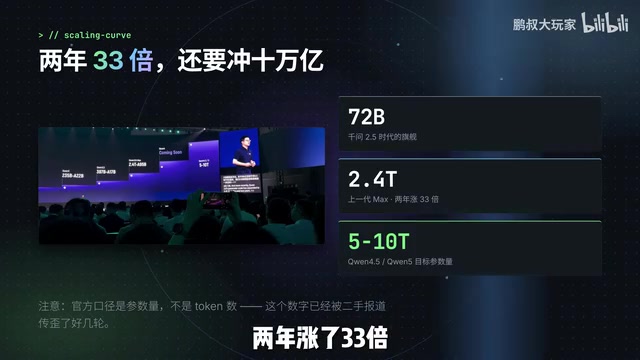
One point worth correcting, because secondhand reporting has gotten this wrong: these figures refer to parameter count, not token count. After several rounds of retelling through the media chain, the two concepts often get conflated. Pay attention to the source whenever you see related claims.
The Architecture Isn't a Black Box: Reading Qwen4 Through Qwen3.8 Flash Next
Qwen4's architecture isn't entirely secret. Qwen3.8 Flash Next, open-sourced in late August, was officially positioned as a technical preview of the Qwen4 architecture. Its technical characteristics reveal the design philosophy of the next generation: 125B total parameters, but only roughly 6B activated per token; native context of 260K tokens, extensible to 1 million; and training costs reportedly cut to one-ninth of the previous generation.
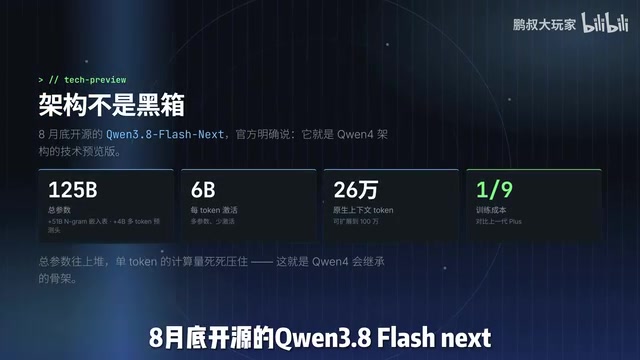
The core logic can be summed up in one sentence: push total parameters up, keep per-token compute locked down. This is classic sparse MoE thinking — use large parameter counts to store knowledge, use low activation rates to control inference costs, balancing capability with efficiency.
What is MoE? Mixture of Experts (MoE) is one of the dominant scaling strategies for large models today. The core idea is to divide a neural network into multiple "expert" sub-networks, with a lightweight "router" dynamically selecting a small subset of experts for each inference pass rather than activating all parameters. The advantage: total parameter count can be enormous (accommodating richer knowledge), while actual inference compute depends only on the number of activated experts, drastically reducing per-inference costs. Flagship models including GPT-4, Gemini 1.5, and DeepSeekAd-V3 all use MoE architectures. Qwen3.8 Flash Next has 125B total parameters but activates only ~6B per token — an activation ratio under 5%. This means inference costs are comparable to a 6B dense model, while still drawing on the knowledge capacity stored in 125B parameters. It's a textbook example of MoE's efficiency advantage.
Strong in Agent Tasks and Coding, Still Behind on Frontier Reasoning
Benchmark results from the preview version paint a clear picture with two distinct narratives. On the coding evaluation SWE-Bench Pro, it scored 62.5, surpassing the Claude Opus series at 53.4 — Agent and coding capabilities are genuinely impressive.
But on the frontier reasoning benchmark HLE, it scored only 35.9, losing to a competing enhanced model at 40. It also trailed DeepSeek's latest model on another code repository evaluation.
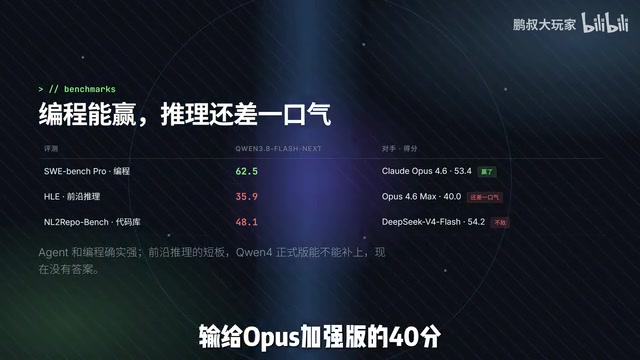
The conclusion is fairly clear: Agent tasks and coding are strengths; frontier reasoning still has a gap. Whether Qwen4's official release can close that gap remains an open question — one that only post-launch testing can answer.
Benchmark Glossary: SWE-Bench is a benchmark that evaluates an AI model's ability to resolve real GitHub Issues. Problems come from actual bug fixes in open-source repositories, requiring models to understand codebases, identify issues, and generate patches that pass tests. SWE-Bench Pro is a harder variant considered closer to real-world software engineering, making it one of the authoritative benchmarks for Agent and coding ability. HLE (Humanity's Last Exam) is an extreme reasoning benchmark released by academia, covering frontier scientific domains including mathematics, physics, and biology. It's designed to probe the reasoning limits of today's most capable models — scoring above 50 out of 100 is extremely rare, and scores around 40 are considered first-tier. One benchmark tests "hands-on ability"; the other tests "limit thinking." Qwen4's architecture leads on the former and lags on the latter, revealing a clear skew in its capability profile.
Developers Are Most Excited About the 27B, Not Max
Interestingly, the developer community's biggest anticipation isn't for the cloud flagship Max — it's for the open-source 27B. The reason is practical: the previous-generation 27B became the most-liked model in Hugging Face history within two months of release, surpassing DeepSeek R1 and Llama in popularity, and it could run on a single consumer GPU with sufficient VRAM. People in the community have already started clearing hard drives in anticipation of Qwen4 27B's quantized versions.
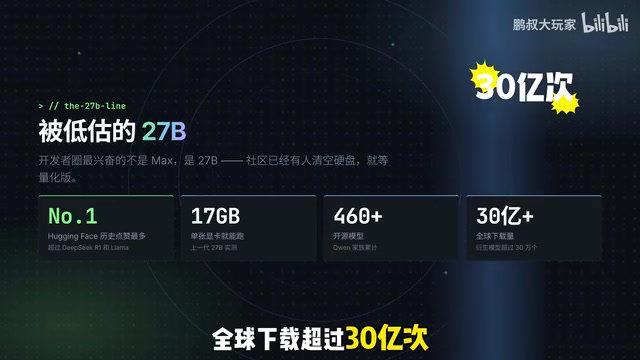
Ecosystem data validates this strategy: the Qwen series has over 460 open-source models, hundreds of millions of global downloads, and more than 300,000 derivative models. The open-source strategy has built Alibaba a massive developer ecosystem — and that's the foundation of confidence behind the 27B.
Chips Get a Simultaneous Upgrade: A Two-Pronged Strategy of Models and Compute
On the same day, Alibaba's chip subsidiary T-Head (平头哥) announced a new generation of AI chips (the PPU series), delivering roughly triple the compute of the previous generation. A single cluster can scale to 500,000 chips, with mass production planned for Q1 next year. Combined with Alibaba's stated long-term goal of building global hyperscale data centers with a 2032 horizon, the strategic picture is clear: push models toward 10 trillion parameters, push chip clusters toward 500,000 units.
This is a dual-engine approach — models and compute working in tandem. In the cloud, giants race toward extreme scale. But that 27B entry is the space reserved for the GPU sitting on an individual developer's desk.
About T-Head Semiconductor: T-Head (平头哥半导体) is Alibaba's in-house chip design subsidiary, founded in 2018, focused on self-developed AI inference, cloud training, and edge computing chips. The PPU (Processing Unit) series announced here targets cloud-side AI training and inference acceleration. "Scalable to 500,000 chips in a single cluster" refers to connecting large numbers of chips via high-speed interconnects into a unified compute cluster — a scale comparable to what systems like NVIDIA's GB200 NVL72 support for hyperscale training. The strategic significance of self-developed chips for Alibaba is twofold: they serve as a baseline safeguard if geopolitical factors restrict access to high-end GPUs, and they enable custom optimization for Alibaba's own model architectures to reduce long-term inference costs. That said, self-developed chips typically require 12–18 months of validation from tape-out to mass production — whether the "Q1 next year" timeline holds remains to be seen.
When Does the Official Release Arrive?
Alibaba hasn't provided a timeline for Qwen4's official launch — just "Coming Soon." But looking at the previous generation's release cadence, there was typically a new development every two to three weeks, so the wait probably won't be long.
Until official parameters and benchmarks are published, any numbers circulating online deserve a question mark. The real storyline to watch: can Qwen4 maintain its lead in coding and Agent tasks while closing the gap in frontier reasoning — and can that 27B open-source model ignite the community all over again?
Related articles

JobRunner MCP Server: AI Agents Can Now Fix Failed Java Jobs
JobRunner launches an open-source MCP server enabling AI agents to view cluster status, diagnose failures, and recover Java jobs—incident response from any cloud coding environment or existing agent.

MLAI Digital Launches 9 Security Agents: MCP Server Safeguards the Full Lifecycle of Agentic AI
MLAI Digital launches Security MCP Server with nine built-in specialized security agents covering vulnerability discovery, attack simulation, prompt injection detection, API and infrastructure assessment, and accelerated remediation—embedding security validation across the full Agentic AI lifecycle from development to production.

Running Isaac Lab on H100 GPUs: Exploring Better Approaches
Exploring optimization methods for running Isaac Lab on NVIDIA H100 GPUs, including MIG configuration, mixed precision, TensorRT acceleration, and community experience to improve robotics simulation and reinforcement learning efficiency.