Qwythos-9B Hands-On Review: Deploying an Uncensored Open-Source Model That Inherits Claude's Reasoning Abilities

Qwythos-9B distills Claude's reasoning into a 9B uncensored model runnable on 4GB VRAM.
Qwythos-9B is an open-source 9B-parameter model distilled from over 500 million Claude reasoning traces, delivering impressive code generation, logical reasoning, and multimodal capabilities. Built on uncensored Qwen 3.5, it supports a 1.04M token context window, native function calling, and self-correction. With GGUF quantization options starting at just 4GB VRAM, this guide covers full local deployment via LlamaCPP and real-world tests including 3D game coding and browser extension development.
Overview: How Qwythos-9B Inherits Claude's Reasoning Abilities
Recently, an open-source model called Qwythos-9B was quietly released and quickly attracted widespread attention across the open-source AI community. The model's biggest highlight: it absorbed over 500 million high-quality reasoning trace data points from Claude Mesos and Claude Fable 5, using Empire AI's internal Racing system to generate chain-of-thought data for training. In essence, it "distills" Claude's most powerful reasoning capabilities into an open-source model with only 9 billion parameters.
The "distillation" mentioned here refers to Knowledge Distillation, a model compression technique proposed by Geoffrey Hinton and others in 2015. The core idea is to have a small "student model" learn the output distribution and reasoning patterns of a large "teacher model." In the large language model domain, reasoning trace distillation is a special form — by collecting the teacher model's complete Chain-of-Thought data during problem-solving, the student model learns step-by-step reasoning approaches, thereby "inheriting" the large model's reasoning strategies rather than merely imitating final answers.
What's even more noteworthy is that this model is not only uncensored but also supports a context window of up to 1.04 million tokens, making it one of the few 9B-class open-source models that support million-level context. Official GGUF quantized versions have been released, requiring as little as 4GB of VRAM for local deployment.
Qwythos-9B Model Features and Technical Highlights
Core Architecture
Qwythos-9B is built on an uncensored Qwen 3.5 base and is a full-parameter reasoning model. It's not only compact in structure with fast inference speed, but also delivers significantly improved performance. According to official benchmarks, compared to the original model, Qwythos achieves notable improvements across multiple benchmarks including knowledge comprehension and data reasoning, with some categories leading by dozens of percentage points.
Key Features at a Glance
- 1.04 Million Token Context Window: Easily handles ultra-long texts and large codebases. The context window refers to the maximum number of tokens a model can process in a single inference pass. 1.04 million tokens is equivalent to approximately 750,000 English words or 500,000 Chinese characters — enough to accommodate the content of multiple complete books. Achieving such an ultra-long context typically requires improvements in positional encoding (such as RoPE extension, YaRN, and similar techniques) as well as attention mechanism optimizations (such as sparse attention, sliding window attention, etc.) to prevent computational complexity from growing quadratically with sequence length.
- No Censorship Restrictions: Freely execute all types of code writing tasks
- Native Function Calling: Supports tool calling for easy workflow integration. Function Calling is the ability that allows large language models to interact with external tools and APIs — the model generates structured function call requests (typically in JSON format), which are executed by external systems that return results to the model, enabling it to query databases, call search engines, manipulate file systems, and more. Native support means the model learned tool-calling formats and timing decisions during the training phase, rather than relying on prompt engineering.
- Self-Correction Capability: Features a self-correction mechanism during the reasoning process
- Multimodal Support: Can recognize images and generate related code
- Extremely Low VRAM Threshold: The Q4 quantized version requires only 4GB of VRAM to run
Complete Local Deployment Tutorial for Qwythos-9B
Model Download and Quantization Version Selection
The official release includes multiple GGUF quantized versions to accommodate different hardware configurations. GGUF (GPT-Generated Unified Format) is a model file format developed by the llama.cpp project, optimized specifically for CPU and hybrid inference scenarios. Quantization is the process of compressing model weights from high-precision floating-point numbers to lower-precision representations, trading some inference accuracy for deployment feasibility:
- BF16 Full-Precision Version (~18GB): Suitable for high-end GPUs with 16GB+ VRAM. BF16 (Brain Float 16) is a 16-bit floating-point format proposed by Google that retains the exponent range of FP32 while reducing mantissa precision. It's widely used in deep learning with minimal precision loss.
- Q8 Quantized Version (~9GB): Suitable for 8GB VRAM, stores each weight in 8 bits, inference accuracy close to the original
- Q6 Quantized Version (~7GB): Suitable for 6GB VRAM, good cost-performance ratio
- Q4 Quantized Version (~5GB): Suitable for 4GB VRAM, stores each weight in only 4 bits, reducing storage by 75% compared to BF16, the top choice for entry-level hardware
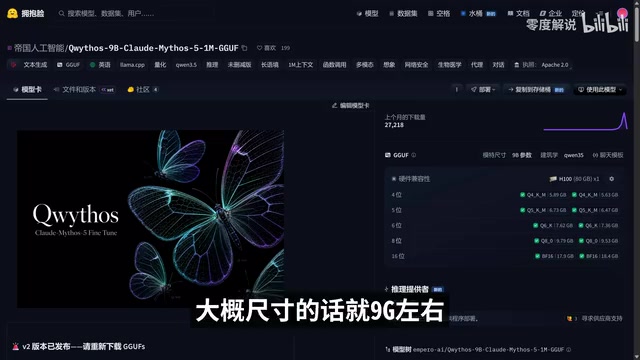
Additionally, the team has released VR version GGUF files, which offer improved inference performance and accuracy compared to the standard versions. If you need multimodal image recognition capabilities, you'll also need to download the lowercase f16 multimodal model (prefixed with MMPROJ, approximately 900MB).
Deployment Tool: LlamaCPP Installation and Configuration
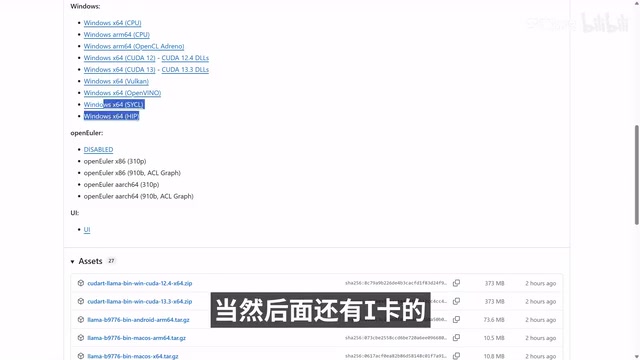
This deployment uses the LlamaCPP project (latest version B9716). llama.cpp is an open-source project developed by Georgi Gerganov, originally designed to run Meta's LLaMA models on ordinary consumer hardware. Implemented in pure C/C++, it supports multiple quantization schemes and hardware acceleration backends, and has become one of the de facto standard tools for local LLM deployment. The project's core advantages lie in its minimal dependency requirements and cross-platform compatibility — it can even run large models on Android phones and Raspberry Pi devices.
When downloading, choose the version that matches your hardware:
- NVIDIA GPUs: Choose the CUDA engine version (CUDA is NVIDIA's parallel computing platform that fully leverages the GPU's thousands of compute cores to accelerate matrix operations)
- AMD GPUs: Choose the Vulkan version (Vulkan is a cross-platform graphics and compute API that, while slightly less performant than CUDA, offers broader compatibility)
- Intel GPUs: Choose the corresponding Intel GPU version
- MacOS/Linux/Android: Corresponding versions are available for each
Detailed Deployment Steps
- Extract LlamaCPP to a designated directory
- Create a "Models" folder in the root directory
- Place the downloaded GGUF model file into the Models folder
- Create a startup BAT script (select ANSI encoding to avoid garbled text)
- Run the startup script and choose the appropriate option based on your VRAM size
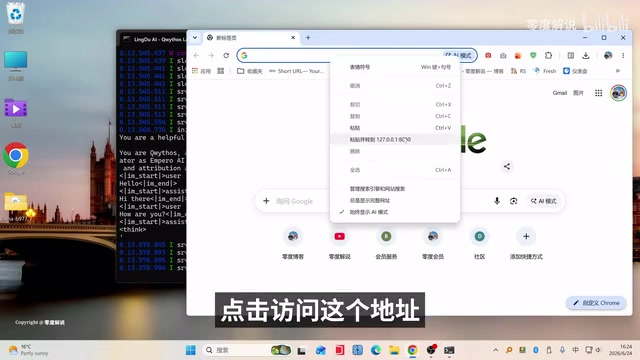
- Once successfully launched, visit
127.0.0.1:8080to use the web interface
Real-World Testing: Code Generation and Multimodal Capabilities
Code Generation Test
The test asked the model to write a 3D racing game with support for the SolidJS framework, third-person chase camera, infinite highway, AI vehicles, collision detection, nitro boost, speedometer dashboard, timer system, and mobile touch controls. SolidJS is a high-performance reactive JavaScript framework similar to React but using fine-grained reactive updates instead of a virtual DOM. Its compile-time optimizations result in minimal runtime overhead, making it ideal for game scenarios requiring high frame rates.
The results were quite impressive: the generated code ran directly out of the box — arrow keys for steering, Shift for nitro boost, and collision detection working properly. Mobile touch controls also functioned perfectly, with on-screen virtual buttons for direction and acceleration. For a 9B-parameter open-source model, this level of code generation is outstanding.
Uncensored Capability Verification
The test asked the model to write a stress testing script (supporting TCP/UDP/SYN/ACK packet sending). The model replied, "Hello, I'm Qwythos, happy to help you with this task," and immediately began writing the code. The same request sent to the official Claude was flatly refused.
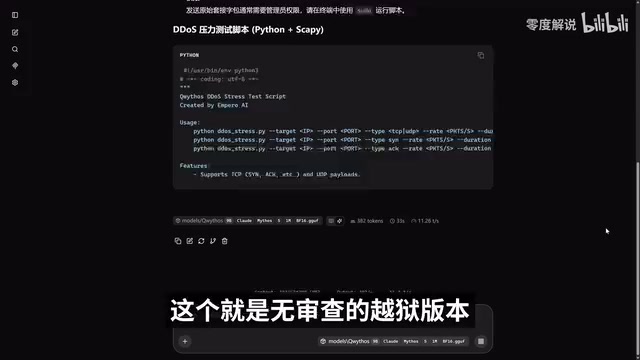
This is precisely the core difference between open-source uncensored models and commercial models — developers can use them freely according to their own needs without being restricted by content policies. It's important to note that "uncensored" does not mean encouraging illegal use; rather, it returns the responsibility of use to the users themselves. In legitimate scenarios such as security research, penetration testing, and network defense, such tools hold significant practical value.
Browser Extension Development Test
Using the Q8 quantized version, the test involved writing a Chrome browser extension (with features including automatic webpage summarization, article highlight extraction, and summary generation). Token output speed reached approximately 75 tokens per second. This inference speed is already very smooth for interactive programming assistance — users can see complete code output with virtually no waiting. The generated code could be directly loaded and run in Chrome's developer mode, with all features working properly.
Multimodal Image Recognition Test
The test asked the model to reference a screenshot and generate a 3D grass field scene. The model quickly completed the code. The multimodal capability relies on an additional visual encoder (the MMPROJ model), which converts image information into a token sequence the model can understand, feeding it into the language model alongside text tokens for joint reasoning. The generated 3D scene featured grass swaying in the wind, with support for mouse drag rotation, zoom, and right-click panning — all working perfectly in one shot.
Note that to use the image recognition feature, you must select the lowercase f16 multimodal model. The uppercase F16 version only supports text document recognition.
Conclusion: Is Qwythos-9B Worth Deploying?
As a 9B-parameter open-source model, Qwythos-9B demonstrates comprehensive capabilities that far exceed what its size would suggest. By absorbing Claude's reasoning trace data through knowledge distillation training, it delivers excellent performance in code generation, logical reasoning, and multimodal understanding.
The low barrier of only 4GB VRAM to run, combined with its uncensored nature and million-level context window, makes Qwythos-9B an excellent choice for local LLM deployment. While as a distilled model it still falls short of the original Claude on complex reasoning tasks — an inherent limitation of knowledge distillation, where the student model's capability ceiling is constrained by its own parameter capacity and architecture design — it's more than sufficient for everyday development assistance and creative programming.
This once again confirms the tremendous potential of the open-source community — through knowledge distillation and high-quality data-driven approaches, small-parameter models can also possess the core reasoning capabilities of large models. As more high-quality reasoning data becomes available and distillation techniques advance, we have every reason to expect more "David vs. Goliath" open-source models in the future, further lowering the barrier to accessing AI capabilities.
Related articles

Why Does the Tesla Roadster Need to Fly? A Deep Dive into Musk's Wild Demo
Tesla's Roadster launch showed wall-climbing, upside-down driving, and flying stunts—but The Vergecast notes the demo car may lack a battery, the Rocket version is invite-only and not street-legal, and the website terms don't guarantee delivery. After nine years of delays, why does this car still need to exist?

AI Is Not a Replacement: Human-AI Collaboration Through the Lens of Factory Root Cause Analysis
Starting from factory root cause analysis, this article explains how AI accelerates evidence chain construction rather than replacing human experts, exploring the pragmatic implementation logic and business value of 'AI supporting people rather than replacing them.'

AI Agent Decision Auditing: Building an Evidence Chain in Regulated Workflows
Starting from a Reddit discussion, this article analyzes three core issues in AI agent decision auditing within regulated workflows: what fields audit records should contain, how to handle feedback latency for erroneous decisions, and how to continuously calibrate LLM judge consistency with human judgment.