Raccoon Kids: Turn Chores into a Game with a Cute Raccoon and Say Goodbye to Nagging
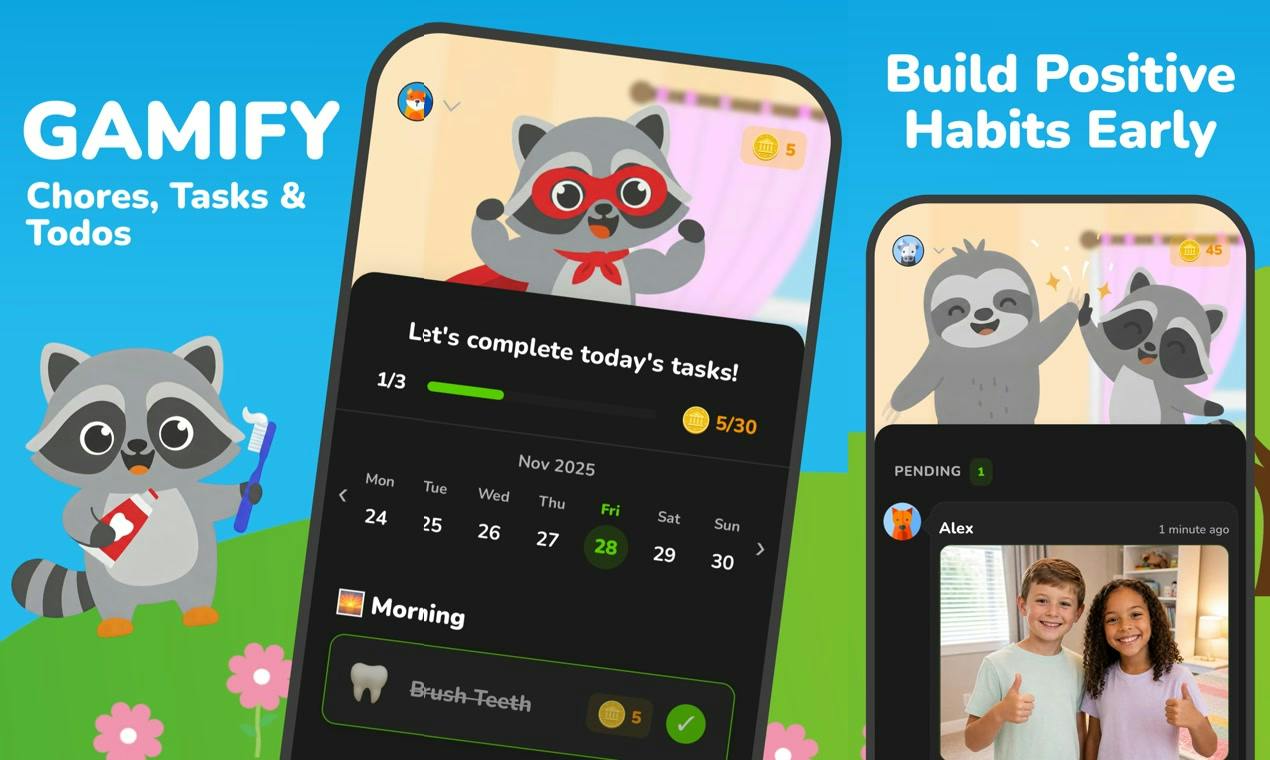
Raccoon Kids uses a raccoon character and a gamified loop to turn chores into tasks kids complete on their own, reducing parental nagging.
Raccoon Kids is an Android parenting app on Product Hunt that uses gamification to solve the pain point of parents nagging kids about chores. The flow: parents set tasks, the system sends automatic reminders, kids complete chores and upload photos, parents approve, and kids earn coins redeemable for rewards they choose. A cartoon raccoon provides encouragement throughout. The product shifts the enforcer role from parent to app, reducing parent-child friction and creating a positive feedback loop. With 70 upvotes and 9 comments, ranking 19th for the day, it's still early-stage—details like multi-child management and reward customization remain to be seen.
Asking your kid "Did you make your bed?" every single day is basically a household routine. Raccoon Kids, a new product on Product Hunt, is trying to replace parental nagging with a cute raccoon—it turns chores into a game so kids complete them on their own, and parents just tap "approve" at the end.
Core Concept: Automated Reminders + Photo Verification + Reward Loop
According to its Product Hunt page, Raccoon Kids' mechanics aren't complicated: parents set up chore tasks, reminders are automatically sent to the child; the child completes the chore and uploads a photo, which the parent reviews and approves; coins earned from completing tasks can be redeemed for rewards the child picks themselves. A cartoon raccoon accompanies and encourages the child throughout, turning what used to be dull instructions into a positive feedback loop.
The key to this design is taking "nagging" off the parent's shoulders. The Product Hunt tagline states the pain point directly: "no more nagging, just a cute raccoon." For parents who remind their kids to do chores every day, this role transfer alone is appealing.
Why "Gamified Chores" Is Worth Watching
Gamifying chores isn't a new concept, but Raccoon Kids focuses on reducing parent-child friction. Traditional chore charts rely on parents actively checking in, while this product standardizes the process with automated reminders and photo review—kids know the rules are "set by the system," not "here comes Mom again."
The product is categorized under Android, Parenting, Kids, and Kids & Parenting, indicating it targets Android families and has a clear parent-child focus. Developer Luca Köster received 70 upvotes and 9 comments on Product Hunt, ranking 19th for the day—not explosive numbers, but in the parenting niche, it shows the product hits a real need for some parents.
Gamification refers to applying game design elements (such as points, badges, leaderboards, instant feedback, and escalating challenges) to non-game contexts to boost user engagement and sustained motivation. Its theoretical foundations include self-determination theory (emphasizing autonomy, competence, and relatedness) and operant conditioning (reinforcing behavior through rewards). In the context of chores, gamification typically manifests as task lists, virtual currency, and achievement systems. Raccoon Kids' coin rewards and raccoon encouragement are typical applications. It's worth noting that the long-term effectiveness of gamification depends on whether rewards are combined with intrinsic motivation, avoiding over-reliance on external stimuli.
Breaking Down the Mechanics: How the Three Stages Work
1. Automated Reminders Replace Manual Nagging
After parents configure tasks, reminders are sent automatically by the system. This step seems simple but is the starting point of the entire product logic: it hands the conflict-prone act of "reminding" to a neutral third party (the app), so parents no longer need to play the enforcer.
2. Photo Submission and Parent Approval
The child takes a photo after completing the chore and uploads it; the task is only marked complete after the parent confirms. Photo verification ensures the task was actually done, and it also gives the child a chance to show off their work—the raccoon's encouragement kicks in here, instantly reinforcing the sense of accomplishment.
Photo verification in this type of task management app is essentially a lightweight "proof mechanism." It uses image evidence to reduce the parent's cost of verifying task completion while giving the child a record of accomplishments to show. Technically, such features typically rely on mobile camera access and a simple upload flow—no complex AI recognition needed. The design challenge lies in balancing verification strictness with user experience: overly cumbersome photo requirements may burden the child, while overly lax ones defeat the purpose of verification. Additionally, photo data involves children's privacy, so the product needs clear data storage and sharing policies.
3. Coins Redeemed for Self-Selected Rewards
Coins earned from completing tasks can be redeemed for rewards that the child chooses themselves. This design ties external incentives to the child's own choices, making motivation easier to sustain than rewards promised unilaterally by parents.
Token economy is a reinforcement system in behavioral psychology that uses symbolic tokens (such as coins or points) as a reward medium; individuals accumulate tokens and later exchange them for tangible rewards. Its advantages lie in delayed gratification and flexible reinforcement, helping children establish connections between behavior and outcomes. In family settings, token economies are often used to build habits, but care must be taken not to turn chores into a purely transactional activity, which could weaken a child's intrinsic sense of responsibility. The self-selected reward design incorporates autonomy support, aligning with the self-determination theory principle of enhancing intrinsic motivation.
Things to Keep in Mind
Based on the limited information on Product Hunt, Raccoon Kids currently presents a clear MVP loop, but its long-term effectiveness depends on factors not elaborated in the materials: whether the reward system is customizable, how multi-child families are managed, and whether photo review becomes a new burden. These can only be judged through actual use.
Also, the community feedback scale of 70 upvotes and 9 comments indicates it's still in an early stage—product iteration and user word-of-mouth remain to be seen. For parents wanting to try it, it's advisable to start with a small set of tasks to see whether the kid buys into this raccoon.
Conclusion
Raccoon Kids' approach is straightforward: use automated reminders, photo verification, and self-selected rewards to turn chores from a parent-child tug-of-war into a mini-game with instant feedback. It may not solve all chore procrastination problems, but the angle of "handing nagging over to an app" is genuinely appealing to tired parents.
Related articles

Jensen Huang Returns to Nvidia: The Power Game Behind an "Aggro Reset"
Nvidia's board reappointed Jensen Huang as CEO less than two weeks after his scandal-driven resignation. This analysis explores the board's decision-making, Trump's political intervention, media power failure, and market reaction behind the dramatic return.

Why Voice AI Can't Understand Kenyans' Everyday Conversations
Swahili speech recognition hits 3.24% error on read text, but everyday Kenyan speech mixes English, Sheng slang, and accents—leaving mainstream voice AI struggling.

Data Centers Build Their Own Natural Gas Plants: AI Compute's Breakout Around a Decade-Long Grid Wait
Grid interconnection approvals can take a decade, so xAI and others are building off-grid natural gas plants to power AI clusters. This article analyzes the drivers, costs, and impact of behind-the-meter generation on AI infrastructure.