Radaric: The AI Feed Reader That Learns Your Editorial Taste

Radaric uses AI to learn users' editorial taste, aggregates multi-source info, and merges duplicate stories to fight information overload.
Radaric is an information aggregation tool by news editor Kirill Oleinichenko, supporting RSS, Telegram, X, and YouTube. Its AI learns users' "editorial taste" from approvals, rejections, and explanations to personalize the feed, and automatically merges duplicate coverage into single stories while keeping original links. Priced from $9/month, it ranks 20th on Product Hunt with 68 votes. Challenges include filter bubbles, cold-start learning, and API limits.
Drowning in RSS, Telegram, X, and YouTube every day, yet never finding what you actually want to read? Radaric tries to solve this pain point with AI. Built by a seasoned news editor, this tool doesn't just aggregate content across multiple platforms—it also gradually learns your "editorial taste" from every approval, rejection, and explanation you provide, and even merges duplicate coverage into a single story. Can it become the savior of the information overload era?
Multi-Source Aggregation and AI-Driven Personalization
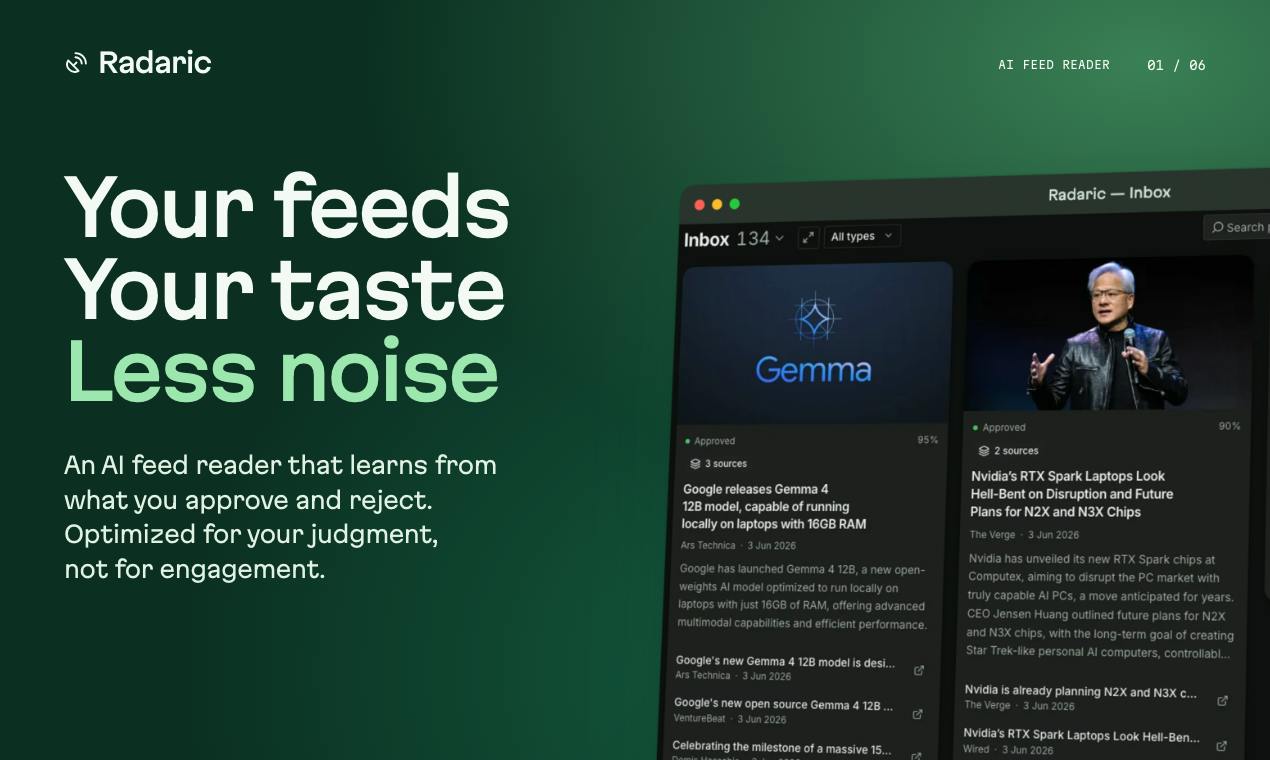
Radaric's core idea isn't complicated: unify information sources scattered across platforms into a single feed. It supports RSS subscriptions, Telegram channels, X (formerly Twitter), and YouTube, covering text, social, and video content. But what truly sets it apart is the AI learning mechanism behind it.
According to its Product Hunt page, Radaric learns from users' "approvals, rejections, and explanations" for each piece of content. This means you can not only like or block something, but also tell it why—for example, "this is too technical" or "this source is unreliable." The AI translates this feedback into an understanding of your editorial taste, gradually making the feed more aligned with your interests. This interaction design is more nuanced than simple like/dislike buttons and offers more long-term value.
RSS (Really Simple Syndication) is an XML-based standard format for publishing frequently updated content such as blog posts, news headlines, and podcast episodes. Users subscribe to "feeds" through an RSS reader, gathering the latest content from multiple websites in one interface without visiting each site individually. Since its emergence in 1999, RSS has been a foundational protocol for information aggregation. Telegram channels are a one-way broadcast tool on the Telegram platform, where channel administrators can push messages to an unlimited number of subscribers, often used by media and communities for information distribution. X (formerly Twitter)'s API allows developers to programmatically read tweets and timelines, but its access policies and pricing have been adjusted multiple times in recent years, posing challenges for third-party aggregation tools. YouTube provides video metadata and search functionality through its Data API. Radaric needs to integrate these four heterogeneous sources, meaning it must handle different data formats, update frequencies, and access restrictions—a non-trivial technical challenge.
Merging Duplicate Coverage: Saying Goodbye to Information Noise
Another symptom of information overload is the same event being reported over and over. Radaric's solution is to merge content covering the same event into a single "story" while preserving the original links. This is similar to the "event clustering" features of some news aggregators, but Radaric emphasizes that it's done automatically without manual configuration. For users who need to track hot topics without being flooded, this feature is quite practical.
You might not have noticed that merged stories still retain original links, making it easy for users to trace sources. This mitigates to some extent the information distortion that AI aggregation can introduce, and also lets users judge content credibility for themselves.
Event clustering is a natural language processing technique aimed at automatically identifying and grouping multiple documents that describe the same real-world event. Common methods include: similarity computation based on keywords and entities (people, places, organizations), semantic similarity based on topic models (such as LDA), and deep learning methods based on embedding vectors. News aggregators like Google News have long used clustering algorithms to group different reports of the same event. Radaric's "story merging" is essentially incremental cross-source clustering: when new content arrives, the system must determine whether it belongs to the same event as an existing story—merging if similarity exceeds a threshold, otherwise creating a new story. This process demands high accuracy—false merges lose information, while missed merges fail to reduce noise.
Built by a News Editor: The Advantage of a Professional Perspective
Radaric's creator, Kirill Oleinichenko, describes himself as a newsletter editor. This background lends the product credibility—it's not just an engineer's imagination of what a feed should be, but a practical synthesis from a professional who deals with information every day. Judging by its pricing (starting at $9 per month), Radaric is positioned as a productivity tool for users willing to pay for efficient information gathering.
On Product Hunt, Radaric received 68 votes and 2 comments, ranking 20th for the day. That's not a spectacular result, but given the fierce competition in the information aggregation space and the product's early stage, its AI learning mechanism and editorial perspective are still worth watching.
Cold start is a classic problem in recommendation systems and personalized learning, referring to the difficulty a system faces in making accurate recommendations when it lacks user history data. For tools like Radaric that rely on feedback-based learning, new users face a double cold start: first, user cold start—the system doesn't know the user's taste; second, content cold start—newly added information sources haven't been feedback-rated by any user yet. Common solutions include: initializing with interest tags or sample content selected by the user at registration; using content-based recommendation (rather than collaborative filtering) to reduce dependence on group data; designing interactive onboarding flows that let users complete a batch of meaningful feedback in the first few minutes (such as approving/rejecting/explaining 10-20 representative items); and using active learning strategies to prioritize labeling items with the highest information gain. If designed well, Radaric's "explanation" mechanism can yield richer signals with fewer feedback instances, thereby accelerating the cold-start process.
Challenges and Outlook
Radaric's biggest challenge is balancing personalization with filter bubbles. AI learning user taste is great, but excessive pandering could cause users to miss important information that doesn't suit their palate. Whether the product offers diversity adjustment options is currently unclear. Additionally, multi-platform aggregation involves API restrictions and content copyright issues—long-term operations will need to address these risks.
Another issue is learning cold start. How many rounds of feedback does a new user need before the AI accurately understands their taste? If the initial experience is poor, users may churn quickly. Radaric needs to design clever onboarding mechanisms to make the learning process as smooth as possible.
Overall, Radaric captures the core pain point of the information overload era, and its approach of using AI to learn editorial taste is quite novel. Whether it can stand out among numerous RSS readers and AI aggregation tools depends on the actual effectiveness of its learning algorithms and the polish of its user experience. For professionals seeking efficient information gathering, this tool is worth a try.
Filter bubble, a term coined by internet activist Eli Pariser in 2011, refers to personalized algorithms filtering information based on user preferences, causing users to only encounter content that matches their existing views, thereby exacerbating cognitive narrowness and polarization. In recommendation systems, pure exploitation strategies—only pushing content the user has already demonstrated they like—tend to reinforce filter bubbles. Common mitigation approaches include: introducing exploration mechanisms such as ε-greedy strategies or Thompson sampling to recommend content the user hasn't explicitly shown interest in with some probability; setting diversity constraints that force the recommendation list to include items from different sources or topics; and providing a user-controllable "diversity slider." If Radaric wants to balance personalization with informational breadth, it needs to explicitly design these mechanisms at the algorithmic level rather than relying solely on passive learning.
One-line Summary
Radaric uses AI to learn users' editorial taste, aggregates multi-source information, and merges duplicate coverage in an attempt to solve information overload.
Paragraph Summary
Radaric is an information aggregation tool built by news editor Kirill Oleinichenko, supporting multi-source inputs from RSS, Telegram, X, and YouTube. Its core innovation is an AI learning mechanism: users approve, reject, or explain each piece of content, and the AI gradually understands their "editorial taste," making the feed increasingly personalized. The product can also automatically merge content covering the same event into a single "story" while preserving original links to reduce information noise. Radaric is priced from $9 per month, positioned as a productivity tool, and received 68 votes on Product Hunt, ranking 20th for the day. The article notes challenges such as balancing personalization with filter bubbles, cold-start learning efficiency, and multi-platform API restrictions, but considers its AI learning approach and editorial perspective still novel.
Related articles

OpenAI Partners with Shield: How the Astra Agent Revolutionizes IT Troubleshooting
OpenAI and Shield launch the Astra agent, which autonomously logs into computers and legacy systems to fix IT issues in real time, 35-40% faster than traditional models, with humans involved only when judgment is needed.

iPhone Duo Battery Life Tested: One Charge a Day Is Unavoidable, and the Large Screen Is the Culprit
iPhone Duo battery test: heavy use needs at least one charge a day, and about 30% remains after 6.5 hours of screen-on time. How often the large screen is unfolded is key; a MagSafe battery pack helps, and long-term degradation is also worth watching.

Kimi K3.1 Pro Open-Sourced: 2.8 Trillion Parameters Close In on Opus
Moonshot releases the open-source MoE model Kimi K3.1 Pro, with 2.8T total parameters and 104B activated, trailing Opus 5.5 by under 1 point on Terminal Bench 4.0.