radiusHQ: One Link to End Appointment Management Chaos

radiusHQ consolidates scheduling, payments, and service display into one shareable link for freelancers.
radiusHQ is a newly launched tool that replaces fragmented appointment management with a single shareable link. It integrates service listings, pricing, calendar availability, online payments, and automated reminders into one landing page. Service providers can set up in 10 minutes, while clients complete bookings in 30 seconds. Targeting freelancers, coaches, and small-studio operators, it competes with Calendly by offering a more complete business loop from discovery to payment.
When Appointment Management Becomes a Nightmare
For freelancers, consultants, coaches, beauticians, and all kinds of small-scale service providers, appointment management is often a grossly underestimated piece of tedious work. Clients reach out through WeChat, email, phone calls, or social media DMs to ask about availability. You go back and forth to confirm times, manually record them in a calendar, send reminders separately, and then deal with payment issues. The entire workflow is scattered across multiple tools, and any slip-up can lead to double bookings, lost clients, or delayed payments.
The severity of this pain point is often underestimated. Research shows that independent service providers spend an average of 5–8 hours per week on appointment-related communication and management—a massive hidden cost for professionals who bill by the hour. The deeper issue is "channel fragmentation"—when client touchpoints are spread across WeChat, WhatsApp, Instagram DMs, email, and other platforms, the difficulty of syncing information grows exponentially. The "decision fatigue" theory from behavioral economics also explains why complex booking processes cause client drop-off: each additional step reduces conversion rates by approximately 20%.
radiusHQ, which recently launched on Product Hunt, targets exactly this pain point. Its core proposition is clean and powerful: "One link replaces your scheduling chaos." The product currently ranks #15 for the day with 80 upvotes. While comments are still sparse, its positioning hits a real need shared by a large number of independent service providers.
Product Hunt is one of the world's most influential platforms for new product launches, with dozens of products competing for attention every day. Earning rankings and votes on the platform is crucial for early-stage products' cold starts—it not only brings in the first batch of seed users but also attracts tech media coverage and potential investors. An 80-vote performance amid hundreds of daily launches represents a moderate level of attention, indicating the product has generated some interest but hasn't yet achieved viral spread.
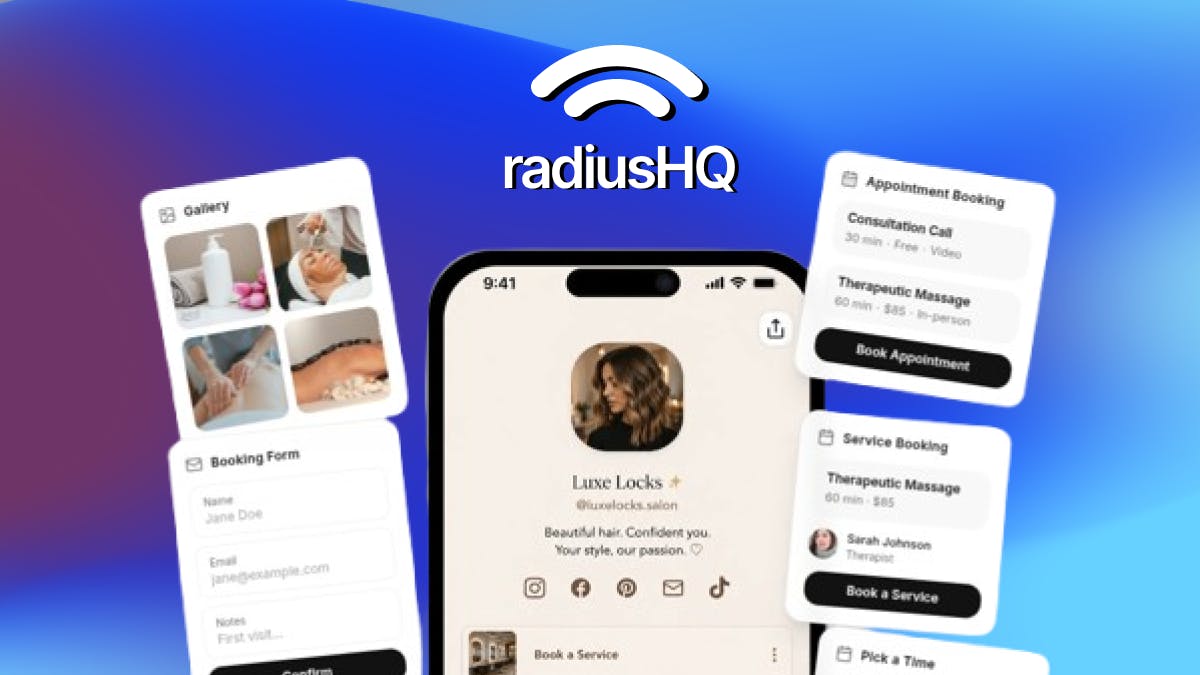
One Page Integrating Five Core Booking Elements
radiusHQ's product logic consolidates the five most critical elements of a booking business—services, pricing, calendar, payments, and reminders—into a single beautifully designed landing page. This means service providers no longer need to switch between and stitch together multiple SaaS tools, and clients don't need to go through cumbersome communication workflows.
A landing page is a core concept in digital marketing, referring to the first page a user visits through a link. In the SaaS world, landing page design directly determines conversion rates. By condensing the entire business logic into a single landing page, radiusHQ essentially borrows from the "Single Page Application" (SPA) design philosophy—reducing page transitions and presenting all key information and actions in one place. This design is especially important in the mobile-first era, as mobile users are extremely sensitive to loading times and number of steps. Every page transition means potential user drop-off.
From the Client's Perspective: Complete an Online Booking in 30 Seconds
For clients, the entire experience is compressed to the extreme. According to the official description, clients simply open the link to see a clear service list with transparent pricing, select an available time slot, complete payment, and automatically receive confirmation and reminders. "Clients complete a booking within 30 seconds" is the product's core promise for user experience.
This "what you see is what you get" one-stop experience reduces friction in the conversion process. In service-based transactions, the lower the communication cost and the shorter the decision path, the higher the close rate tends to be. radiusHQ aims to transform what traditionally requires several rounds of back-and-forth into a single linear click-through process.
From the Service Provider's Perspective: Set Up in 10 Minutes
On the other end, radiusHQ emphasizes an extremely low barrier to entry: service providers can complete the entire page configuration in just 10 minutes. You set up your service offerings, pricing, available time slots, and payment methods, and the system generates a shareable link. This link can be placed in social media bios, business cards, email signatures, or any channel where clients can find you.
For individual service providers who lack technical backgrounds and don't have the energy to maintain complex booking systems, this "no-code, out-of-the-box" model is extremely attractive. The No-Code movement is one of the most important trends in the software industry in recent years, with the core philosophy of enabling non-technical people to build digital tools and workflows through visual interfaces. According to Gartner, by 2025, 70% of new enterprise applications will be developed using low-code/no-code technology. For individual service providers, no-code tools are particularly significant—they eliminate the competitive disadvantage created by the "tech divide," enabling a yoga instructor or nail artist to offer a digital booking experience comparable to large chain establishments without hiring developers or learning to code.
radiusHQ's Product Positioning and Market Logic
radiusHQ is categorized under Productivity, Marketing, and Calendar—a cross-category positioning that reflects its ambition: it's not just a calendar tool, but a lightweight business front-end that integrates marketing presentation and transaction closure.
From Tool Aggregation to Business Closure
The market has no shortage of mature booking tools like Calendly and Acuity Scheduling. However, many such products focus more on "scheduling" as a single action, while payments, service presentation, and pricing often require additional third-party integrations. radiusHQ's differentiation lies in bundling presentation (marketing) + scheduling + payment into one cohesive unit, forming a complete loop from the moment a client sees you, learns about your services, places an order, and pays.
To understand the significance of this competitive landscape, consider the industry status quo. Calendly was founded in 2013, is currently valued at over $3 billion, has more than 10 million users, and is the undisputed leader in the scheduling space. Its success lies in radically simplifying the core action of "finding mutually available time." Acuity Scheduling (now a Squarespace product) leans more toward service industries and supports payment integration. Other competitors include Cal.com (an open-source alternative), Setmore, and SimplyBook.me. This market is characterized by low entry barriers but difficulty in building moats—once users embed a booking system into their workflow, migration costs are extremely high. This "lock-in effect" means newcomers must offer significantly differentiated value to disrupt the existing landscape.
For independent service providers, the value of this integration goes beyond convenience—it's also about building a professional image. A beautifully designed, fully functional booking page is itself a form of brand endorsement.
Who Is radiusHQ Best Suited For?
Based on product characteristics, the following groups are likely radiusHQ's core audience:
- Freelancers and consultants: Need to showcase services, manage consultation schedules, and collect fees;
- Fitness trainers, yoga instructors, and therapists: Provide services in time-based units with high booking frequency;
- Beauty, hair, and nail studio operators: Need clients to self-book and prepay deposits;
- All types of one-on-one online course or tutoring providers: Need cross-regional clients to book conveniently.
The commonality across these scenarios is: highly standardized services, time as the unit of transaction, and frequent need to confirm availability with clients and collect payment. radiusHQ provides a smooth solution precisely for these high-frequency, lightweight transactions.
The service model where time is the unit of transaction is called "Time Commoditization" in economics. These services are characterized by relatively standardized content, fixed duration, and transparent pricing. This is precisely the scenario best suited for automated booking, because there are minimal variables for both parties to negotiate. In contrast, highly customized services (such as architectural design or complex legal cases) are difficult to fully address through a standardized booking page due to the significant variation in each engagement. Understanding this distinction helps assess radiusHQ's target market boundaries—it's best suited for "high-frequency, standardized, time-slot-based" service transaction scenarios.
Opportunities and Challenges Coexist
Despite its clear product philosophy, as a newly launched booking management tool, radiusHQ still faces some real-world tests.
First, the booking space is already quite crowded. Dominant products like Calendly occupy significant mindshare, so radiusHQ needs to win users over with a more polished integrated experience or a more focused niche. Second, whether the promise of "one link handles everything" can withstand complex business scenarios in actual use—such as multi-staff scheduling, package combinations, and cancellation/rescheduling rules—remains to be seen. Additionally, the payment component involves payment compliance issues across different countries and regions, which is a hidden barrier to global deployment for products like this.
The complexity of cross-border payments far exceeds what most users imagine. It involves multiple layers of regulatory frameworks, including payment licensing requirements in various countries, Anti-Money Laundering (AML) regulations, consumer protection laws, and data privacy legislation (such as the EU's GDPR and China's Personal Information Protection Law). Take Stripe as an example: although it supports payment collection in over 40 countries, entering each new market requires local regulatory approval. For booking products specifically, there's also the issue of prepayment fund custody—who holds the client's prepaid service fee before the service is delivered, and how refund disputes are handled—all of which must comply with local financial regulations. This is why many lightweight booking tools choose to focus on a single market first before gradually expanding.
Looking at the current data of 80 votes and only 1 comment, radiusHQ is still in its early validation stage. Its core value proposition is clear enough, but to truly turn "scheduling chaos" into "one link," it still needs continuous refinement in feature depth, stability, and differentiation.
Conclusion
radiusHQ represents an increasingly popular product philosophy: consolidating scattered business processes into a minimalist entry point, trading minimal operational cost for maximum conversion efficiency. For independent service providers plagued by booking communications, calendar management, and payment workflows, it offers a lightweight solution worth trying. Whether one link can truly end scheduling chaos ultimately depends on whether the product can consistently deliver on its promise in real business scenarios.
Related articles

Poison-Resistant Concept Anchoring: A New Approach to Defending Against AI Data Poisoning
Deep dive into Poison-Resistant Concept Anchoring, defending against data poisoning via signed anchors and bounded updates. Experiments show 62% poison isolation with 0% false rejection rate.

Hungarian Algorithm Explained: Principles, Complexity, and Engineering Implementation Guide
In-depth explanation of the Hungarian Algorithm: core principles, O(N³) time complexity advantages, and engineering implementation. Covers assignment problem definition, step-by-step algorithm walkthrough, Python/C++ libraries, and applications in multi-object tracking and resource scheduling.
OpenAI's First Enterprise AI Report: H…
OpenAI's First Enterprise AI Report: How ChatGPT Is Changing the Way Organizations Work
OpenAI's first enterprise AI report reveals three key traits of ChatGPT Enterprise adoption: the shift from novelty to necessity, writing and coding as top use cases, and data governance as a core prerequisite.