Rakazo: The Open-Source AI Teammate That's Truly Yours, with Memory and a Computer

Rakazo: an open-source, self-hostable AI teammate with a computer and take-over-able browser for each bot.
Rakazo is an open-source AI assistant that topped Product Hunt, positioned as an alternative to Grok Bot and emphasizing complete user ownership of AI. Its core design assigns each bot independent memory, routines, and a virtual computer running a browser that can be watched and taken over, turning AI from a Q&A machine into an observable executor. It supports self-hosting, any model, and your own API keys, covering Web, desktop, and mobile, and suits users needing continuous task tracking, privacy-sensitive users, or those wanting secondary development. Currently, details on model integration, resource consumption, and task reliability are insufficient, and actual experience still needs verification.
Can AI Keep Working After You Close the Chat Window?
Most AI assistants operate on a "ask and answer" model: you open a chat box, type a question, get a reply, and close it. Task done, context gone. But Rakazo, which topped Product Hunt, proposes a different approach—making AI a true "teammate" that keeps running even after you close the chat window.
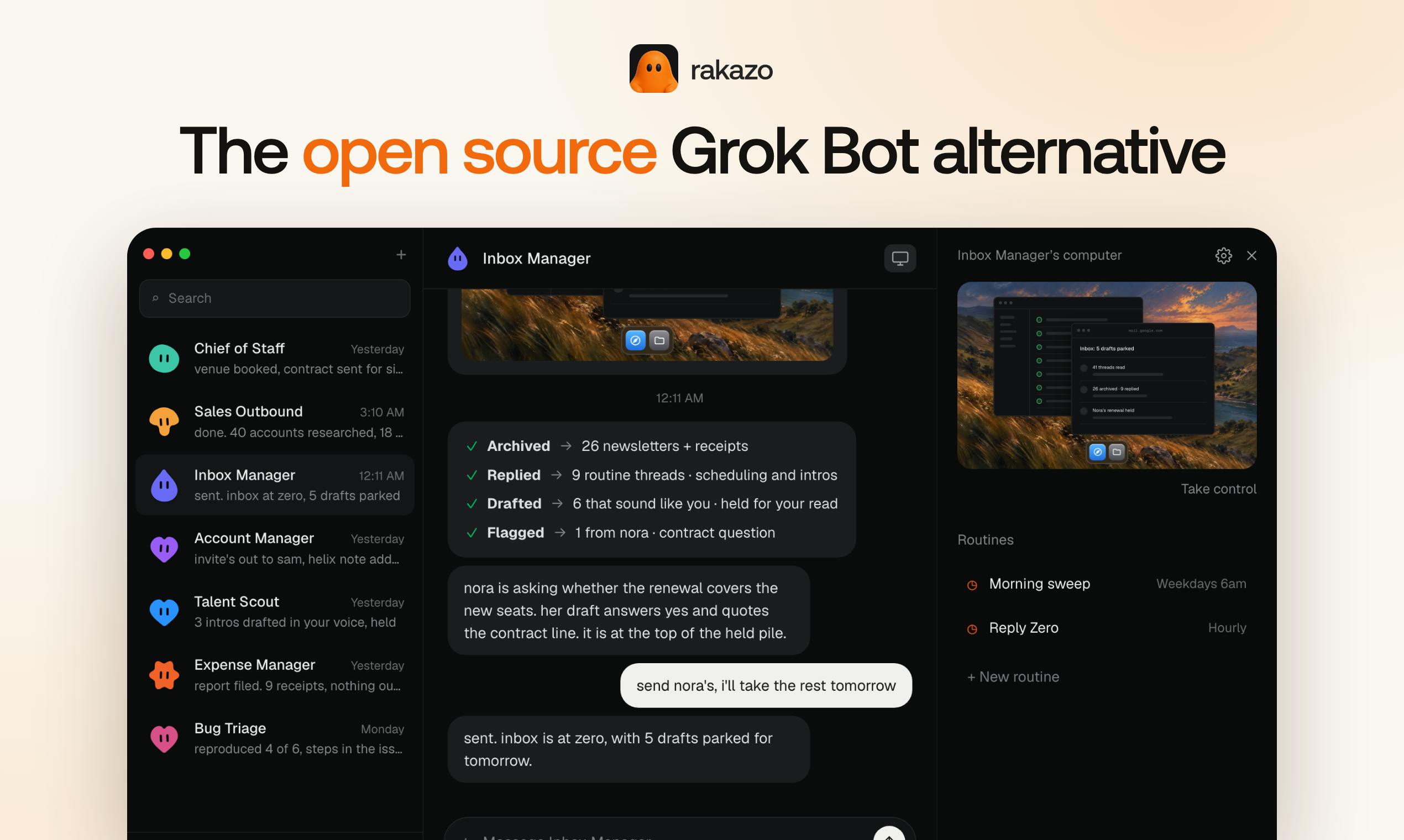
Rakazo positions itself as an open-source alternative to Grok Bot, emphasizing complete user ownership of AI. Each bot has its own memory, routines, and a "computer" equipped with a browser that can be watched and taken over. The project is self-hosted, supports any model and your own API keys, and covers Web, desktop, and mobile.
Core Design: Every Bot Is an Independently Running "Computer"
Rakazo's most distinctive design is assigning each bot its own virtual computer. On this "computer," a browser runs, and users can watch the bot's operations in real time and take over directly when needed.
The significance of this design is transforming AI from a "Q&A machine" into an "observable executor." With traditional AI assistants, users often have no idea what happens in the background; Rakazo visualizes the execution process so humans can intervene and correct at any time. For scenarios requiring AI to complete multi-step tasks (such as web operations, information gathering, and process automation), this transparency and controllability are especially important.
Combined with independent memory and routine mechanisms, bots can remember previous interactions and continue working at a preset pace, rather than starting from scratch every conversation.
Virtual Machine / Sandbox Environment here refers to an isolated runtime environment for each bot, typically implemented via containers or lightweight virtual machines. The bot runs a browser, executes commands, and accesses the network within this environment; its operations are confined to the sandbox and do not affect the host machine or other bots. This isolation enhances security (limiting the impact of AI misoperations) and facilitates running multiple bots in parallel without interference. Combined with browser automation technologies (such as Playwright, Puppeteer, or the CDP protocol), bots can simulate clicks, fill forms, and scrape page content, while "takeover" is usually achieved through remote desktop or browser debugging interfaces, allowing humans to intervene at critical moments.
Open Source and Self-Hosted: Returning Control to Users
Rakazo received 108 upvotes and 9 comments on Product Hunt, topping the day's leaderboard. Its open-source and self-hosted positioning is one of its core selling points.
"Any model, your keys, your machine"—this product description directly addresses a pain point in the current AI tool market: users often entrust data, context, and workflows to closed-source platforms but cannot control model selection, data flow, or runtime environment. Rakazo returns all three dimensions to the user.
Self-hosting means data stays local, API keys are managed by users themselves, and models can be switched as needed. For teams and individuals sensitive to data privacy or looking to deeply customize AI workflows, this model has practical appeal. Open source further allows auditing and secondary development.
Self-hosting refers to users deploying and running software on their own servers or local devices, rather than using vendor-provided cloud services. For AI assistants, self-hosting means model inference, data storage, and task execution all occur in a user-controlled environment. Common implementations include Docker containerized deployment, local models (e.g., running open-source large models via Ollama or vLLM), and exposing services through reverse proxies. The advantages of self-hosting are controllable data privacy, deep customization, and independence from vendor terms of service or service shutdowns; the cost is requiring some operational capability, with hardware costs (especially GPU resources) borne by the user.
Open-source alternative typically refers to a project with similar functional positioning to a closed-source commercial product but with publicly available source code, allowing free use and modification. Rakazo benchmarks against Grok Bot; its open-source nature allows users to audit code, verify data processing logic, and build secondary development or integrate into their own systems—contrasting with the SaaS model where you "can only use, not modify."
Multi-Platform Coverage and Use Cases
Rakazo offers Web, desktop, and mobile support, and on Product Hunt it is tagged under Android, Productivity, Open Source, Artificial Intelligence, and GitHub.
Judging from the product form, it suits several scenarios: individual users who need AI to continuously track a task; privacy-sensitive users who want a self-hosted alternative to cloud AI assistants; and developers who want to build on open-source code. The take-over-able browser gives it room for web automation tasks, while independent memory and routines make it closer to a "digital employee" than a "chat tool."
Routine in the AI agent context refers to a pre-defined or bot-maintained task execution plan, including trigger conditions (e.g., scheduled, event-based) and step sequences. Unlike single conversations, routines allow bots to repeatedly execute tasks at a pace, such as daily scheduled information gathering or periodic web page change checks. Independent memory means each bot has persistent context storage (e.g., vector databases or structured memory files), enabling it to remember user preferences, historical tasks, and intermediate results across multiple sessions—the infrastructure for "continuous work" rather than "ask and answer."
Points to Note
Rakazo's currently public information still focuses on product positioning; details such as specific model integration methods, resource consumption, and task orchestration capabilities are not yet sufficient. Self-hosted solutions typically have certain requirements for users' deployment capabilities, and actual experience depends on hardware environment and configuration level. Additionally, "AI teammate" products generally face challenges in task reliability and long-term operational stability; whether Rakazo can deliver satisfactorily in these areas requires more real-world feedback to verify.
For readers looking for an open-source, self-hostable AI assistant solution, Rakazo offers a noteworthy new option.
One-line Summary
Rakazo: an open-source, self-hostable AI teammate where each bot has its own computer and take-over-able browser.
Paragraph Summary
Rakazo is an open-source AI assistant that topped Product Hunt, positioned as an alternative to Grok Bot and emphasizing complete user ownership of AI. Its core design assigns each bot independent memory, routines, and a virtual computer running a browser that can be watched and taken over, turning AI from a Q&A machine into an observable executor. The product supports self-hosting, any model, and your own API keys, covering Web, desktop, and mobile. It suits users needing continuous task tracking, privacy-sensitive users, or those wanting secondary development. Currently, details on model integration, resource consumption, and task reliability are insufficient, and actual experience still needs verification.
Related articles

Gemini 4 Neon Leak: A Potential Strong Contender Against Opus 5.5
A Hacker News thread suggests Gemini 4 Neon looks like an Opus 5.5 competitor. This article unpacks the product positioning behind this community signal, shifts in the top-model competitive landscape, and what it means for developers' model selection strategy.

Claude Fable 5.2's Self-Authored Short Film 'Fable' Sparks Discussion
A short film 'Fable,' credited to Claude Fable 5.2 for script, visuals, and directing, appears on Hacker News. This article analyzes the significance of full-pipeline AI creation, community reactions, and what it means for content creators.

Anthropic IPO Pricing: A Signal of AI Giants Going Public
Anthropic's IPO pricing draws attention. This article analyzes its potential impact on AI industry valuation, commercialization paths, and the competitive landscape, and highlights public-market expectations and challenges for AI companies.