Readest Alternatives: Free Self-Hosted Reading Apps with Sync

Free self-hosted reading app alternatives to Readest with cross-platform sync capabilities.
After Readest began charging for self-hosted sync features, users sought free alternatives. This article explores why this angered the self-hosting community, examines the technical challenges of cross-platform reading sync, and recommends open-source solutions like KOReader, Calibre-Web, Kavita, and Komga that support free self-hosted sync via WebDAV or Nextcloud.
A User Revolt Over an E-Book Reading App
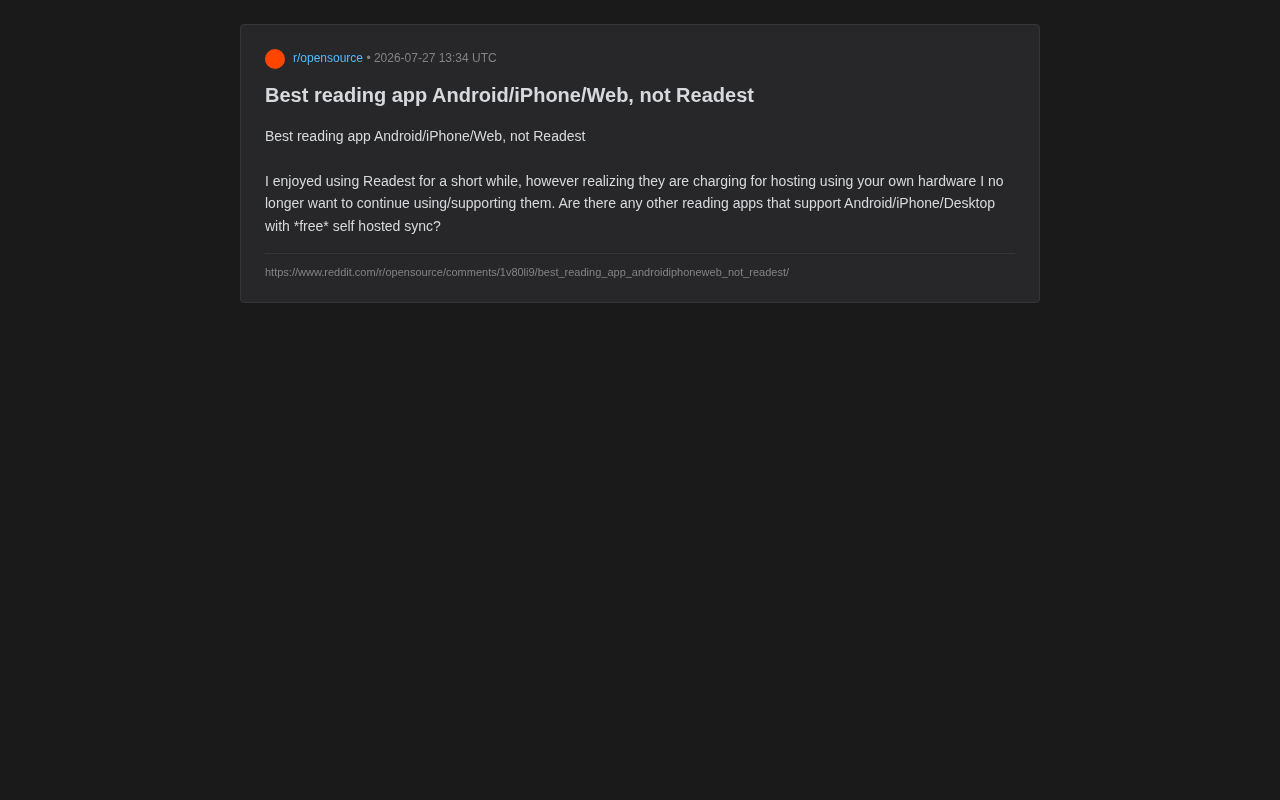
Recently, a post seeking Readest alternatives sparked widespread discussion in Reddit's open-source software community. The user explained that they had briefly enjoyed the reading experience Readest offered, but once they discovered the app was charging for the ability to "host on your own hardware," they were no longer willing to use or support the product.
The request sounds simple, yet it touches on a core pain point in today's cross-platform reading tool ecosystem: users want seamless reading progress sync across Android, iPhone, and desktop, while insisting on a free self-hosted solution.
Why Readest's "Paid Self-Hosting" Angered Users
The Conflict Between Self-Hosting Philosophy and Business Models
The essence of self-hosting is "data sovereignty" — users store data on their own servers or hardware, freeing themselves from dependence on third-party cloud services. For privacy-conscious technical users, self-hosting typically means "deploy once, free forever, full control."
The self-hosted philosophy originates from the early internet's decentralization ethos and has experienced a resurgence in recent years as privacy awareness grows and cloud service costs rise. Reddit's r/selfhosted community has over 400,000 subscribers, covering everything from home NAS setups to enterprise-grade deployments. Self-hosting users typically deploy services using Docker containerization on Raspberry Pis, old PCs, or VPS instances, forming a complete open-source software ecosystem. This community holds an almost religious commitment to "freedom" and "control" — any attempt to charge additional fees when users are already bearing the infrastructure costs themselves is seen as a betrayal of the community compact.
However, Readest's approach broke this expectation. When software charges for sync functionality even though users are already providing their own hardware resources, users feel "double-charged": paying for hardware costs and paying for software features. This directly conflicts with the open-source, freedom-oriented spirit upheld by the self-hosting community.
The Technical Complexity of Cross-Platform Reading Sync
You might not realize it, but cross-platform reading sync is far from a simple feature. It requires coordinating reading positions, bookmarks, notes, highlights, and other data across different operating systems (iOS, Android, desktop) while ensuring real-time consistency. Such sync services typically rely on backend servers running continuously, so there are genuine maintenance costs. This is why many developers choose to make sync a paid feature.
From a technical architecture perspective, cross-platform reading sync typically involves three key layers: client-side state management, transport protocols, and backend storage. The client needs to precisely record reading positions — in EPUB format, this usually involves CFI (Canonical Fragment Identifier) to pinpoint exact locations within a document — along with timestamps and device identifiers. Conflict resolution is one of the core challenges: when users read offline on multiple devices and then reconnect, the system needs to decide which state is "most recent." Common strategies include "Last Write Wins" and merge algorithms based on CRDTs (Conflict-free Replicated Data Types). These technical complexities do impose an ongoing maintenance burden on developers.
But the key question remains: if users are willing to bear the server costs themselves, should the software still charge extra? This is precisely the crux of the controversy.
Readest Alternatives: Free Self-Hosted Reading Solutions
The Open-Source Reading App Ecosystem
For the requirement of "three-platform support + free self-hosted sync," the community typically recommends these categories of solutions:
KOReader is a star project in the open-source e-book reader space. While primarily designed for e-ink devices, it also supports Android. It can sync reading progress through third-party sync servers and is completely free and open-source. KOReader is written in Lua and is known for extremely low resource usage, making it particularly suitable for Kindle, Kobo, and other E-Ink devices. Its sync functionality is implemented through the kosync protocol — users can deploy their own kosync server or use free public servers provided by the community.
Calibre + Calibre-Web is the classic self-hosted book library management combination. Calibre was created by Kovid Goyal in 2006, originally named libprs500 as an e-book management tool designed for the Sony Reader. After nearly 20 years of development, it has become the de facto standard in e-book management, supporting conversion from over 20 input formats. Calibre-Web is a community-derived project that provides a web interface through the Python Flask framework, making Calibre libraries accessible via browser on any device. Combined with OPDS (Open Publication Distribution System), users can browse and download library content directly from any OPDS-compatible reading app. While the native app experience may be slightly inferior, it's completely free with full data autonomy.
Kavita and Komga are self-hosted media servers that have emerged in recent years, supporting e-books, comics, and various other formats. They provide web interfaces with corresponding third-party clients and strong sync capabilities. Kavita is developed in .NET and offers a built-in reader with reading progress tracking; Komga is based on Kotlin/Spring Boot and excels particularly in manga management. Both offer Docker one-click deployment, lowering the technical barrier for self-hosting.
Choosing a Sync Protocol: WebDAV and Nextcloud
For users committed to self-hosting, the choice of sync protocol is equally important. Many open-source reading apps support progress sync through WebDAV, Nextcloud, or self-built sync servers.
WebDAV (Web Distributed Authoring and Versioning) is an extension of the HTTP protocol that allows clients to create, modify, and move files on remote servers. It's widely adopted in the self-hosting ecosystem because virtually all major NAS systems (such as Synology, QNAP) and cloud storage solutions (such as Nextcloud, ownCloud) natively support WebDAV. For reading apps, syncing via WebDAV means storing reading progress data as JSON or XML files on the user's own WebDAV server, achieving complete decoupling of the data layer from the application layer. Users can even switch between different reading apps without worrying about data migration.
This approach decouples sync logic from the reading app, allowing users to freely choose their underlying storage solution and avoid vendor lock-in. Nextcloud, as the flagship self-hosted cloud storage solution, offers file sync, calendar, contacts, and other all-in-one services. Combined with its built-in WebDAV interface, it can serve as a universal sync backend for various reading apps.
The Deeper Trends Behind This Discussion
User Backlash Against "Subscription Fatigue"
This incident is not isolated. More and more software is converting previously one-time purchase or free features to subscription models, and even charging for self-hosted features that should be within users' own domain. The widespread adoption of this business model is triggering "subscription fatigue" among technical user communities.
Industry data confirms the severity of this trend: according to Zuora's Subscription Economy Index, between 2012 and 2023, subscription business models grew 3.7 times faster than S&P 500 company revenue. However, a West Monroe survey shows that American consumers underestimate their monthly subscription spending by 2.5 times on average, with actual monthly subscription costs exceeding $200. This cognitive gap has led to a concentrated outbreak of "subscription fatigue." In the software space, Adobe faced massive user protests when it switched from perpetual licenses to Creative Cloud subscriptions in 2013, but ultimately completed the transition thanks to its market monopoly. However, for small and medium-sized apps without moats, the risk of premature subscription conversion is much greater — users' switching costs are extremely low, and a single negative reputation event can cause an entire user base to flee.
The vitality of the open-source self-hosting community is a manifestation of this backlash. Users are beginning to value tools that truly respect data sovereignty and adhere to free, open-source principles, and are willing to invest time learning deployment rather than paying ongoing fees for convenience.
The Value Negotiation Between Developers and Users
From another perspective, developers' dilemmas deserve understanding too. Maintaining a high-quality, cross-platform reading app requires continuous investment. Finding the balance between "a sustainable business model" and "users' expectations of free" is a challenge every independent developer must face.
This negotiation has rich precedents and model explorations in the open-source world. Common sustainable business models include: Open Core (core features open-source, premium enterprise features paid), hosted service model (code is open-source but paid hosting is offered), sponsorship/donation models (such as GitHub Sponsors, Open Collective), and dual licensing. Each model has its applicable scenarios and limitations — the key is whether the payment boundary aligns with users' perceived value.
Perhaps a healthier approach is: placing the paywall on cloud hosting services where the vendor genuinely bears costs, while keeping the self-hosted scenario free and open. This way, developers can generate revenue from users willing to pay for cloud services while earning goodwill and contributions from the self-hosting community. This strategy has been successfully validated by projects like Bitwarden (password manager) and Plausible Analytics (website analytics): they offer completely free self-hosted versions while generating revenue through paid cloud services. The two user groups form a virtuous complement — self-hosting users contribute code and community reputation, while paying users contribute revenue.
Conclusion
This Reddit user's request reflects the shared voice of a growing technical community: when choosing between paying for convenience and maintaining data autonomy, they choose the latter. For users seeking Readest alternatives, open-source solutions like KOReader, Calibre-Web, and Kavita are all worth trying. And for software developers, designing a business model that can generate revenue without alienating core users will remain a long-term challenge.
In an era of intensifying software subscription trends, discussions like these remind us: respecting users' data sovereignty may be the enduring path to earning the trust of the technical community.
Related articles

The Truth Behind Codex 'Build a Website in 5 Minutes': AI Isn't Creating Sites—It's Helping You Copy Them
Exposing the truth behind viral Codex 5-minute website videos: creators aren't building original sites with AI—they're copying shared prompts or scraping others' work. Learn AI coding tools' real limits.

Getting Started with AI Agent Development: A Complete Guide from Concept to Practice
A comprehensive guide to AI Agent architecture and development, covering automated marketing, intelligent customer service, and investment analysis scenarios with single and multi-agent collaboration.

The Truth Behind Codex 'Build a Website in 5 Minutes': AI Isn't Creating Sites — It's Helping You Copy Them
Exposing the truth behind viral Codex 5-minute website videos: creators aren't building original sites with AI — they're copying shared prompts or scraping others' work.