Readwise Enters the Ebook Market, Challenging Kindle and Kobo
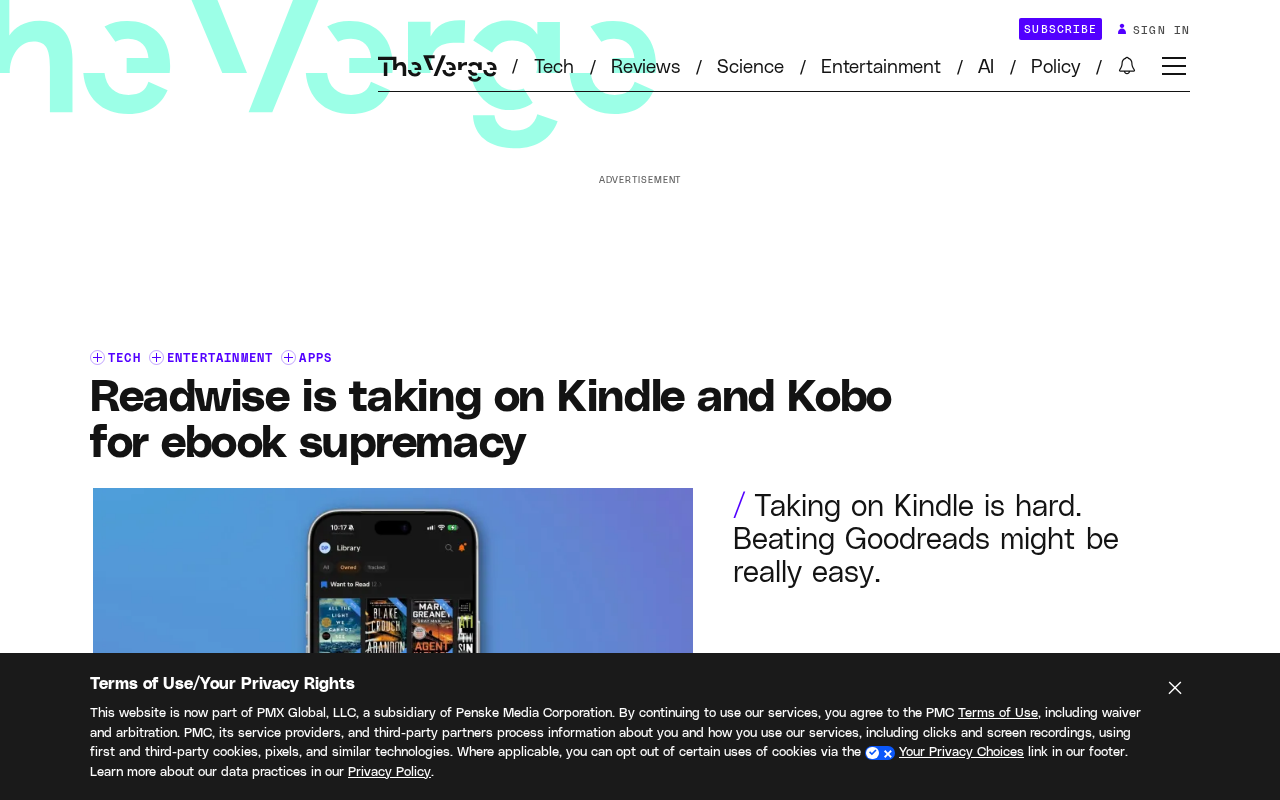
Readwise launches the ebook platform Books, challenging Kindle and Kobo through differentiated knowledge management.
Readwise started as a Kindle highlight sync tool, later launched Reader supporting newsletters, PDFs, and web articles, and has now officially released the fully featured ebook platform Readwise Books, directly challenging Kindle and Kobo. The article traces Readwise's evolution from a "peripheral reading tool" to "hosting reading itself," noting that its differentiation lies not in hardware or bookstore scale but in seamlessly connecting ebook reading with highlights, notes, and spaced-repetition review, and in achieving a unified cross-source knowledge stream across books, articles, and newsletters. The challenge lies in the ebook market's formidable barriers: bookstore ecosystem, hardware experience, copyright, and format compatibility are all difficult problems; its target users are heavy readers with high willingness to pay but limited scale. The article argues that this reflects the trend of reading tools evolving from single functions toward full-process integration.
Readwise is a name that heavy readers know well. For the past few years, it has quietly built tools for "power readers"—from its earliest Kindle highlight sync management to the later Readwise Reader, which supports read-it-later for newsletters, PDFs, and web articles. Now, Readwise has officially launched Readwise Books, a fully featured ebook platform that takes direct aim at Kindle and Kobo.
From Highlight Sync to Ebook Platform: Readwise's Evolution Path
Readwise started as a highlight management tool: it connects to your Kindle account, centrally stores and categorizes your annotations and notes from books, and then uses features like daily review to help you remember what you've read. This product hit a real pain point—many people highlight endlessly yet almost never look back.
Later, Readwise launched Reader, expanding the reading context from ebooks to newsletters, PDFs, and web articles. Reader is not just a read-it-later tool; it also integrates highlights, notes, and review mechanisms. Now, the release of Readwise Books means it is no longer content to be a "peripheral tool for reading"—it wants to directly host reading itself: ebooks.
This path resembles the expansion logic of many tool-type products: first build auxiliary capabilities (annotation management) around a core behavior (reading), then gradually move toward the main scenario (the reader). But the ebook market is not a blank space—Kindle and Kobo have been entrenched for years, so Readwise's entry point needs to be sufficiently differentiated.
Spaced repetition is a learning technique based on the forgetting curve: the system dynamically schedules review times based on how strongly you remember each knowledge point—stretching intervals for content you remember well and surfacing content you tend to forget more frequently. Readwise's daily review feature is a lightweight application of this mechanism: each day it pulls a handful of items from your highlight library and pushes them via email or cards, letting you complete a "micro-review" in seconds. Unlike traditional rote memorization, spaced repetition emphasizes retrieval at "the critical point just before forgetting," thereby achieving the highest memory retention with the least time investment. Understanding this makes it clear why Readwise treats "review" rather than "reading" as its core competitiveness—it isn't selling books; it's selling the act of remembering the books you've read.
The Differentiation Logic of Readwise Books
Public information is currently limited, but given Readwise's existing product DNA, we can infer that its ebook platform's competitiveness will not lie in hardware or the scale of its bookstore, but rather in "post-reading knowledge management."
The core of traditional ebook platforms is "selling books" and "reading books," whereas Readwise's strength is "digesting and reviewing after reading." If Readwise Books can seamlessly connect ebook reading with highlights, notes, and spaced-repetition review, then its appeal to heavy readers will differ from Kindle—which, although it also has annotation features, offers relatively basic knowledge management capabilities.
Another potential differentiator is cross-source integration. Readwise Reader already supports multiple content formats; if ebooks can also be brought into the same review system, users will be able to manage all highlights from books, articles, and newsletters in a single interface. This "unified knowledge stream" experience is something existing ebook platforms have not yet solved well.
Challenging Kindle and Kobo: Opportunities and Obstacles Coexist
The barriers in the ebook market should not be underestimated. Kindle is backed by Amazon's bookstore ecosystem and hardware devices, while Kobo has its own user base thanks to its openness and multi-format support. As a latecomer, Readwise will find it hard in the short term to compete head-on in book quantity and hardware experience.
Its opportunity lies in user segmentation: heavy readers who are not satisfied with "reading without remembering" may be willing to migrate or use multiple platforms in parallel for a better knowledge management experience. Readwise's existing user base is exactly this group—they are already used to paying for reading tools and have a clear need for highlight review.
The obstacles are equally obvious. Ebooks involve complex issues such as copyright, format compatibility, and reader experience; a weakness in any one link could deter ordinary users. And while heavy readers have a high willingness to pay, their numbers are limited. Whether Readwise can find a balance between "niche essential need" and "mass market" will determine how far Readwise Books can go.
Ebook formats and DRM (Digital Rights Management) are key background for understanding the obstacles in this section. Mainstream ebook platforms typically use their own proprietary formats: Amazon Kindle uses AZW/KFX, Kobo uses Kepub, while the open standard EPUB is widely supported. Even trickier is DRM—it uses encryption to restrict ebooks to specific devices or apps to prevent copying and distribution. This means that if Readwise wants to build a bookstore, it must either negotiate authorization with publishers one by one or sell only DRM-free independent publications—the former is costly, and the latter offers a limited catalog. Format compatibility is also a challenge: even if users can import their own EPUB files, details of the reading experience such as layout rendering, fonts, pagination, and footnote navigation still require substantial engineering investment—and this is precisely the moat that Kindle and Kobo have built over many years.
Potential Impact on the Reading Tool Landscape
The emergence of Readwise Books reflects a broader trend: reading tools are evolving from single functions toward full-process coverage. In the past, reading, annotation, note-taking, and review belonged to different tools; now, more and more products are trying to connect this entire chain.
For users, this integration means less tool switching and a more complete data loop. For the industry, Readwise's attempt may prompt platforms like Kindle and Kobo to strengthen their knowledge management capabilities or open more data interfaces. Regardless of the outcome, heavy readers are the beneficiaries.
Whether Readwise can gain a foothold in the ebook market is still hard to say. But its entry at least shows one thing: reading is not just looking at words on a screen—how to make what you've read truly stay with you is becoming a new dimension of product competition.
One-line Summary
Readwise launches the ebook platform Books, challenging Kindle and Kobo through differentiated knowledge management.
Paragraph Summary
Readwise started as a Kindle highlight sync tool, later launched Reader supporting newsletters, PDFs, and web articles, and has now officially released the fully featured ebook platform Readwise Books, directly challenging Kindle and Kobo. The article traces Readwise's evolution from a "peripheral reading tool" to "hosting reading itself," noting that its differentiation lies not in hardware or bookstore scale but in seamlessly connecting ebook reading with highlights, notes, and spaced-repetition review, and in achieving a unified cross-source knowledge stream across books, articles, and newsletters. The challenge lies in the ebook market's formidable barriers: bookstore ecosystem, hardware experience, copyright, and format compatibility are all difficult problems; its target users are heavy readers with high willingness to pay but limited scale. The article argues that this reflects the trend of reading tools evolving from single functions toward full-process integration.
Related articles

Ollama+RAG Local Knowledge Base Setup: A Step-by-Step AnythingLLM Tutorial
Based on a Bilibili tutorial, this guide details building a local RAG knowledge base with Ollama + AnythingLLM: from general LLM knowledge limits and RAG principles to document upload, vector storage, and verification.

The Ultimate Ollama Tutorial: A Beginner's Guide to Running Large Models Locally for Free
Ollama is an open-source local large model management tool supporting free download and deployment of models like DeepSeek, with command-line and Web UI, cross-platform, automatic GPU/CPU scheduling — ideal for AI beginners and private deployment.

Giving Claude "Hands": Exoproc Open-Source MCP Server Enables Live Process Hooking
Exoproc is an open-source MCP server enabling Claude Code to hook live Windows x64 processes via thread hijacking, bypassing EDR for dynamic analysis. Static decompilation gave Claude eyes; dynamic hooking gives it hands.