Real Motors Project Ares: A Cyberpunk Fantasy Comes to Life

Electrification unlocks styling freedom as Project Ares explores new design boundaries for electric motorcycles with cyberpunk flair.
Using Real Motors' Project Ares as an example, the article explores how electrification reshapes motorcycle design. Freed from engine and fuel tank constraints, designers can shape form around experience from scratch—and Project Ares turns cyberpunk's sharp angles, metallic textures, and visual tension into a physical vehicle. Contrasted with retro-futurism and minimalism, it takes a third path emphasizing visual impact and personal expression. The article also soberly notes that highly stylized concepts must still contend with aerodynamics, structural strength, ergonomics, and regulations at the production stage; with limited public information, it remains closer to a design manifesto. The core takeaway: electric motorcycle competition is shifting from powertrain specs toward differentiation in design and culture.
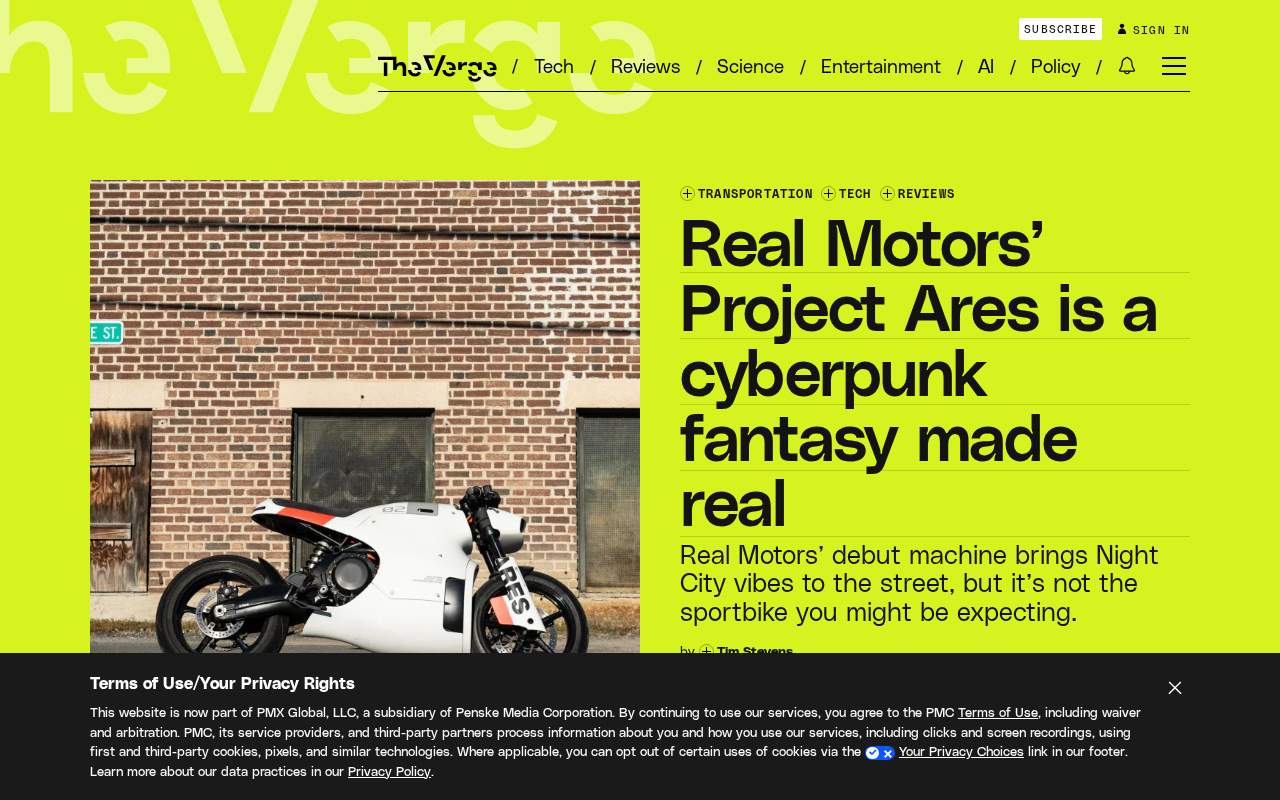
Electrification is reshaping the boundaries of motorcycle design. Freed from the constraints of engines and fuel tanks, designers now enjoy unprecedented creative freedom—and the results are sometimes stunning. Real Motors' Project Ares is one of the most extreme expressions of this trend, bringing cyberpunk visual fantasies straight onto real roads.
When Electrification Unlocks Design Freedom
Traditional motorcycle styling has long been dictated by the structural logic of internal combustion engines and fuel tanks: the size of the engine bay, the position of the fuel tank, and the routing of the exhaust system essentially determine a bike's proportions and stance. Electric powertrains remove these constraints one by one—batteries can be laid out flat, motors can be compactly integrated, and the way the body wraps around them can be reimagined.
Project Ares' styling is built on this kind of "structural liberation." It doesn't look like a subtractive redesign of an old combustion-vehicle skeleton; it looks more like a vehicle sketch drawn from scratch against a futuristic urban backdrop. This approach—starting from the underlying architecture—is one of the most substantive changes electrification has brought to the motorcycle industry.
Electric powertrain typically refers to a drive unit consisting of a battery pack, motor, and electronic control system. Unlike internal combustion engines, which require intake and exhaust channels, cooling ducts, and fuel tank space, batteries can be formed into flat or irregular packs and placed at the bottom of the vehicle body, while motors can be integrated with the rear swingarm or wheel hub. This modularity allows designers to first define seat height, wheelbase, and visual stance, then arrange powertrain components accordingly—breaking free from the proportional relationships locked in by mechanical layout during the combustion era.
Bringing Cyberpunk Aesthetics into Reality
Visually, cyberpunk often means sharp angles, cold metallic textures, bold contrasting colors, and a tension of "high tech, low life." Project Ares translates these elements—previously confined to games and films—into a tangible physical object.
Its overall silhouette leans low and massive, with sharply defined body lines that contrast starkly with the rounded curves of traditional retro models. This design language doesn't aim to please everyone—it's more of a statement of attitude: electric motorcycles can be about more than efficiency and environmental friendliness; they can also be about style and personality.
Cyberpunk is a subgenre of science fiction that, through film and game visualization, has developed into a visual symbol system centered on neon high-contrast colors, dense exposed machinery, rainy-night urban settings, and class contrasts. In vehicle design, it often manifests as angular bodywork, visible structural components, asymmetrical details, and cold-toned metal finishes. For production vehicles, these elements need to be translated into manufacturable body panel seams, lighting shapes, and paint processes—otherwise they tend to remain at the rendering stage.
Diverging from Mainstream Electric Motorcycle Styles
A detail worth noting: current electric motorcycle design roughly splits into two paths. One is retro-futurism that pays homage to the classics—like the Maeving RM2 mentioned in the article—evoking nostalgia through proportions and details reminiscent of vintage combustion bikes. The other is thorough minimalism, expressing modernity through clean lines and restrained mass.
Project Ares takes a third path: it's neither nostalgic nor restrained, but rather emphasizes presence through high-frequency visual impact. This orientation makes it more memorable in an increasingly homogenized electric two-wheeler market, but it also means its audience will be more focused on a specific niche—those who treat their bike as a form of personal expression rather than a mere commuting tool.
The Gap Between Concept and Production
What deserves sober consideration is that highly stylized designs like this often face tough questions from real-world engineering. The sharp angles, exposed structural feel, and extreme proportions of cyberpunk styling must contend with a series of constraints at the production stage: aerodynamics, structural strength, ergonomics, and regulatory compliance.
Based on currently available information, Project Ares is more of a design manifesto than a production product that has completed engineering validation. It's aggressive enough visually, but whether it can avoid compromising on everyday dimensions like range, handling, and comfort is the key to whether it can move from "fantasy" to "reality." The source material doesn't provide specific power figures, range data, or a production timeline—which itself suggests it remains at the concept-showcase stage for now.
Ergonomics refers to the matching relationship between the vehicle and the rider's body, including the riding triangle, seat support, handlebar position, footpeg height, and the transmission paths of vibration and wind pressure. Concept designs often lower seat height, stretch wheelbase, or tighten legroom in pursuit of visual tension—problems that are not easily exposed in static displays but directly affect handling confidence and long-distance comfort in real riding. This is therefore one of the areas most likely to be revised when a concept car moves toward production.
The New Design Battleground for Electric Two-Wheelers
Perhaps the significance of Project Ares isn't entirely about whether it will ever be produced. Electrification is shifting motorcycle design from "arranging the body around the engine" to "shaping the form around the experience," and this shift is spawning a wave of products with wildly different styles. As powertrains become increasingly standardized and supply chains mature, design will become the core battleground where electric motorcycle brands differentiate themselves.
From this perspective, Project Ares is more of a signal: competition in electric motorcycles is extending from battery-motor-controller spec sheets to the realms of aesthetics and culture. Whoever can turn a fantasy into a credible, rideable reality will have a chance to secure a position in the next round of market reshuffling.
One-line Summary
Electrification unlocks styling freedom, and Project Ares explores new design boundaries for electric motorcycles with its cyberpunk style.
Paragraph Summary
Using Real Motors' Project Ares as an example, the article explores how electrification is reshaping motorcycle design. Freed from the structural constraints of engines and fuel tanks, designers can now shape form around experience from scratch—and Project Ares translates cyberpunk's sharp angles, metallic textures, and visual tension into a physical vehicle. The article contrasts it with retro-futurist and minimalist approaches, identifying it as a third path emphasizing visual impact and personal expression. It also soberly notes that highly stylized concept designs must still contend with engineering constraints like aerodynamics, structural strength, ergonomics, and regulations at the production stage. With limited public information available, it remains closer to a design manifesto. The core judgment: competition in electric motorcycles is shifting from battery-motor-controller specs toward differentiation in design and culture.
Related articles

Jensen Huang Returns to Nvidia: The Power Game Behind an "Aggro Reset"
Nvidia's board reappointed Jensen Huang as CEO less than two weeks after his scandal-driven resignation. This analysis explores the board's decision-making, Trump's political intervention, media power failure, and market reaction behind the dramatic return.

Why Voice AI Can't Understand Kenyans' Everyday Conversations
Swahili speech recognition hits 3.24% error on read text, but everyday Kenyan speech mixes English, Sheng slang, and accents—leaving mainstream voice AI struggling.

Data Centers Build Their Own Natural Gas Plants: AI Compute's Breakout Around a Decade-Long Grid Wait
Grid interconnection approvals can take a decade, so xAI and others are building off-grid natural gas plants to power AI clusters. This article analyzes the drivers, costs, and impact of behind-the-meter generation on AI infrastructure.