Real-Time Underwater Image Processing System: The Technology Behind 4K 60FPS

A developer builds a laptop-based real-time 4K 60FPS underwater image processing system using CUDA and adaptive Sea-Thru.
A developer has showcased a real-time underwater image processing system capable of 4K 60FPS video color restoration running on a laptop. The system leverages NVIDIA CUDA GPU acceleration and a custom adaptive Sea-Thru engine based on physical light attenuation models to overcome underwater imaging challenges. Integrated with HUD telemetry and tested on a FIFISH V-EVO ROV in real ocean conditions, it represents a significant step toward practical real-time underwater computer vision.
A Real-Time Computer Vision Challenge from Beneath the Surface
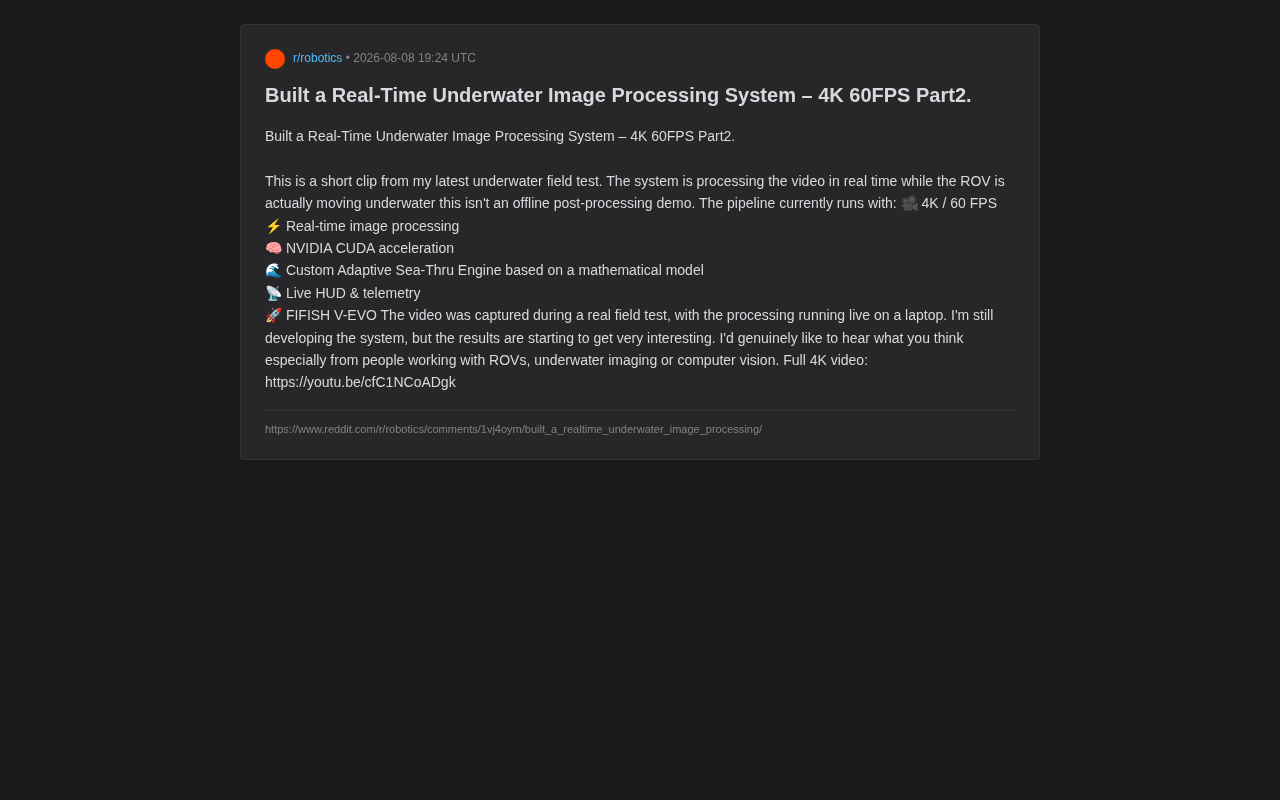
Recently, a developer shared the latest testing progress of his real-time underwater image processing system on Reddit. This system can process 4K resolution video at 60 frames per second in real time while an ROV (Remote Operated Vehicle) is actively moving and operating underwater — and to be clear, this is not an offline post-processing demo, but a genuine real-time pipeline running on a laptop in the field.
For anyone who has worked with underwater imaging, the difficulty here is obvious. The underwater environment degrades image quality in every conceivable way: light attenuation, color distortion, and particle scattering turn otherwise clear footage into murky, color-shifted, low-contrast imagery.
Specifically, the core challenges of underwater imaging stem from the physics of light propagation in water. First, there's selective attenuation: red light loses over 90% of its energy at just 3 meters depth, while blue-green light penetrates much further, causing underwater images to exhibit a pronounced blue-green color shift. Then there's forward scattering and backscattering — suspended plankton, sediment, and organic debris in the water randomly deflect light rays. Forward scattering causes image blur, while backscattering creates a fog-like veiling effect in front of the lens, severely reducing contrast. Additionally, available natural light decreases exponentially with depth, forcing ROVs to rely on artificial lighting, which introduces uneven illumination with a bright center and dark edges. These factors combined make underwater image restoration far more complex than atmospheric dehazing.
Achieving real-time HD processing under such demanding conditions requires an entire carefully designed technology stack.
Technical Pipeline Breakdown: How Real-Time 4K Underwater Processing Works
Based on information disclosed by the developer, the system's core technology stack includes the following key components:
4K 60FPS High-Spec Video Processing Capability
The system operates at 4K / 60 FPS, meaning it needs to process over 500 million pixels per second. More precisely, 4K resolution means each frame contains approximately 8.3 million pixels (3840×2160), and at 60FPS, the system must process roughly 497 million pixels per second. If each pixel requires RGB three-channel color correction, de-scattering calculations, and contrast adjustment — assuming a minimum of 50-100 floating-point operations per pixel — the system's computational throughput requirement reaches 25-50 billion floating-point operations per second (25-50 GFLOPS). This doesn't even account for potentially more complex operations like depth estimation and spatial filtering.
More critically, the latency budget for a real-time system is extremely tight — at 60FPS, the processing time window per frame is only about 16.67 milliseconds. Any computation exceeding this window causes frame drops or latency accumulation, impacting the operator's real-time control experience.
In an underwater scenario requiring complex color correction, achieving this throughput is no trivial feat. The developer explicitly emphasized that this is real-time processing, not post-editing, which fundamentally dictates that the entire architecture must be optimized for low latency.
NVIDIA CUDA GPU Acceleration
The key to achieving real-time performance lies in NVIDIA CUDA acceleration. Traditional image processing algorithms running on a CPU would find it nearly impossible to keep up with the data flood of 4K 60FPS in real time. Parallelizing computationally intensive tasks like color correction, de-scattering, and contrast enhancement onto the GPU is the inevitable choice for systems like this.
NVIDIA CUDA (Compute Unified Device Architecture) is a general-purpose GPU parallel computing platform that has become the de facto standard in scientific computing and image processing since its introduction in 2007. Modern NVIDIA GPUs have thousands of CUDA cores (e.g., the RTX 4080 has 9,728), each capable of independently executing floating-point operations. CUDA's programming model organizes tasks into a hierarchy of Grids, Blocks, and Threads, making it particularly suited for image processing — a classic SIMD (Single Instruction, Multiple Data) scenario where the same operation is applied to massive amounts of data.
In underwater image processing, operations like color correction and dehazing are inherently parallelizable at the pixel level — each pixel's processing is relatively independent and can be mapped to a GPU thread, with millions of pixels processed simultaneously. Additionally, CUDA supports special memory hierarchies like shared memory and texture memory, which can optimize operations requiring neighborhood pixel access, such as spatial filtering. Compared to cross-platform alternatives like OpenCL, CUDA typically delivers superior performance and more mature toolchain support on NVIDIA hardware.
CUDA enables developers to fully leverage the GPU's thousands of cores, distributing per-pixel computations across a massively parallel pipeline.
Adaptive Sea-Thru Underwater Color Restoration Engine
The most notable technology is the developer's custom Adaptive Sea-Thru Engine, which uses a mathematical model to restore true underwater colors.
Sea-Thru is an influential method in the field of underwater computer vision in recent years. It was proposed by Derya Akkaynak and Tali Treibitz from the University of Haifa at CVPR 2019 (IEEE Conference on Computer Vision and Pattern Recognition, a top-tier conference in computer vision), with the full paper title "Sea-Thru: A Method for Removing Water from Underwater Images."
Unlike traditional atmospheric dehazing models (such as dark channel prior), Sea-Thru recognizes that underwater image degradation cannot be simply described by a single scattering model. Its core innovation lies in decomposing underwater image degradation into two physical processes modeled separately: direct attenuation and backscatter. Mathematically, an underwater image can be expressed as:
I(x) = J(x)·e^(-β_D·z(x)) + B_∞·(1-e^(-β_B·z(x)))
Where J(x) is the true scene radiance, z(x) is the distance from the scene point to the camera, β_D and β_B are the direct attenuation coefficient and backscatter coefficient respectively, and these coefficients vary with wavelength λ. The method requires a distance map of the scene (obtainable through stereo vision or structured light) to solve for attenuation parameters, then inversely recovers true colors.
Unlike simple white balancing or histogram equalization, Sea-Thru attempts to "strip away" the water's influence from first physical principles. The original Sea-Thru was an offline processing method; adapting it into a real-time adaptive version requires solving the dual challenges of online parameter estimation and computational efficiency.
The "adaptive" nature of this system means it can dynamically adjust parameters based on real-time changes in water quality, depth, and lighting conditions — which is particularly important for an ROV operating in continuously changing imaging environments.
From Lab to Real Ocean: Field Validation
Real-Time HUD Display and Telemetry Integration
Beyond image processing itself, the system also integrates real-time HUD display and telemetry functionality.
The HUD (Head-Up Display) concept originally comes from fighter jet avionics systems, with the core idea of overlaying critical flight data in the pilot's field of view to avoid the attention split caused by looking down at instruments. In ROV operations, HUD telemetry is equally valuable. The underwater environment lacks the landmarks and sense of direction found on land, making operators heavily dependent on instrument data to assess the ROV's state. Typical ROV telemetry data includes: depth (from pressure sensors), heading (magnetometer or gyroscope), pitch and roll attitude (IMU — Inertial Measurement Unit), water temperature, battery level, thruster status, and more.
For ROV operators, this means key operational data such as depth, heading, and attitude can be overlaid on the processed, clear video feed, dramatically improving situational awareness during underwater operations. Displaying this data as an OSD (On-Screen Display) in real time on the video allows operators to simultaneously obtain environmental visual information and robot status from a single screen, significantly reducing cognitive load. Especially in extremely low-visibility underwater environments, telemetry data can sometimes be more important than the visual feed itself.
This integrated "processing + information overlay" design elevates the system from a mere image beautification tool to a truly practical operational assistance platform.
Test Platform: FIFISH V-EVO Underwater Robot
The hardware platform used for this test is the FIFISH V-EVO underwater robot. This is a consumer/professional-grade ROV produced by QYSEA (Shenzhen Fifish Technology), positioned in the prosumer market. The platform features 6-degree-of-freedom movement capability, a maximum dive depth of 100 meters, a 4K camera, and real-time video transmission. The V-EVO uses an omnidirectional vectored thruster system, enabling complex underwater maneuvers like hovering, lateral movement, and rotation — which is crucial for inspection and filming tasks requiring precise positioning.
Choosing a commercially available ROV platform as the carrier for the vision system reflects a "software-hardware decoupling" engineering strategy: the vision processing system processes the video signal transmitted back from the ROV without needing to modify the ROV's hardware, reducing integration difficulty while also making the visual processing solution theoretically adaptable to ROVs from other brands and models. The developer doesn't need to build a robot from scratch but can focus on their core strength — image processing innovation.
You might not have noticed, but the entire processing pipeline runs on a laptop rather than a dedicated workstation or cloud server. This is both a test of system efficiency and demonstrates its portability advantage for actual field deployment.
Why This Underwater Vision System Deserves Attention
From an industry perspective, this project addresses several core pain points in underwater computer vision:
First, real-time capability solves a critical bottleneck. A vast amount of underwater image enhancement research remains at the offline processing stage, and solutions that can truly process while capturing are extremely rare. For applications like underwater archaeology, pipeline inspection, marine research, and underwater rescue, operators need immediately usable clear imagery — not recordings they can only review clearly after returning to shore.
Second, physics-model-driven processing ensures color authenticity. Compared to currently popular pure deep learning "black box" enhancement approaches, methods based on the Sea-Thru mathematical model offer advantages in interpretability and physical accuracy, recovering colors that are closer to reality rather than "imagined."
Currently, two main technical approaches exist in the underwater image enhancement field. Deep learning methods (such as GAN-based WaterNet and UGAN, or Transformer-based architectures) train end-to-end on large collections of underwater image pairs and can produce visually appealing results, but have several fundamental limitations: training data bias can lead to color "hallucination" — generating colors that look beautiful but are physically inaccurate; model generalization is limited and may fail under water conditions not covered by the training set; additionally, the inference latency of complex neural networks is an obstacle for real-time applications. In contrast, physics-model-based methods work from first principles of optics, recovering colors with physical meaning and better adaptability to unseen water conditions. In fact, cutting-edge research is exploring the fusion of both approaches — using physical models to provide prior constraints while employing deep learning to estimate intermediate parameters that are difficult to measure directly.
This is crucial for research and inspection applications that demand extremely high fidelity.
Third, the engineering completeness of the software-hardware integration. From CUDA acceleration to HUD telemetry to actual ROV platform integration, this is no longer just an algorithm demo but a system prototype approaching practical usability.
Conclusion
The developer admits the system is still under active development and iteration, but notes that "the results are starting to get really interesting." He specifically hopes to receive feedback from ROV operators, underwater imaging professionals, and computer vision practitioners. The complete 4K video has been published on YouTube.
This kind of practical technological exploration driven by individual developers often produces surprisingly impressive results in vertical niche domains. Underwater vision is a direction with high technical barriers, significant application value, yet relatively niche audience. Seeing someone solidly stitch together physical models, GPU acceleration, and real-world field testing is itself something worth encouraging. We look forward to seeing more mature performance from this system in future iterations.
Related articles

AI Video Generation Makes 'Interdimensional Cable' Real: When a Sci-Fi Gag Becomes Reality
AI video generation technology turns Rick and Morty's Interdimensional Cable into reality. Explore how absurd AI content reshapes the creative industry and redefines value in the free content era.

Replayable A2A Jury: How to Trace Multi-AI Agent Decision Influence Chains
Deep dive into the Replayable A2A Jury project, exploring decision tracing and influence attribution in multi-agent collaboration systems, covering explainability, influence tracking, and debugging.

AI Faking Creativity: When Every Office's Ideas Start Looking the Same
Does AI truly have creativity? As enterprises adopt AI office tools, marketing copy collisions and proposal similarities are increasing. This article analyzes the limits of LLM creativity and how to avoid the homogenization trap.