Reality Is Far Richer Than We Imagine: Why Our Plans Always Fall Short

Why reality's hidden detail overflows every plan — and what to do about it.
The classic essay "Reality has a surprising amount of detail" argues that the real world is always richer than our mental models. This piece explores why abstract thinking systematically misleads us through the Planning Fallacy and recursive detail layers, how this manifests in software engineering and AI failures like distribution shift and the long-tail problem, and how embracing iterative action and cognitive humility helps us navigate irreducible complexity.
Introduction: A Deceptively Simple Question
A post titled Reality has a surprising amount of detail keeps resurfacing on Hacker News, consistently earning upvotes and lively discussion years after it was first published. Its central insight feels more relevant than ever — especially in an age when we increasingly rely on abstract models to make sense of the world.
The core argument is simple yet profound: the real world contains far more detail than any mental model we can construct. And it is precisely this richness of detail that underlies so many failed plans, stalled projects, and stalled innovations.
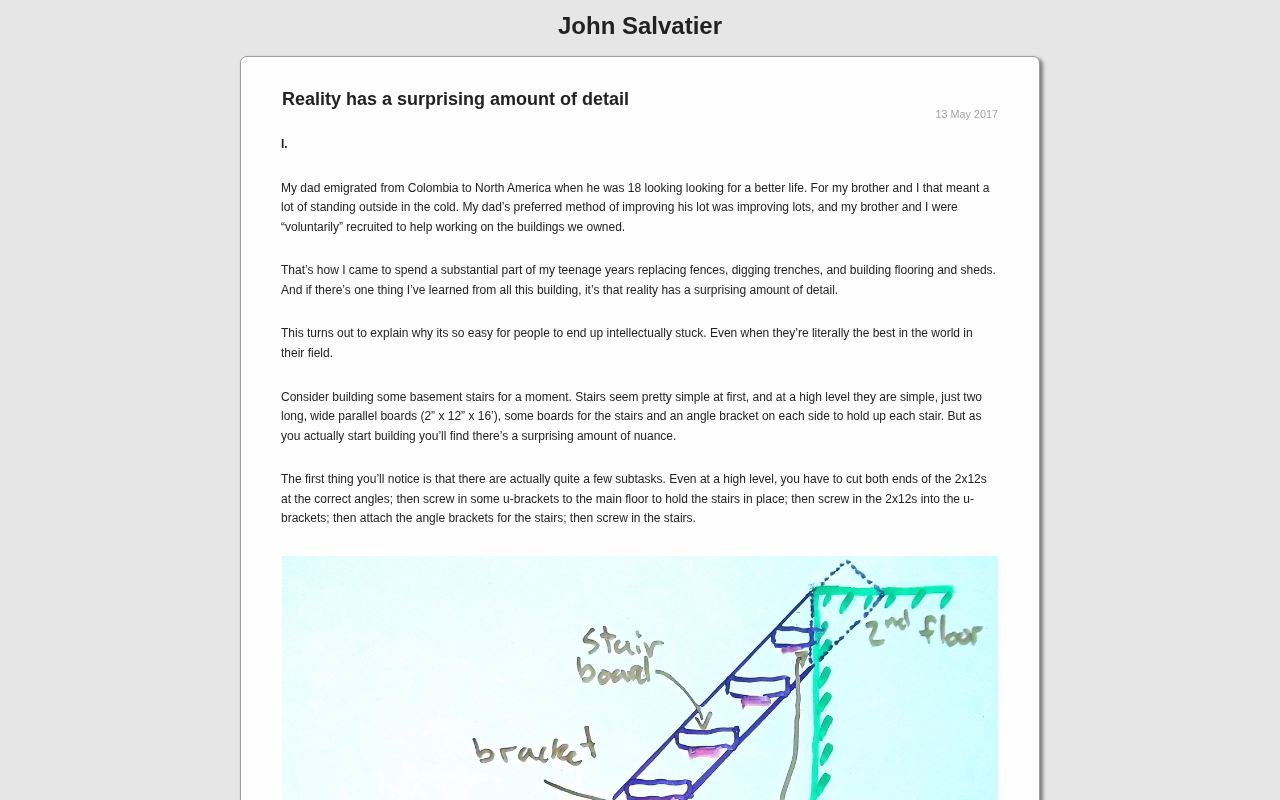
It Starts with a Wooden Staircase
The author opens with a vivid example: building a wooden staircase leading to a kitchen, together with his father. Before starting, his mental image of "building a staircase" was clean and simple — just nailing a few boards together. But the moment they began, that "simple" task exploded into countless micro-decisions.
The Detail Explosion Hidden Inside Simple Tasks
How tall should each step be? How deep? Where exactly do you cut the boards? How do you ensure everything is level? What if the floor isn't flat? Which screws should you use, and how long? Where do you drill the holes? Every seemingly trivial question required stopping, observing, measuring, judging, and deciding.
This leads to a key insight: from a distance, any task looks like a smooth, well-defined concept. Only when you move in close and actually engage with it do you discover it is built from countless details — details that are almost entirely invisible before you start.
Why Abstract Thinking Systematically Misleads Us
The human brain naturally gravitates toward abstraction and simplification. This is a highly efficient cognitive mechanism — if we had to hold every detail of every object in mind at once, thinking would grind to a halt. But this efficiency comes at a cost: systematic cognitive bias.
The Planning Trap of "I Thought It Would Be Simple"
Our plans are built on the abstract image we carry in our heads, not on the full, messy reality. This explains one of the most universal phenomena in human endeavor: nearly every project runs over time and over budget. The hidden details have not yet surfaced during the planning phase, so estimates are inevitably too optimistic.
Psychologists Daniel Kahneman and Amos Tversky named this systematic underestimation of task complexity the Planning Fallacy. Research shows that when predicting future tasks, the human brain tends to activate System 1 intuitive thinking, collapsing the task into an idealized linear sequence while ignoring the layered details that only System 2 can handle. This is closely related to the Focusing Illusion in cognitive psychology — during planning, we attend only to the most salient steps, and the details quietly vanish outside our field of attention.
The Planning Fallacy is not just a psychological phenomenon; it has a neurological basis. The prefrontal cortex, when planning future tasks, tends to construct a "best-case scenario" model rather than a probability-weighted realistic one. This is tied to the brain's Default Mode Network — highly active when we imagine the future, but operating through the recombination of episodic memory rather than precise prediction of detail. fMRI studies show that experts, when estimating tasks, additionally activate motor cortex regions associated with concrete execution. This is the neural mechanism behind expert intuition being more accurate: their brains have already encoded the details encountered across countless executions as implicit experience.
You cannot foresee details you have not yet encountered — this is not a question of ability, but a fundamental cognitive constraint. Only by entering a domain and actually doing the work do the details reveal themselves, layer by layer. This is the real reason why there is an unbridgeable gap between armchair theorizing and hard-won practical experience.
The Recursive Layers of Detail
There is a deeper observation here: detail has layers. Solve one level of detail, and you discover that each element contains its own sub-details. Once you sort out the stair tread problem, you run into issues with wood quality. Solve that, and you hit tool precision problems. This recursive unfolding is the fundamental source of real-world complexity — and why more experienced people consistently show greater respect for detail.
Computer scientist Douglas Hofstadter captured this with his famous Hofstadter's Law: Any task takes longer than you expect, even when you take Hofstadter's Law into account. This self-referential recursion precisely captures the nature of detail unfolding endlessly inward.
In software engineering, this phenomenon gave rise to the concept of Technical Debt — a term first coined by Ward Cunningham in 1992 as a metaphor: imperfect technical decisions made for short-term speed are like borrowed money, requiring extra development work to repay later. But modern software engineering research shows that technical debt behaves more like compound interest than a simple loan. A 2022 McKinsey survey found that large technology companies allocate an average of 40% of their technology budgets to managing technical debt rather than building new features. Neglected details entangle with each other: a poorly handled edge case can trigger cascading failures as a system scales, and fixing those failures exposes even more previously hidden details. Every ignored detail eventually charges the engineering team interest in the form of maintenance costs — and it tends to compound.
Deep Implications for Software Engineering and AI
This article never directly addresses technology, yet it resonates powerfully in developer communities — and for good reason. Its insights have direct practical implications for modern technical work.
The "Detail Tax" in Software Engineering
Every engineer knows the feeling: a feature is a single line in the requirements document, but implementing it requires handling edge cases, error conditions, performance bottlenecks, and compatibility issues across a mountain of detail. A feature that looks "simple" to a product manager is often a "detail hell" to the engineer. This cognitive gap is the everyday manifestation of the crack between abstraction and reality.
This phenomenon has been extensively documented in the software industry. Research from the US Department of Defense and NASA shows that software projects run an average of 50% to 100% over schedule, with more than 60% exceeding their budgets. The gap between abstract optimism in the planning phase and the detailed reality of the execution phase is the root cause of this persistent problem.
The Structural Gap Between AI Models and the Real World
In the AI domain, this insight cuts especially deep. Large language models and AI systems are, at their core, abstractions and compressions of reality. They perform well on typical cases, but when confronted with the rare, detail-laden "long-tail scenarios" of the real world, they frequently fail.
Machine learning uses the term Distribution Shift to describe the mismatch between the statistical distribution of a model's training data and its real-world deployment environment. This breaks down into three main subtypes: Covariate Shift, Concept Drift, and Dataset Shift. A 2019 Stanford study on medical AI found that a skin cancer diagnosis model showed performance differences of up to 15% across different hospital datasets — simply because different institutions used different brands of dermatoscopes. That seemingly minor "detail difference" was enough to render a top-paper model practically worthless in real-world deployment.
The Long-tail Problem specifically describes the vast number of low-frequency but critical edge cases in the real world. Reinforcement learning has its own term for this: the sim-to-real gap — the observation that robot policies trained in simulated environments frequently fail in the physical world due to countless small physical differences that the simulation didn't capture.
Waymo has publicly acknowledged that despite accumulating millions of miles of data in Phoenix, certain extreme weather conditions and unusual road situations remain vanishingly rare. This is exactly why a model with "99% accuracy" can still fail frequently in production — that remaining 1% often corresponds to the richest, most critical detail scenarios in reality. The persistent difficulty of fully deploying autonomous vehicles is, at a macro level, a direct expression of this principle.
Reality always contains more detail than the model — perhaps this sentence should be engraved on every AI practitioner's desk. Embracing AI's capabilities while maintaining humility about the inevitable gap between models and reality is essential knowledge for everyone in the field.
How to Live with the Richness of Detail
Recognizing the complexity of reality does not mean succumbing to pessimism or paralysis. On the contrary, it is the starting point for a more mature philosophy of action.
Embrace Learning by Doing
Since details only reveal themselves through action, the best strategy is to start early. Rather than spending enormous effort on "perfect planning," move into practice quickly and let reality teach you the details you could not have foreseen.
Agile Development is not merely a project management toolkit — it rests on a deep epistemological foundation. Its philosophical roots trace back to Karl Popper's falsificationism and John Dewey's pragmatist epistemology: knowledge comes from the cycle of action and feedback, not from pure a priori reasoning. The 2001 Agile Manifesto's emphasis on "responding to change over following a plan" is an institutional acknowledgment of the unpredictability of real-world detail. By contrast, the traditional Waterfall Model assumes that detail can be fully planned upfront — and routinely encounters massive surprises during execution.
It is worth noting that Agile is not universally optimal. High-safety domains like aerospace and nuclear power still rely on rigorous upfront waterfall-style planning, because in those contexts, "learning by doing" can be catastrophic. NASA's principle of "Test as you fly, fly as you test" is also a strategy for surfacing real-world details as early as possible — just in a far more rigorous and systematic form. This actually underscores the depth of the original insight: how to respond to the unpredictability of detail requires different institutional choices depending on the cost of failure.
The Minimum Viable Product (MVP) methodology follows the same core logic: enter reality at the lowest possible cost, and let real user behavior and market feedback reveal the critical details that could never have been foreseen in a conference room. Agile, rapid prototyping, MVP — at their core, all of these are institutional forms of respect for the complexity of reality.
Build in Buffers for Unknown Details
When estimating time and resources, actively leave room for "details not yet surfaced." Experienced engineers and project managers know this well: multiplying the initial estimate by 2 or even 3 tends to produce a number much closer to the truth. This is not a sign of incompetence — it is an honest acknowledgment of real-world complexity.
Stay Curious and Cultivate Cognitive Humility
Finally, the article conveys a profound wisdom: approach everything with curiosity, because it is richer and more interesting than you think. When you feel you understand something, you have usually only grasped its abstract surface. True mastery comes from being willing to go deep into the details that others overlook.
Conclusion
Reality has a surprising amount of detail continues to be rediscovered and discussed years after its publication because it touches something timeless. In an era of increasing reliance on abstractions, models, and AI, we need the constant reminder: do not mistake the model for reality, and do not mistake the abstraction for the whole. The rich detail of the real world is both the reason our plans so often falter and the very thing that makes this world worth endlessly exploring.
Whether you are building a wooden staircase or training an AI model, approaching the complexity of reality with humility may be the truest starting point for wisdom.
Related articles

Kimi K3 Launches on Telnyx Inference API: A New Path for Chinese LLMs Going Global
Moonshot AI's Kimi K3 is now available on Telnyx Inference API. Explore how Chinese LLMs are entering global developer ecosystems through third-party inference platforms.

The Truth Behind Codex 'Build a Website in 5 Minutes': AI Isn't Creating Sites—It's Helping You Copy Them
Exposing the truth behind viral Codex 5-minute website videos: creators aren't building original sites with AI—they're copying shared prompts or scraping others' work. Learn AI coding tools' real limits.

Getting Started with AI Agent Development: A Complete Guide from Concept to Practice
A comprehensive guide to AI Agent architecture and development, covering automated marketing, intelligent customer service, and investment analysis scenarios with single and multi-agent collaboration.