RearAware: A Local AI That Blurs Cat Butts Reveals the Dataset Dilemma

A cat-butt-blurring AI project exposes the universal challenge of building niche computer vision datasets.
RearAware is a local-first Chrome extension that uses AI to detect and blur cat butts during video meetings. While humorous, the project highlights a critical challenge in computer vision: collecting sufficient labeled data for niche targets. With only 200 usable positive samples out of 1,500 cat photos, the developer explores data augmentation, synthetic generation via diffusion models, crowdsourcing, and transfer learning as viable expansion strategies.
A Ridiculous Yet Real Work-From-Home Pain Point
In the era of remote work, cat owners have probably all experienced this awkward moment: you're in a video meeting with colleagues when your cat suddenly jumps onto the desk and plants its rear end right in front of the camera. This seemingly absurd scenario gave rise to an equally entertaining open-source project — RearAware.
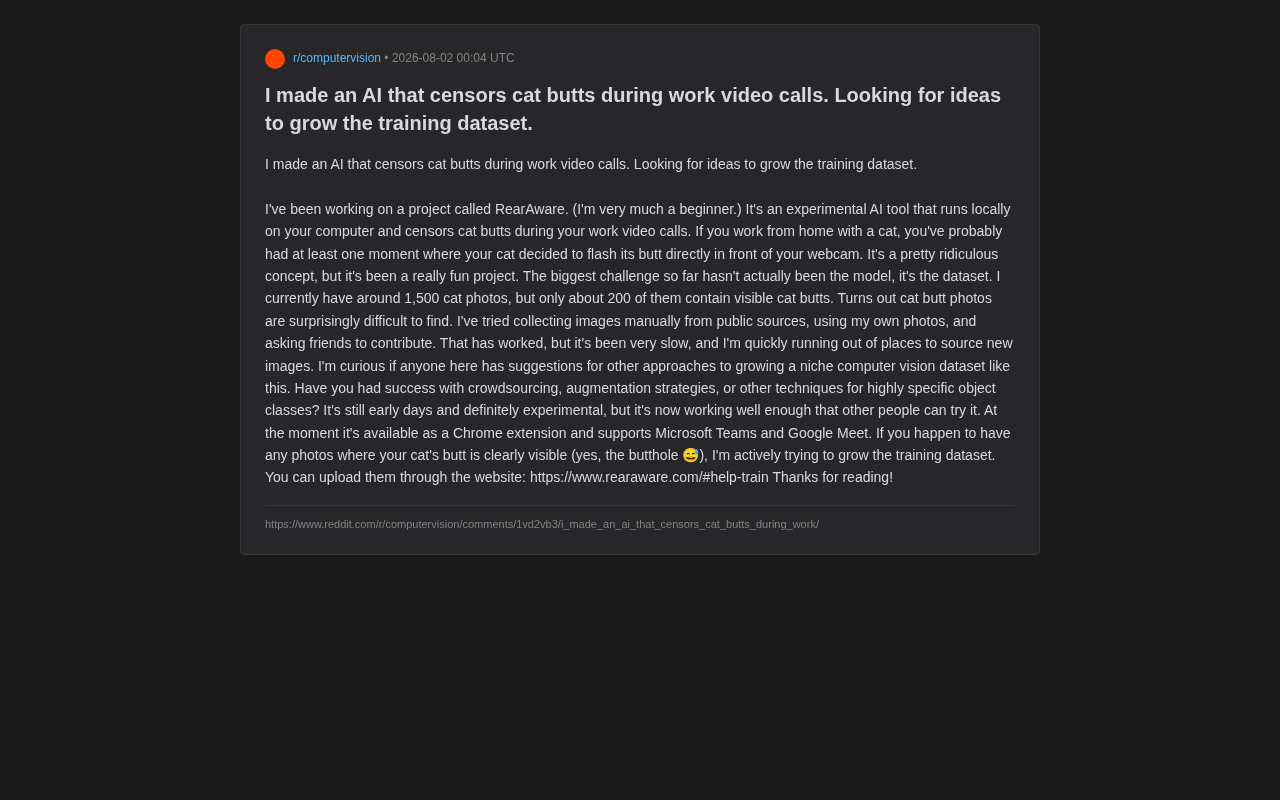
According to a self-described "beginner" developer on Reddit, RearAware is a fully local, experimental AI tool designed to detect and blur "cat butts" in real-time during video meetings. It currently ships as a Chrome extension supporting Microsoft Teams and Google Meet.
While the project is clearly tongue-in-cheek, it addresses a real work-from-home scenario and inadvertently exposes the most common — and most underestimated — bottleneck in computer vision projects: the dataset.
The Real Challenge Isn't the Model — It's the Dataset
The developer admits that the biggest challenge of this project "isn't the model itself, but the dataset." This statement will ring true for anyone who has worked on a real computer vision project.
Currently, the developer has about 1,500 photos of cats, but only around 200 of them contain a clearly visible "cat butt." That means positive samples account for less than 14%. For a model that needs to precisely detect a specific target, this quantity and proportion of positive samples are far from sufficient.
Why Is "Cat Butt" Data So Hard to Collect?
This actually reflects a universal dilemma faced by fine-grained, niche object detection tasks:
- Scarcity of public datasets: Mainstream cat image datasets mostly focus on cat faces, breed recognition, or overall posture — virtually none have a specifically labeled "rear close-up" category. In computer vision, the richness of available datasets directly determines the boundaries of what's possible in research and applications. ImageNet has over 14 million labeled images, and the COCO dataset contains 330,000 images across 80 object categories. These large-scale general datasets have fueled the rapid development of modern deep learning. However, once requirements deviate from mainstream categories — such as detecting specific animal postures, industrial defects, or rare medical imagery — developers often find that publicly available labeled data is virtually nonexistent. This "data desert" phenomenon is particularly pronounced for long-tail object categories and remains one of the most common bottlenecks when deploying AI in industry.
- Low willingness to photograph: When people photograph their cats, they instinctively aim at the face rather than the rear, making such images naturally scarce on the internet.
- Scene specificity: RearAware needs images from a specific angle — "facing directly toward the camera" — which further narrows the pool of usable samples.
The developer tried manually collecting from public sources, using personal photos, and soliciting from friends. While effective, it was slow, and sources were quickly "exhausted."
Strategies for Expanding Niche CV Datasets
The developer asked the community for advice on expanding niche computer vision datasets. This is actually a universal problem worth discussing in depth. For similarly highly specific target categories, the industry typically has several viable paths.
Data Augmentation
With only 200 positive samples, data augmentation is practically mandatory. Common techniques include random rotation, flipping, cropping, color jittering, and brightness/contrast adjustments. For video conferencing scenarios, you can also simulate different lighting conditions, camera distortion, motion blur, and other conditions to make the model more robust in real-world usage environments.
The philosophical foundation of data augmentation lies in applying reasonable geometric and photometric transformations to existing images to simulate the image variations a model might encounter during actual deployment. Beyond traditional geometric augmentation, advanced strategies have emerged in recent years, including Mixup (blending two images and their labels), CutMix (pasting a region from one image onto another), and Mosaic (stitching four images into one). For object detection tasks, augmentation operations need to synchronously transform bounding box annotations to ensure label accuracy. Research shows that well-designed data augmentation strategies can effectively multiply dataset size by 5-10x — which is hugely significant for RearAware with its mere 200 positive samples.
Synthetic Data and Generative Models
Using diffusion models (such as Stable Diffusion) to generate large quantities of "cat butt" images is currently a popular approach for expanding niche datasets.
Diffusion models represent a major breakthrough in generative AI. The core idea is: during training, Gaussian noise is progressively added to images until they become pure noise, then a denoising network learns to reverse this process. During inference, starting from random noise, the model can progressively generate high-quality images. Stable Diffusion, as an open-source representative, supports text-guided generation, meaning developers can control the content, angle, and scene of generated images through precise text prompts. When used for dataset expansion, it's typically combined with conditional control techniques like ControlNet to ensure generated images meet training requirements in terms of pose, composition, and other aspects.
Generated data can cover angles and scenarios that are difficult to capture in reality, but it's important to note: the distribution of synthetic data may deviate from real data (the so-called "domain gap"). It often needs to be mixed with real samples during training and rigorously validated to ensure the model doesn't overfit to the specific style or texture patterns of generated images.
Crowdsourced Collection
The developer has already opened an image upload channel on the official website, inviting cat owners worldwide to contribute "rear close-ups" of their cats. This crowdsourcing model is especially effective for niche datasets — long-tail scenarios that a single developer can't possibly cover can be quickly filled through the scale advantage of a community. However, crowdsourcing also introduces challenges like inconsistent data quality, labeling inconsistency, and privacy compliance, requiring screening and review mechanisms.
Transfer Learning and Pre-trained Model Fine-tuning
For beginners, training from scratch often yields poor results relative to effort. A more practical approach is to fine-tune existing general-purpose object detection models (such as the YOLO or DETR family) and only use a small number of positive samples to teach the model to recognize new categories. Pre-trained models already possess powerful general visual features, significantly reducing dependence on data volume.
YOLO (You Only Look Once) is a landmark architecture in object detection. Its core innovation lies in transforming the detection problem into a single regression problem — one forward pass simultaneously predicts the locations and classes of all objects, achieving real-time detection. From YOLOv1 to the latest YOLOv8/v9, the series has continuously optimized the speed-accuracy tradeoff, making it particularly suitable for edge devices and real-time applications. DETR (Detection Transformer), proposed by Facebook Research, is a Transformer-based detection model that abandons traditional hand-designed components like anchor boxes and Non-Maximum Suppression (NMS), directly predicting object sets in an end-to-end manner. Both provide rich pre-trained weights, making fine-tuning on small datasets possible — typically requiring only a few hundred annotated images to achieve usable detection results. For scenarios like RearAware that need to run in real-time in a browser, lightweight versions of the YOLO series (such as YOLOv8-nano) are especially suitable, with model sizes compressible to just a few MB.
Local Execution: A Privacy-Friendly Architecture
It's commendable that RearAware chose a fully local execution architecture. Video conferencing footage is highly sensitive privacy data — uploading frames to the cloud for processing would be unacceptable in terms of both latency and privacy risk. Local inference ensures real-time performance while eliminating concerns about data leakage.
From a technical implementation perspective, running AI models in the browser primarily relies on technologies like WebAssembly (WASM) and WebGL/WebGPU. Frameworks such as TensorFlow.js and ONNX Runtime Web allow developers to deploy trained models directly in the browser environment, leveraging the user's device CPU or GPU for inference computation. Chrome extensions can inject Content Scripts into web pages through the Manifest V3 architecture to intercept and process video streams. Specifically for RearAware's scenario, the extension likely captures frame data from <video> elements, performs inference and pixel-level blurring on a Canvas, then outputs the processed frames to the WebRTC stream. This architecture ensures video data always stays on the user's device and never passes through any external server.
This also shows that even for a "just for fun" project, the developer still followed responsible engineering practices in architecture decisions. For any AI application involving real-time video processing, local-first is a design direction worth emulating.
Big Lessons Behind a Small Project
RearAware is essentially a lighthearted weekend project, but it has inadvertently become an excellent teaching case.
First, data determines the ceiling. No matter how clever an idea is, without sufficient high-quality data, the model can't be deployed effectively. This is why data collection and cleaning often account for the vast majority of work in real projects — there's a widely circulated saying in the industry: "Machine learning engineers spend 80% of their time on data and the remaining 20% complaining about data quality."
Second, niche tasks require unconventional approaches. When public data can't meet requirements, crowdsourcing, synthesis, augmentation, and transfer learning are all tools worth combining.
Third, start from solving a concrete problem. RearAware didn't chase grand narratives — it precisely solved a real, albeit minor, embarrassment. This "small but beautiful" product philosophy is exactly what many successful independent projects have in common.
For beginners, diving into AI engineering through a project you'd actually use and find fun might be more sustainable than grinding through textbooks. And the story of RearAware reminds us: the barrier to AI is lowering, but the value of data has never changed.
Related articles

Go Microservices in Practice: Detailed Architecture for E-Commerce, AI Agent, and IM System Integration
Deep dive into integrating e-commerce, AI Agent, and IM systems under Go microservices architecture, covering unified auth, gRPC, componentized Agent engines, and group chat bots.

X Platform's Recommendation Algorithm Caught Filtering Brazilian Election Content, Reigniting Algorithm Transparency Debate
X (formerly Twitter) was found filtering Brazilian election content in its For You feed, sparking debate over algorithm transparency and free speech.

Poison-Resistant Concept Anchoring: A New Approach to Defending Against AI Data Poisoning
Deep dive into Poison-Resistant Concept Anchoring, defending against data poisoning via signed anchors and bounded updates. Experiments show 62% poison isolation with 0% false rejection rate.