Reckon: An iOS Quantified Self Tool That Calibrates Your Judgment Through Decision Journaling
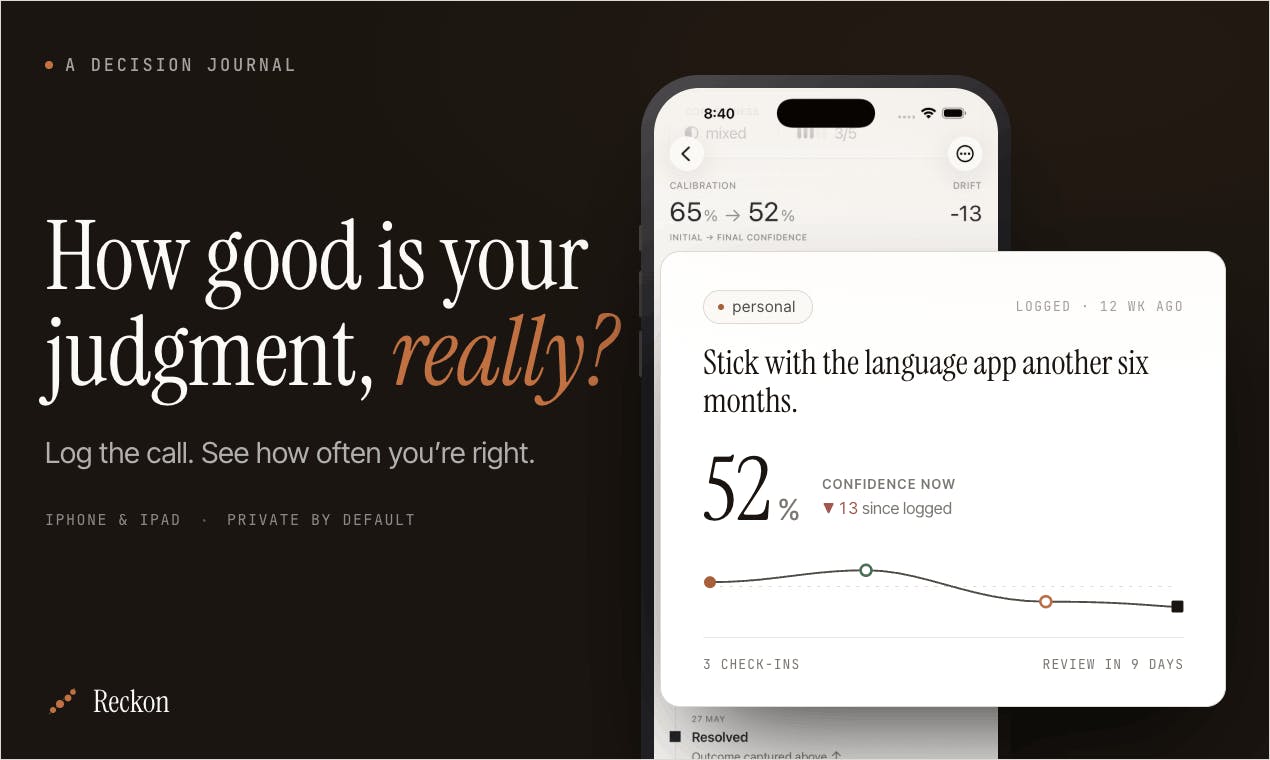
Reckon is an iOS decision journal that helps you calibrate judgment by tracking predictions and confidence over time.
Reckon is an iOS decision journal app that combats hindsight bias by letting users record predictions, quantify confidence levels, log reasoning, and revisit outcomes weeks later. With check-in mechanisms, iCloud-based zero-knowledge privacy, and a one-time purchase model, it turns calibration science into a personal tool for systematically improving judgment quality over time.
The tricky thing about decisions is that they seem to settle like dust the moment they're made. We rarely look back to examine whether our predictions were accurate or our confidence was overblown, because hindsight quietly rewrites our memories. Reckon, an iOS app recently launched on Product Hunt, aims to address exactly this blind spot — it's a decision journal tool focused on "calibration," currently ranking #11 with 82 votes across the iOS, Productivity, and Quantified Self categories.
Why We Need a Decision Journal
Human judgment has a systematic flaw: hindsight bias. Once an outcome is revealed, we unconsciously reconstruct our memories, thinking "I knew it all along." This self-soothing mechanism makes it nearly impossible to truly learn from past decisions, because what we remember isn't our original thinking — it's a version contaminated by the outcome.
Hindsight bias is one of the most thoroughly studied systematic biases in cognitive psychology, first formally established by psychologist Baruch Fischhoff through a series of experiments in 1975. The mechanism involves memory reconstruction: once we learn an outcome, the brain automatically integrates that information into existing knowledge structures, making cues consistent with the outcome more salient while suppressing contradictory information. Nobel laureate Daniel Kahneman called it "the illusion of understanding the past" in Thinking, Fast and Slow, noting that it not only affects individual decisions but profoundly distorts performance evaluation and accountability in organizations. This is precisely why relying on "post-hoc reflection" alone to improve judgment is almost futile — you need to lock down evidence before the fact.
Reckon's product logic is built squarely on combating this bias. Its core proposition is straightforward: preserve the things that hindsight erases — the prediction itself, the confidence level at the time, and the reasoning behind it. Once these three elements are locked in, they become irrefutable "evidence" that allows you to honestly confront the quality of your own judgment.
From Prediction to Review: Reckon's Complete Decision-Recording Loop
The app's greatest value lies in its design of a recording chain that covers the entire lifecycle of a decision, rather than simply "jotting down a choice."
At Decision Time: Locking In Predictions and Confidence Levels
At the moment of making a decision, you write down your prediction, assign a confidence level, and record your reasoning. This step is the foundation of the entire system. Quantifying the confidence level is particularly crucial — it transforms vague statements like "I think there's probably an 80% chance this will work" into verifiable numbers.
During the Process: The Check-in Mechanism Captures Changing Information
Reckon introduces a "check-in" mechanism for recording changes that occur before the outcome is revealed. Whenever new information surfaces, you can tag it as positive or negative and update your confidence level accordingly. This is a clever design choice, because real-world decisions are rarely static one-time judgments. Information constantly flows in, and how we interpret that information is often the real source of judgment bias.
Outcome and Re-examination: Two Rounds of Interrogating Your Judgment
When the outcome arrives, you record what actually happened. But the real depth of the product shows in the next step: weeks later, Reckon proactively asks — if you could do it all over again, would you make the same decision?
This question separates two concepts that are routinely conflated: "outcome quality" and "decision quality." A good decision can yield a bad outcome due to bad luck, and a bad decision can succeed by sheer chance. Professional poker player Annie Duke calls the instinct to judge decision quality by outcomes "resulting" in her book Thinking in Bets. In probabilistic environments, this way of thinking is deeply deceptive: losing with an 80% winning hand doesn't mean the bet was wrong, and going all-in on a bad hand and winning doesn't mean the decision was brilliant. The most dangerous quadrant is precisely "bad decision, good outcome" — it reinforces wrong behavior and sets people up for bigger losses down the road. Reckon's "revisit weeks later" design forces users into this decision-outcome separation framework rather than letting results hijack their judgment. Distinguishing between the two is the core discipline of improving judgment.
Long-Term Value: Seeing Your Calibration Curve
Reckon's long-term value proposition is compelling. According to the official description, after a year of consistent journaling, you'll be able to see where your confidence "overshoots," where it "undershoots," and which types of decisions you're sharpest at.
This effectively productizes the concept of "calibration" — a principle repeatedly emphasized in forecasting science and probabilistic thinking — into a tool individuals can actually use. The concept of calibration was first systematically applied in meteorology — weather forecasters were the earliest professional group to be evaluated on calibration at scale, and research found that forecasters who received long-term feedback training could indeed achieve remarkably high calibration levels. In the broader field of forecasting science, Philip Tetlock's "Superforecasters" project is a landmark in calibration research: the project found that the top performers in geopolitical forecasting shared a core trait of being well-calibrated — they could precisely distinguish between 60% and 75% confidence. The core methodology of calibration training includes: converting vague intuitions into probability numbers, establishing feedback loops, and conducting unbiased post-hoc reviews.
A well-calibrated person, when saying "I'm 70% confident," should see their predictions in that category succeed close to 70% of the time. Most people never get the chance to verify whether their confidence is reliable, and Reckon provides exactly that kind of long-term mirror. For investors, entrepreneurs, product managers, or anyone who values rational decision-making and regularly needs to make judgment calls, the value of this feedback loop should not be underestimated.
Product Design and Privacy
In terms of specifics, Reckon currently supports iPhone and iPad. It uses iCloud sync and requires no account registration — meaning data stays within the user's own Apple ecosystem with no need to trust third-party servers, a notably restrained privacy posture.
From a technical architecture perspective, this choice is a variant of "zero-knowledge" design. All information is stored in the user's personal iCloud container, protected by Apple's end-to-end encryption infrastructure, with the developer having absolutely no access to user data. This architecture is especially important for decision journal apps: the predictions, confidence levels, and reasoning processes users record often involve career decisions, investment judgments, and even interpersonal assessments — highly sensitive cognitive data. On the implementation side, iCloud's CloudKit framework allows apps to read and write data in a user's private database, with cross-device sync handled at the Apple system level. The developer doesn't need to maintain server infrastructure — which also dramatically reduces operational costs for indie developers, making a one-time purchase business model economically viable.
The business model is a one-time purchase rather than the currently popular subscription model — a plus for users tired of subscription fatigue. Without server costs, there's no need for recurring revenue to cover operational expenses, creating a self-consistent business logic between one-time payment and zero-server architecture. The developer is Roland Leth.
Summary: A Small but Sharp Judgment Training Tool
Reckon is a classic example of a "small but sharp" utility product: rather than piling on features, it goes deep on a specific cognitive problem — self-calibration of judgment. Its success largely depends on whether users can develop the habit of consistent journaling, since "insights after a year" require a year of commitment to unlock. This is the retention challenge shared by all quantified self apps.
The severity of this challenge shouldn't be underestimated. The Quantified Self movement began in 2007, initiated by Wired magazine editors Kevin Kelly and Gary Wolf, with the core idea of gaining self-knowledge through data tracking. Yet for over a decade, the field has faced a persistent dilemma: user retention drops dramatically after the initial novelty wears off. Research shows that roughly one-third of wearable device users stop using them within six months. Unlike hardware devices that collect data automatically, apps requiring manual input face an even steeper retention challenge — the "present bias" in behavioral economics means users tend to undervalue future insights while overestimating the cost of recording in the moment. Products that successfully overcome this barrier typically rely on three strategies: extremely low recording friction, instant micro-feedback, and social accountability mechanisms. Reckon's check-in mechanism can be seen as an attempt to reduce the cognitive burden of each recording session, but the lack of a social layer may be a potential weakness for long-term retention.
Still, from a design philosophy standpoint, Reckon has seized upon a real and universal pain point. In an era that increasingly emphasizes data-driven decision-making, we pour enormous effort into optimizing external systems yet rarely systematically optimize ourselves as "judgment machines." What Reckon offers is the opportunity to run a long-term regression test on yourself.
Related articles

Kira Community: How an AI Creation Tool Is Transforming Into a Creator Community
Kira Community pivots from an AI image/video generation tool to a creator community, using hashtags to organize content and help creators build portfolios and find peers.

DeepSeek V4 Pro Real-World Test: 7 Projects Reveal Its True Coding Ability and Value
Real-world test of DeepSeek V4 Pro across 7 projects covering frontend, backend, 3D games, and long tasks. Frontend lags behind Claude, but at 1/180th the cost.

Google Search Launches Five AI Learning Features: A Complete Guide to Test Prep Assistants and Smart Learning Platforms
Google Search launches five AI learning features covering standardized test prep, structured knowledge review, and interactive practice — transforming search into a smart learning platform.