Reddit Community Debate: Is Strata Being Spammed by Bots, or Is It Actually That Good?

Reddit user invokes a KonoSuba cult joke to call out Strata's bot-spam problem, exposing tech community fatigue with over-marketing.
A Reddit post calling out Strata for being relentlessly spammed by suspected bot accounts struck a nerve across the community. The poster borrowed a KonoSuba cult analogy — "manufacture anxiety, offer the one true solution" — to skewer the manipulative pattern behind suspicious marketing behavior. The real tension isn't about Strata's product quality, but a growing trust crisis: when authentic user recommendations become indistinguishable from bot-driven spam, even genuinely good products get damaged by the noise. The post subtly reflects a deeper anxiety about AI-era information pollution in tech communities, reminding product teams that restraint in marketing often delivers more long-term value than mass bombardment.
A Community Phenomenon Behind One Complaint Post
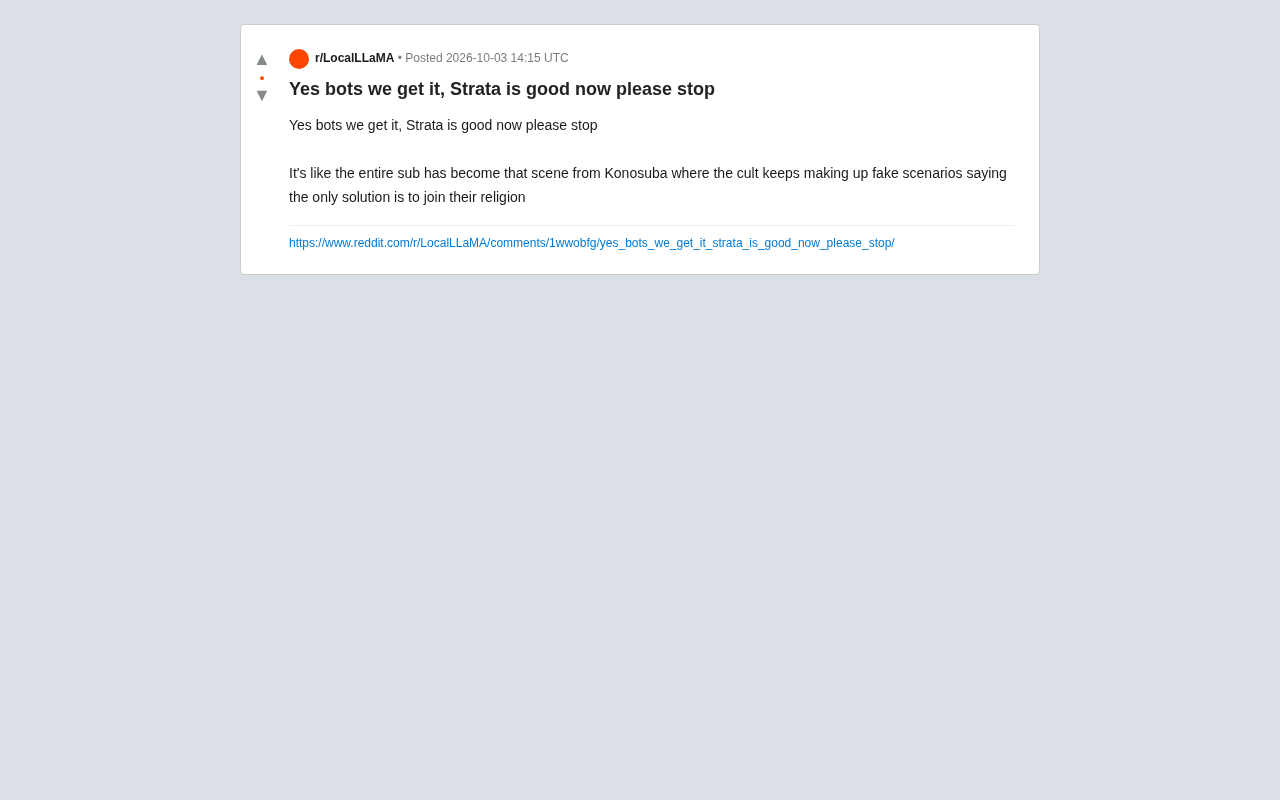
A Reddit post has recently sparked considerable discussion. The title is blunt and weary: "Yes bots we get it, Strata is good now please stop."
The poster used a vivid analogy, comparing the current state of the community to a scene from the anime KonoSuba: God's Blessing on This Wonderful World! — where a cult continuously fabricates various fake scenarios and repeatedly claims that joining their religion is the only solution.
Though brief, the post precisely captured a phenomenon that's far from uncommon in tech communities: when a product or tool is suddenly recommended with unusual frequency — almost mechanically — real users tend to grow suspicious and fatigued.
Why Spammy Recommendations Backfire
The poster's core frustration isn't directed at Strata as a product, but at the flood of repetitive, seemingly bot-driven recommendations saturating the community.
This kind of thing appears across all sorts of tech forums and communities. When positive reviews of a tool show up with abnormal frequency and suspiciously similar phrasing, it's natural for users to wonder whether there's an organized promotional campaign at play — rather than genuine word-of-mouth.
The phrase "we get it" in the post speaks for many community members: even if a product is genuinely good, excessive and repetitive promotion can backfire, triggering a psychological resistance that leaves people more skeptical, not less.
Psychologically, this can be explained by the Reactance Effect: when people feel their autonomy of judgment is being deliberately manipulated by an external force, they tend to push back — even if they were previously neutral or even positive about the product. The mere exposure effect also reverses here — while moderate repetition normally increases likeability, once the frequency crosses a psychological threshold and the exposure is perceived as inorganic, favorability drops sharply. For tech communities, this trust erosion is especially damaging, because the credibility of peer recommendations is foundational to how technical products build their reputations. Once the authenticity of those recommendations is called into question, the entire information source loses its value.
Why the KonoSuba Analogy Hits the Mark
The KonoSuba cult reference is a remarkably apt comparison. In that storyline, cult members constantly manufacture and amplify problems, then position joining their religion as the one and only salvation.
This "manufacture anxiety → offer the single solution" pattern is a textbook move in many dubious marketing playbooks. Applying it to community product recommendations implies that the poster suspects these repetitive endorsements may carry a deliberately manipulative agenda.
The analogy resonates because it uses lighthearted humor to surface a real concern: that the community's information environment may be getting contaminated.
A Trust Crisis in Tech Communities
What looks like a joke of a post actually touches on something deeper: in an era where bot accounts and automated marketing are increasingly common, authentic reputation-building in tech communities is under genuine threat.
When users can no longer tell whether a recommendation reflects a real personal experience or a carefully orchestrated campaign, the trust foundation of the entire community begins to erode. This is precisely why — even if Strata is a genuinely excellent product — this kind of spam-style promotion can end up hurting its reputation.
For product teams, this is a warning worth heeding: over-marketing can sometimes be more destructive than silence. And for community members, maintaining independent judgment and staying alert to unusual recommendation patterns is becoming increasingly important.
The typical playbook for bot accounts in community marketing includes: registering accounts in bulk, mimicking the posting cadence of real users, copy-pasting varied versions of the same recommendation across different threads, and cross-upvoting to boost visibility. Platforms like Reddit do have anti-abuse mechanisms, but with the rise of large language models, AI-generated natural language has become increasingly difficult for both algorithms and humans to detect. This practice — known as "AstroTurfing" — is nothing new; it existed across Web 2.0 forums long before today. But generative AI has dramatically lowered the cost and expanded the scale. Tech community users on platforms like Hacker News and Reddit tend to be especially sensitive to this, partly because they have the technical background to spot abnormal patterns — which is why repetitive recommendations often trigger swift collective pushback and public discussion.
Takeaway
This Reddit post, in its tongue-in-cheek way, reflects a collective exhaustion in tech communities with bot-driven spam and over-the-top marketing. It's a reminder that genuine reputation is built on restraint and authenticity — not sheer volume.
It's worth noting that the original source material is limited in scope. The post itself doesn't elaborate on Strata's specific features, what category it belongs to, or the true origins of the "spam" wave — all of which would benefit from additional context.
Related articles

Why Does the Tesla Roadster Need to Fly? A Deep Dive into Musk's Wild Demo
Tesla's Roadster launch showed wall-climbing, upside-down driving, and flying stunts—but The Vergecast notes the demo car may lack a battery, the Rocket version is invite-only and not street-legal, and the website terms don't guarantee delivery. After nine years of delays, why does this car still need to exist?

AI Is Not a Replacement: Human-AI Collaboration Through the Lens of Factory Root Cause Analysis
Starting from factory root cause analysis, this article explains how AI accelerates evidence chain construction rather than replacing human experts, exploring the pragmatic implementation logic and business value of 'AI supporting people rather than replacing them.'

AI Agent Decision Auditing: Building an Evidence Chain in Regulated Workflows
Starting from a Reddit discussion, this article analyzes three core issues in AI agent decision auditing within regulated workflows: what fields audit records should contain, how to handle feedback latency for erroneous decisions, and how to continuously calibrate LLM judge consistency with human judgment.