Reddit Debates: Is the Model Value Ranking Chart a Masterpiece or Propaganda?

Reddit mocks a model cost-effectiveness ranking, exposing unclear metrics and comparability flaws.
A model cost-effectiveness ranking chart on Reddit sparked mockery: users sarcastically cited "3.6/0 approaches infinity" to criticize unclear metric definitions, engaged in math memes over "6 Luna divided by 0.50," and joked the sub "only bashes OpenAI." Serious comments noted two flaws: data based on OpenRouter (some models unavailable, comparability doubtful) and no coverage of 100k+ contexts (misleading), with no response from the publisher. The article advises developers to rely on actual stress testing rather than rankings.
A model value-ranking chart sparked widespread mockery on Reddit. Users joked about Gemini 3.6's "infinite cost-effectiveness," argued over what 6 Luna divided by 0.50 actually equals, and couldn't resist adding: "This sub only bashes OpenAI." Behind the jokes lies the community's collective distrust of AI leaderboard methodology.
A Math Carnival Sparked by One Chart
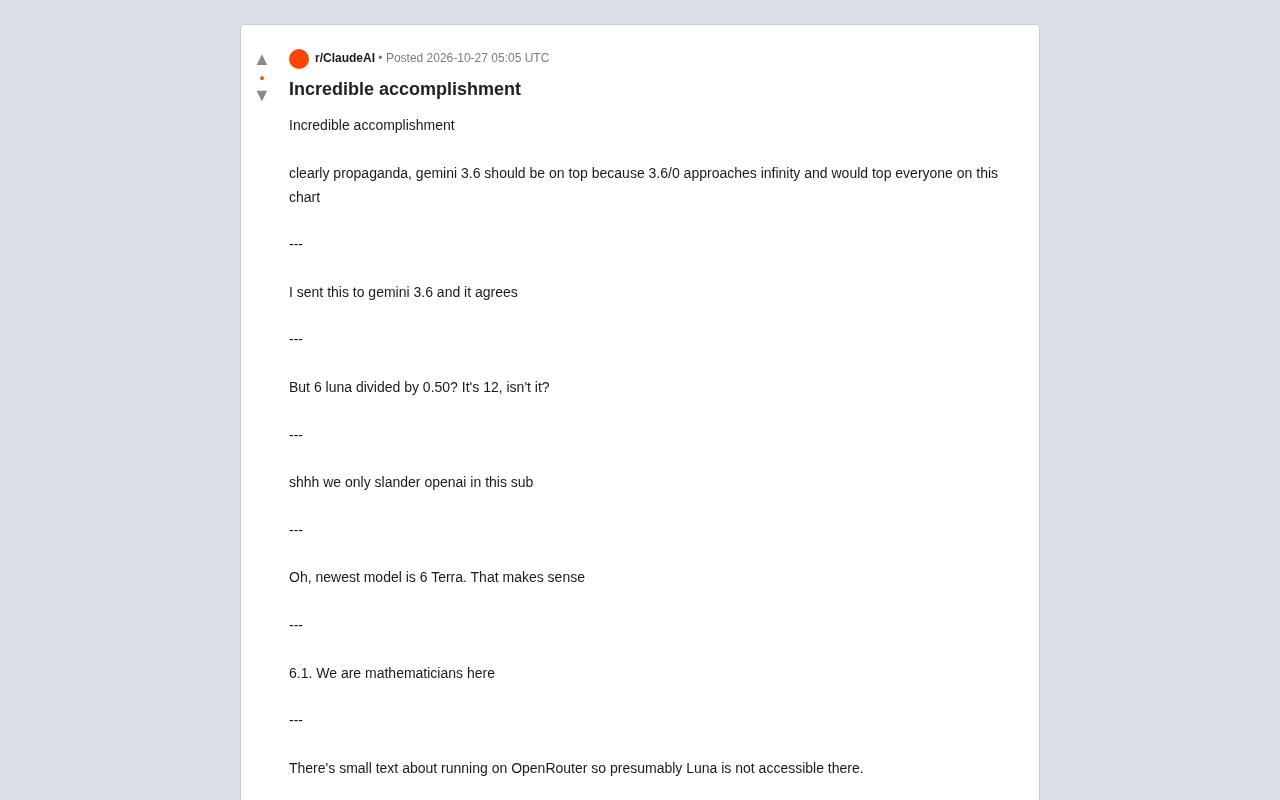
The original post's title was simply "Incredible accomplishment," accompanied by an image allegedly showing a model cost-effectiveness ranking. The comment section quickly went off the rails: some claimed Gemini 3.6 should top the list because "3.6/0 approaches infinity," which by that logic would crush the entire ranking; others chimed in saying they'd sent this take to Gemini 3.6, "and it agreed."
This sarcasm points to a real problem: when the numerator and denominator of a ranking are poorly defined, "cost-effectiveness" becomes nothing more than rhetoric. When metrics like "how many model numbers per dollar" are used for sorting, the comment section simply lost it: "Most model number per dollar? What does that even mean? Are we completely doomed?"
"Only Bash OpenAI" and Naming Memes
One user warned, "Keep it down, this sub only allows slandering OpenAI," half-jokingly revealing how community bias interferes with interpreting rankings. Another thread centered on naming: someone earnestly calculated that 6 Luna divided by 0.50 equals 12, another replied "The latest model is 6 Terra, that makes sense," and yet another corrected, "It's 6.1, we're mathematicians."
These memes show that when model version numbers themselves lack semantic meaning, any metric using version numbers as variables is easily deconstructed into jokes. The "technological progress" signal the ranking intended to convey gets dissolved into entertainment during dissemination.
Overlooked Premises: OpenRouter and Context Length
A few serious comments pointed out two major flaws. First, the fine print in the chart noted the data was based on OpenRouter, meaning models like Luna might not even be available on that platform, casting doubt on the ranking's comparability. Second, someone directly asked, "What about contexts over 100k? This chart is misleading"—if cost-effectiveness is calculated only on short-context pricing, it cannot reflect real costs in long-context scenarios.
According to cross-discussion among Reddit users in the original thread, the chart's publisher did not respond to either concern. Community consensus leaned toward: the ranking is worth looking at, but shouldn't be the sole basis for model selection.
What is OpenRouter: OpenRouter is an aggregator API gateway that lets developers call models from multiple vendors through a single unified interface. The platform bills by token and routes requests among different providers. Its pricing often differs from actual vendor list prices, and whether a model is listed depends on provider authorization and platform strategy. Therefore, cost-effectiveness rankings built on OpenRouter data only reflect "the subset of models purchasable on that platform," not a cross-section of the entire market.
Why context length affects cost-effectiveness: LLM pricing is typically separate for input/output tokens, and long contexts often trigger tiered pricing or additional caching costs. When context extends to 100k or beyond, per-token price, VRAM usage, and inference latency all change, so "performance per dollar" conclusions from short contexts cannot be directly extrapolated. Cost-effectiveness evaluations should clearly state the context range used in testing.
Practical Takeaways for Developers
Rather than arguing over "how many model numbers per dollar," return to your own scenario: how long a context the task requires, how frequent the calls are, and whether it depends on availability on a specific platform. Rankings are marketing material; stress testing is the basis for decisions. The real value of this Reddit carnival isn't about who should top the list—it's a reminder to everyone: if you can't understand the numerator and denominator of a ranking, treat it as a joke first.
How to conduct a credible cost-effectiveness evaluation yourself: First, fix the task and evaluation set (e.g., sample 100–500 real business prompts), then measure three metrics on the target platform—per-call cost (actual billing for input + output tokens), end-to-end latency (P50/P95), and task pass rate or human rating. Use "pass rate ÷ per-call cost" to get task-level cost-effectiveness, which is more meaningful than vague version-number division. Also record the context length distribution and run a separate stress test for long-context scenarios to avoid being misled by short-context rankings.
One-line Summary
Reddit mocks a model cost-effectiveness ranking, exposing unclear metric definitions and comparability flaws.
Paragraph Summary
A model cost-effectiveness ranking chart allegedly from Reddit sparked community mockery: users sarcastically cited "3.6/0 approaches infinity" to criticize the ranking's unclear metric definitions, engaged in a math-meme frenzy over "what is 6 Luna divided by 0.50," and joked that the sub "only bashes OpenAI." Behind the jokes lies collective distrust of AI leaderboard methodology. A few serious comments pointed out two major flaws: the chart's data is based on OpenRouter, where some models may not be available, casting doubt on comparability; the ranking doesn't cover contexts over 100k, making it misleading, and the publisher did not respond. The article ultimately advises developers to return to their own scenarios and use actual stress testing rather than rankings as the basis for model selection.
Related articles
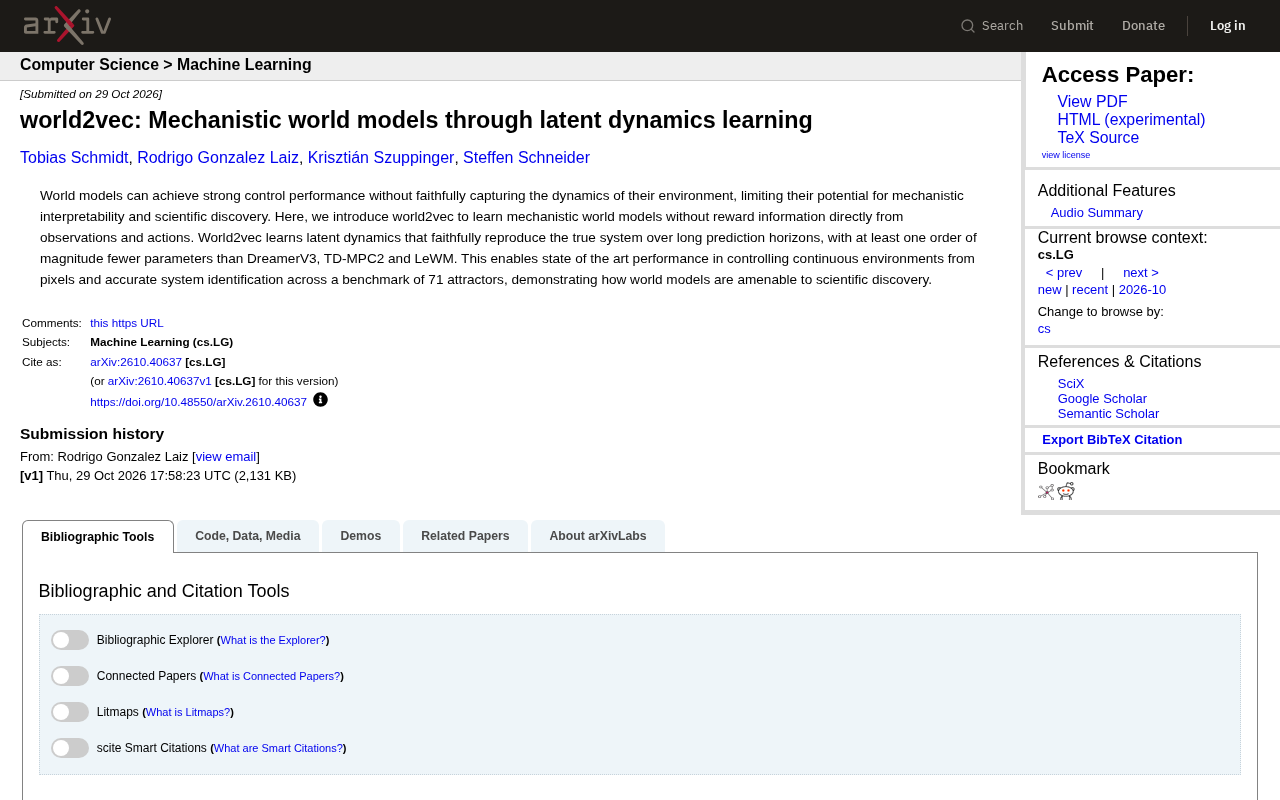
world2vec: Building Mechanistic World Models with Latent Dynamics Learning
world2vec proposes a reward-free method for learning mechanistic world models via latent dynamics, faithfully reproducing systems over long horizons with at least an order of magnitude fewer parameters than DreamerV3, TD-MPC2, and LeWM, and achieving accurate system identification on 71 attractor benchmarks.

A New KL-DRO Paradigm: Adaptive Scenario Generation Around a Learned Density Model
KL-DRO research proposes centering the KL ball on a learned density model instead of the empirical distribution, with adaptive scenario generation guiding sampling toward the worst case. Experiments show lower cost under distribution shift when records are scarce and the model can extrapolate, with comparable in-distribution cost.

ODE Samplers for Discrete Diffusion Models: Exponential Residual Flows Accelerate Generation
Discrete diffusion models lack deterministic ODE sampling? This article introduces Exponential Residual Flows (ERFs), which introduce continuous residual variables per token to construct piecewise ODEs for deterministic sampling and support consistency distillation acceleration. Superior to prior methods on code and text generation tasks.