Reddit Discussion: Real-World AI Agent Use Cases Shared for Business School Classrooms

A business school lecturer solicits real AI Agent use cases on Reddit, reflecting Agents' move from tech buzzword to business education.
Starting from a Reddit post by a business school lecturer seeking AI Agent classroom cases, the article analyzes the essential difference between AI Agents and traditional chatbots—autonomously decomposing tasks around a goal, invoking tools, and executing multi-step operations. It reviews typical use cases in professional scenarios (automated research aggregation, email classification, calendar management) and personal scenarios (knowledge base organization, travel planning), noting their common value in compressing multi-step operations into a single instruction. For classroom teaching, it suggests analyzing cases from three dimensions: task complexity, human intervention, and measurable benefits, while reminding that community shares are mostly experiential and lack quantitative data, requiring verification when cited.
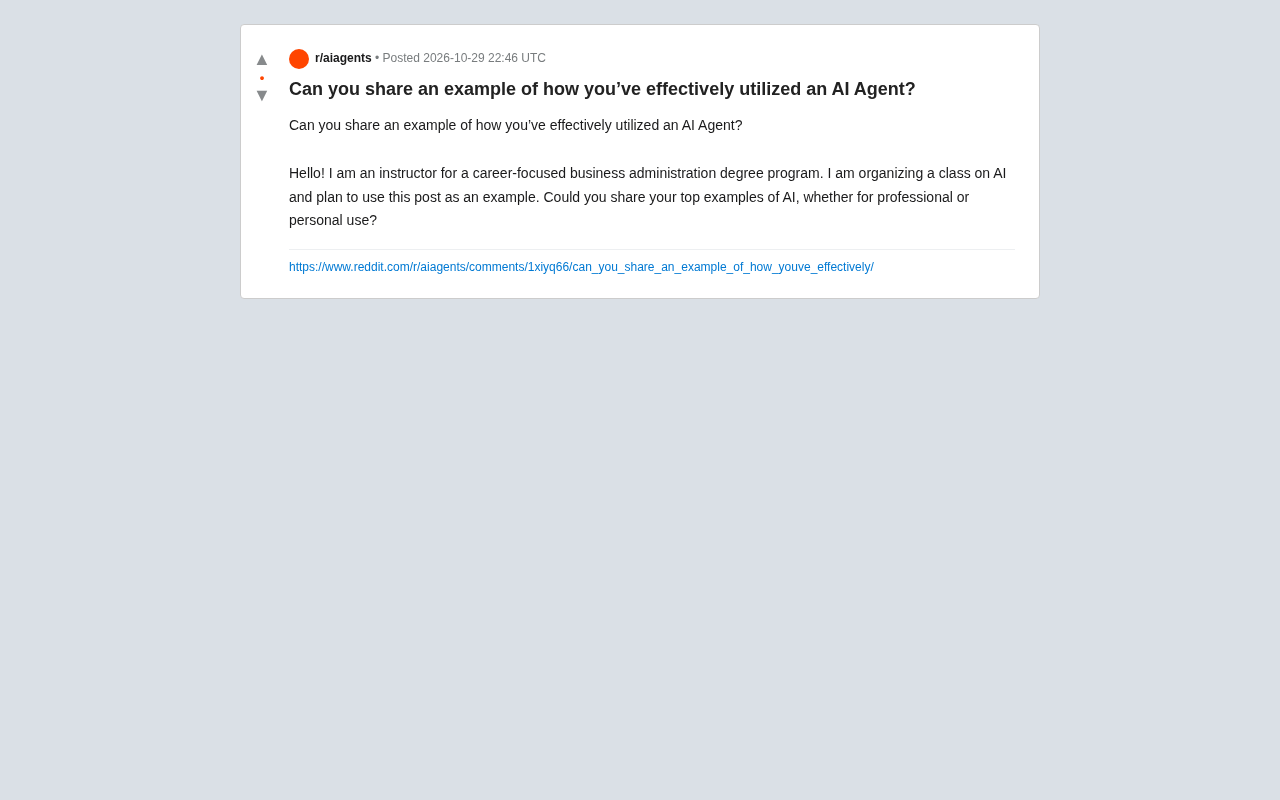
A business school lecturer posted on Reddit seeking real-world AI Agent use cases for classroom teaching. The post itself is an interesting signal: AI Agents have moved from a tech-circle buzzword into the视野 of business education. For those wanting to understand the practical value of AI Agents, the post's framing—"professional or personal use both welcome"—precisely captures the two main threads of current AI Agent adoption: efficiency restructuring in work scenarios, and automation habits in personal scenarios.
Why Business Schools Are Starting to Pay Attention to AI Agents
Traditional AI tools (like chatbots) operate on a "question-answer" interaction model: the user asks, and the model responds. What sets AI Agents apart is their ability to autonomously break down tasks around a goal, invoke tools, execute multi-step operations, and adjust strategies based on feedback along the way.
This capability is highly significant for business management education. Lecturers need to show students not just that "AI can write copy," but "which workflows AI can replace." The emphasis on "effectively utilized" in the Reddit post suggests the evaluation criterion is whether the results genuinely saved time or improved output quality—not merely whether a new technology was tried.
According to the original Reddit post, the lecturer plans to use the collected cases directly for classroom discussion, which means the cases need to be specific and reproducible, ideally with before-and-after efficiency comparisons.
Task decomposition and tool invocation are key technical concepts for understanding AI Agent capabilities. Traditional chatbots typically engage in single-turn or multi-turn dialogue, whereas the core of an AI Agent lies in its Planning ability: it can decompose a high-level goal (e.g., "research the market strategy of competitor A") into multiple sub-tasks (searching news, extracting financial report data, comparing product features) and execute them in dependency order. During execution, the Agent interacts with the external environment through Tool Use, such as calling search engine APIs, reading/writing databases, sending emails, or operating calendars. After each step, the Agent judges whether the task is complete based on the returned results; if not, it adjusts its strategy or re-plans. This "plan-execute-observe-adjust" loop enables the Agent to handle tasks requiring multiple steps with uncertain paths—a defining characteristic that distinguishes it from simple automation scripts.
AI Agent Use Cases in Professional Scenarios
Automated Research and Information Aggregation
A frequently mentioned use case is having an AI Agent replace manual effort in gathering materials. The user sets a topic, and the Agent automatically searches multiple sources, extracts key information, and generates a summary report. Compared to manually browsing web pages, this compresses "information acquisition" from hours to minutes.
In business analysis scenarios, this capability can be directly applied to competitive research and industry trend scanning. The Agent can run periodically and push updates to the user's inbox.
Retrieval-Augmented Generation (RAG) is a key technology supporting AI Agents in research aggregation tasks. When an Agent needs to generate a summary report based on multiple sources, it does not rely directly on the model's internal knowledge; instead, it first retrieves relevant passages from external document libraries or web pages, then feeds the retrieved results as context to the large language model for generation. The RAG workflow typically includes: document chunking and vectorized storage, semantic retrieval of the most relevant fragments based on the query, and concatenating the fragments with the original question before handing them to the model for output. This mechanism significantly reduces the risk of the model "fabricating" information and enables the Agent to cite specific sources. In business research scenarios, RAG allows the Agent to conduct targeted retrieval against a company's internal report library or public industry materials, generating analytical summaries with source citations rather than vague generalities.
Intelligent Email and Calendar Handling
Another frequently mentioned direction is email classification and reply drafting. An AI Agent can automatically categorize emails by content (customer inquiries, internal collaboration, spam) and generate draft replies for common questions. Users only need to review and send, rather than writing from scratch.
Calendar management is similar: the Agent can read meeting invitations in emails, automatically compare calendar availability, and suggest times. These use cases are characterized by "high frequency, low complexity"—precisely the zone where automation yields the most obvious benefits.
Human-in-the-loop is the most commonly adopted interaction design when AI Agents are deployed in business scenarios. Fully autonomous execution means the Agent can send emails or modify calendars without human confirmation, which carries higher risk in business contexts with low error tolerance. The semi-automatic mode introduces human review at key decision points: after the Agent completes classification, drafts replies, or suggests times, it presents the results to the user, who confirms, modifies, or rejects them before subsequent operations are executed. This design balances efficiency and controllability, reducing repetitive work while preserving human accountability for final results. In practice, the semi-automatic mode is typically implemented through a "suggest-confirm" interface, where the Agent's confidence scores or risk levels help users quickly identify which operations require focused review. For business school cases, the semi-automatic mode is also an ideal entry point for discussing the "boundaries of human-AI collaboration."
Personal Use Scenarios Are Equally Worth Noting
The Reddit post specifically states that "personal use is also welcome," reflecting another layer of value in AI Agents. Use cases in personal scenarios are often closer to daily life and more likely to resonate with students from non-technical backgrounds.
For example, some users have AI Agents manage personal knowledge bases: handing collected articles, notes, and bookmarks to the Agent for organization and categorization, then retrieving them via natural language when needed. Other users employ Agents for travel planning, completing everything from price comparison to itinerary arrangement in one stop.
What these cases share is that the tasks themselves are not complex, but they involve multiple steps and multiple information sources, making manual operation time-consuming and prone to omissions. The value of AI Agents lies in compressing "multi-step operations" into "a single instruction."
How to Select Classroom Cases
For business school lecturers, collecting cases is only the first step; the more important task is guiding students to analyze them. It is recommended to approach from three dimensions:
- Task complexity: Is the Agent handling a single-step task or a multi-step process? The more steps, the greater the Agent's space for autonomous decision-making—and the higher the risk.
- Degree of human intervention: Is it fully automated execution, or a semi-automatic mode of "Agent execution + human review"? The latter is more common in business scenarios.
- Measurable benefits: How much time was saved? How much repetitive work was reduced? Cases without quantitative comparison have limited persuasive power.
The framing of the original Reddit post is itself excellent teaching material—it demonstrates how to solicit experiences from real users rather than relying on vendor marketing materials.
A Signal Worth Noting
This post appeared in a Reddit discussion forum, not an academic journal or vendor blog, indicating that practical knowledge about AI Agents is rapidly accumulating in communities. When business students enter the workforce in the future, they will likely need to assess "whether this process can be handed to an Agent." Rather than teaching them how to operate a specific tool, it is better to teach them how to judge which tasks are suitable for automation.
The post does not provide specific usage data or effectiveness comparisons, which is both a limitation of the material and a reminder to readers: community-shared cases are mostly experiential descriptions, and verification should be supplemented when citing them directly.
One-line Summary
A business school lecturer solicits real-world AI Agent use cases on Reddit, reflecting the trend of Agents moving from tech buzzword to business education.
Paragraph Summary
The article starts from a Reddit post by a business school lecturer seeking AI Agent classroom cases and analyzes the essential difference between AI Agents and traditional chatbots—autonomously decomposing tasks around a goal, invoking tools, and executing multi-step operations. It reviews typical use cases in professional scenarios, including automated research aggregation, email classification, and calendar management, as well as personal scenarios such as knowledge base organization and travel planning, noting that their common value lies in compressing multi-step operations into a single instruction. For classroom teaching, the article suggests analyzing cases from three dimensions: task complexity, degree of human intervention, and measurable benefits, and reminds readers that community shares are mostly experiential descriptions lacking quantitative data, requiring supplementary verification when cited.
Related articles

Build a Reasoning Model from Scratch: An 11-Hour Open-Source Course Breakdown
Sebastian Raschka releases a free 8-episode, ~11-hour video course teaching you to build a reasoning model from scratch with Python and PyTorch—from a small Qwen3 model through Verifier, Inference Time Scaling, GRPO, and distillation, with open-source code on GitHub.

An 11-Hour Reasoning Model Course in Practice: How Small Models Learn to Think
Starting from Sebastian Raschka's 11-hour reasoning model course and HN buzz, this analyzes small-model training, legal text version control, Anthropic data policy, and product reliability reviews.

Lightpanda: A Headless Browser Built for AI and Automation
Lightpanda is a headless browser built from scratch in Zig for AI and automation, with 37,852 GitHub stars. This analysis covers its technical approach, design choices, and use cases.