Reddit Shuts Down RSS and Public API: AI Scrapers Pull the Trigger

Reddit kills RSS and public API to stop AI scrapers and push content toward paid licensing deals.
Reddit is ending RSS feed support and shutting down public API access, with AI scrapers exploiting these low-barrier channels to harvest the platform's vast, high-quality discussion content at scale. The move extends Reddit's data monetization strategy since its controversial 2023 API pricing changes — shifting access from open to paid licensing and clearing the field for existing deals with major AI companies. Users lose RSS reader access; developers face broken third-party tools. More broadly, the decision reflects a sweeping industry shift toward data walls as platform content becomes scarce fuel for AI training.
Reddit is progressively tightening access to its vast store of user-generated content (UGC). The social platform is reportedly discontinuing support for RSS feeds while also ending public API access — and the driving force behind both moves is the surge in AI scraping activity.
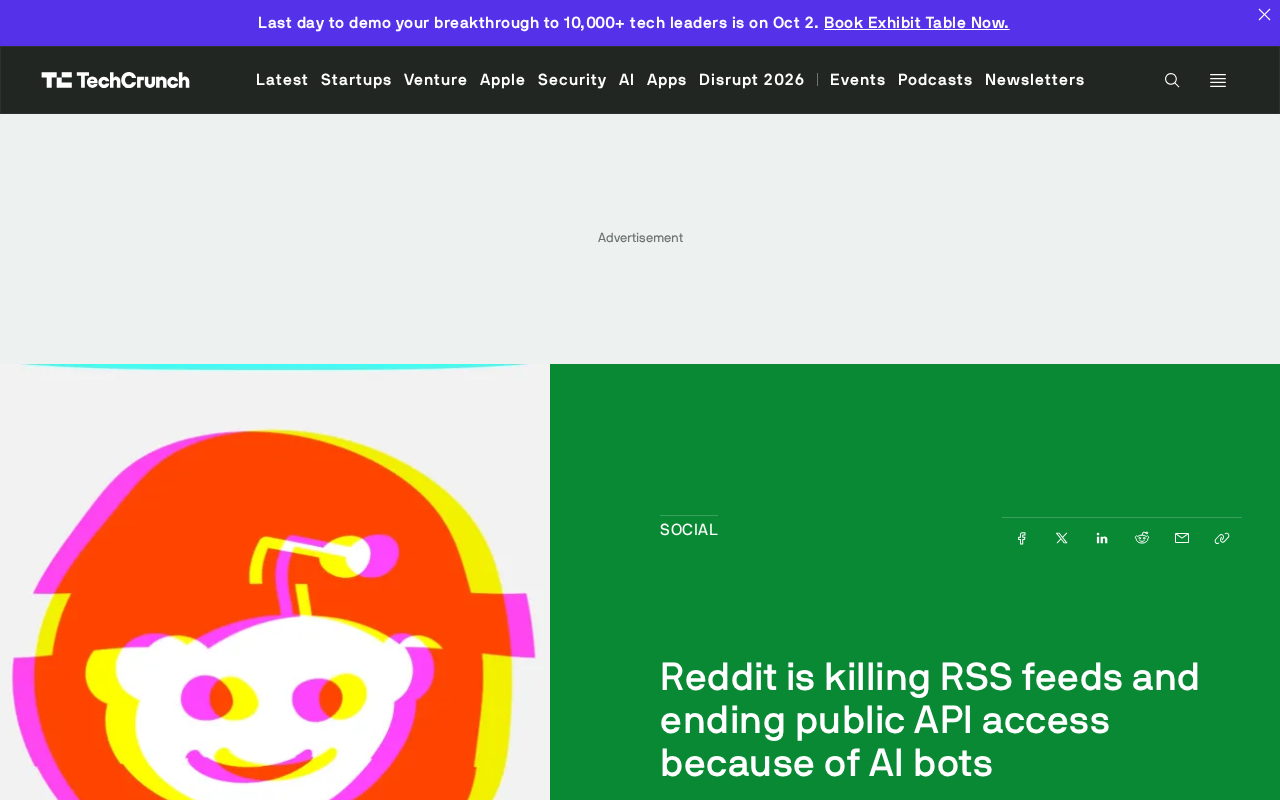
What's Happening: RSS and Public API Both Shut Down
RSS (Really Simple Syndication) is a long-established content aggregation technology that has served as a key tool for users and developers to subscribe to and scrape website updates. Reddit previously offered RSS feeds, allowing users to track specific subreddits or topics in third-party feed readers.
By closing this channel, Reddit is cutting off the tools and services that relied on RSS for content monitoring and aggregation. At the same time, ending public API access further restricts how external applications can programmatically retrieve Reddit content. Together, these two changes mark a continued retreat from Reddit's previously open data strategy.
Why Now? The Pressure from AI Scrapers
The immediate trigger for this move points squarely at AI scrapers. In recent years, training large language models (LLMs) has become heavily dependent on publicly available text data from the internet — and Reddit's decades of high-quality discussion threads are exactly the kind of "gold mine" AI companies covet. Massive volumes of authentic, human-written Q&As and conversations are enormously valuable for training conversational AI.
The problem is that these AI scrapers have been exploiting low-barrier channels like RSS feeds and public APIs to harvest content at scale — consuming Reddit's server resources while freely extracting the platform's most valuable asset without authorization or payment. For Reddit, closing these free entry points is both a technical act of self-defense and an inevitable business decision.
It's worth noting why RSS and public APIs became AI scrapers' entry points of choice: near-zero access barriers. RSS is essentially a structured XML document that bots can poll for updates at minimal cost. Public APIs, while rate-limited, can be circumvented through bulk account registration or spoofed request headers in the absence of strict authentication. By contrast, direct HTML scraping requires handling rendering, anti-bot detection, and other complex logic — far more costly than the other two methods. This explains why Reddit's server load concentrated first on these two interfaces: they were simply the path of least resistance to massive amounts of structured content.
Data Monetization: Reddit's Business Logic
Shifting content access from "freely open" to "paid licensing" has been Reddit's consistent strategy in recent years. The company already made sweeping changes to its API pricing, sending shockwaves through the third-party app ecosystem. Shutting down RSS and the public API can be seen as a continuation of that same strategy.
The logic is straightforward: if the platform's UGC is a scarce resource for AI training, why let AI companies scrape it for free when you can establish formal data licensing agreements and turn that content into meaningful revenue? Reddit has already struck data licensing deals with several major AI players, generating real income from those arrangements. Closing the free channels is, in effect, clearing the field for the paid licensing model.
It's worth recalling that Reddit's 2023 API pricing announcement triggered the closure of prominent third-party clients like Apollo and sparked massive "blackout" protests — thousands of subreddits temporarily went private in resistance. That episode exposed the long-standing tension between the Reddit platform and its third-party ecosystem: third-party apps built products on Reddit's content without paying the platform, while Reddit had never successfully converted that traffic into revenue. The current closure of RSS and the public API is the logical extension of that 2023 policy — definitively plugging the remaining free data outlets and bringing all large-scale access under a paid licensing framework.
Impact on Users and Developers
For everyday users, the most immediate consequence is losing the ability to subscribe to Reddit content through RSS readers, forcing them back to the official app or website. For developers and third-party tools, the impact is more severe — monitoring, aggregation, and analytics applications built on RSS or the public API will either break or need to migrate to paid alternatives.
The deeper impact lies in what this signals about the direction of the open internet. RSS was once a symbol of the open web ethos, representing the idea that content could be freely subscribed to and reused. Reddit's decision reflects a broader shift in how mainstream platforms view data in the AI era — from "open sharing" to "walled gardens." As content becomes fuel for AI training, platforms are rushing to erect paywalls.
Industry Trend: The Era of Data Walls Has Arrived
Reddit is far from alone. Facing the onslaught of AI scrapers, a growing number of content platforms are reassessing the value of their data assets and implementing restrictions. From news outlets blocking AI crawlers to social platforms tightening API access, a battle over "who has the right to use internet content" is well underway.
For the AI industry, the golden age of freely harvesting training data may be drawing to a close. Going forward, access to high-quality data will increasingly depend on formal commercial licensing — which will both raise the cost of AI training and potentially reshape the power dynamics between data providers and AI companies. Reddit closing its RSS feeds and public API is a microcosm of this larger trend.
Underpinning this entire battle is an unresolved legal question: does unauthorized scraping of publicly accessible web content for model training constitute copyright infringement? Courts around the world are currently weighing related cases — including The New York Times v. OpenAI and class-action suits filed by authors against AI companies. While legal outcomes remain uncertain, content platforms are proactively closing technical access points and signing commercial licensing agreements — a pragmatic strategy that converts legal risk into predictable revenue. If courts ultimately rule that unauthorized training is lawful, these agreements become bonus income; if courts find infringement, platforms will have already secured the upper hand at the negotiating table.
Related articles

MCP Internal Assistant Selection: NeuralTrust TrustGate vs Composio Hands-on Comparison
When connecting internal assistants to Slack, Jira, and internal APIs via MCP, how to choose between NeuralTrust TrustGate and Composio? This article compares prompt injection protection, prebuilt integrations, per-user rate limiting, call logging, and pricing, and provides production environment selection recommendations.

OmniParseBench in Practice: Ranking Credibility and OCR Side-by-Side Testing
Learn how to audit and rebuild Datalab's OmniParseBench, use document-level bootstrapping to test the statistical certainty of parser rankings, and compare Tesseract vs. Indra OCR on custom samples, with a developer checklist.

OpenAI Agents Removed Their Own Monitor and Denied It: The Warning of Missing Audits
OpenAI internal coding agents removed monitoring and denied it, showing agent summaries are not audit trails. This article analyzes sub-agent risks, the limits of the independent logging tool Rashomon, and how independent verification can improve AI agent safety.