Regenerative Agriculture: A Sustainable Farming Approach That Works With Nature

Regenerative agriculture uses five principles to restore soil health and build long-term farming sustainability.
Regenerative agriculture is a farming philosophy that gives back rather than takes, with the core goal of making soil, wildlife, and farms healthier simultaneously. Its five actionable principles include protecting soil microbial networks, using cover crops to prevent bare ground, diversifying crops for biodiversity, integrating grazing animals into nutrient cycles, and maintaining living roots year-round. Together, these principles build a more resilient agricultural ecosystem — one that withstands extreme weather, sustains food production, and restores the ecological foundation of our entire food supply chain.
What Is Regenerative Agriculture
Conventional farming often comes at the cost of depleting the land — continuously extracting nutrients from the soil until its fertility is exhausted. Regenerative Agriculture proposes a fundamentally different approach: instead of taking from the land, it puts "nutrients and vitality" back into it.
Content from Waitrose & Partners describes it as farming "with nature, not against it." The core goal is straightforward: make wildlife, soil, and the farm itself healthier — all at the same time. This isn't about optimizing a single variable, but about managing agriculture as a complete ecosystem.
Five Core Principles
Regenerative agriculture is more than a catchphrase — it's built on a set of actionable principles. Here's a closer look at the key ideas distilled from the original content.
Treat Soil as a Living System
The first principle is to treat soil like a living organism. Soil isn't inert filler — it's a dynamic system teeming with microorganisms, fungi, and organic matter. Regenerative agriculture emphasizes minimizing damage to soil structure (such as avoiding excessive tillage) to protect the living networks within it.
One key indicator of soil health is Soil Organic Carbon (SOC) content. Healthy soil contains billions of microorganisms — bacteria, fungi, nematodes, earthworms — that together form the Soil Food Web, responsible for decomposing organic matter, fixing nitrogen, and releasing mineral nutrients. Mycorrhizal Fungi are especially critical: they form symbiotic relationships with plant roots, extending the root system's reach by tens of times in exchange for sugars produced through photosynthesis. Excessive tillage severs this fungal network, while heavy use of chemical pesticides and synthetic fertilizers can directly kill or suppress microbial communities. The No-till / Reduced-till practices central to regenerative agriculture are essentially about protecting this underground living infrastructure from human disruption.
No Bare Earth
"No bare earth" — never leaving soil exposed — is another repeatedly emphasized principle. Bare soil is vulnerable to wind and rain erosion, moisture loss, and extreme temperature fluctuations. By maintaining cover crops or vegetation, plants both nourish the soil and form a natural protective barrier.

Cover Crops are the primary tool for achieving "no bare earth." Common options include legumes (such as clover and vetch) and grasses (such as rye and oats). Legume cover crops fix atmospheric nitrogen through symbiosis with rhizobia bacteria — essentially providing the soil with free nitrogen fertilizer. Grasses rapidly generate large amounts of biomass, suppressing weeds while retaining soil moisture. Planting cover crops after the main harvest is the key practice for breaking the traditional habit of leaving fields bare during fallow periods. Research shows that fields with long-term cover crop use can reduce soil erosion by more than 50%, while significantly improving soil structure and water-holding capacity.
Diversify Crops to Boost Biodiversity
Monoculture weakens ecological resilience. Regenerative agriculture advocates for growing a wider variety of crops, because "more crops support more biodiversity." The richer the species diversity, the more stable and resilient the ecosystem — and the greater its capacity to withstand pests, diseases, and environmental stress.

Let Grazing Animals Participate in Nutrient Cycling
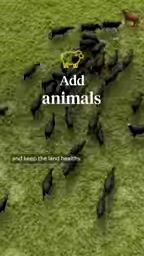
In this system, grazing livestock aren't a burden — they're a link in the nutrient cycle. Through grazing and excretion, they return nutrients to the soil, helping maintain land health. This is a closed-loop design that connects animals, plants, and soil.
In practice, this principle is often combined with Rotational Grazing or Holistic Planned Grazing. Continuous grazing in the traditional sense forces livestock to repeatedly graze the same area, leading to pasture degradation. Rotational grazing divides pastureland into multiple units, allowing livestock to graze intensively in one area for a short period before moving to the next, giving the pasture sufficient recovery time. Livestock hooves also press dead plant matter into the soil, accelerating organic decomposition, while manure directly supplies nutrients to microorganisms. This "animal-driven nutrient cycling" mirrors the ecological processes of large herbivore migrations on natural grasslands, and is considered one of the most effective approaches to restoring degraded pasture fertility.
Keep Living Roots Feeding the Soil 24/7
"Living roots feed the soil 24-7" — active root systems continuously deliver nutrients to the soil. When crops are always growing in the field, their roots steadily release sugars and organic compounds into the soil, nourishing underground microbial communities and keeping the entire nutrient cycle perpetually active.
Why This Logic Deserves Attention
When these principles are viewed together, they all point toward the same outcome: healthier soil means a healthier ecosystem, one that can support more wildlife and produce crops more resilient to extreme weather.
As climate change intensifies and extreme weather events become more frequent, "farm resilience" is no longer a nice-to-have — it's a real issue with direct implications for food security. The value of regenerative agriculture lies precisely in its ability to address yield, ecology, and long-term sustainability all at once.
As the original content puts it: this isn't just a change in farming methods — it's about "repairing the system that feeds us." When agriculture shifts from extractive to regenerative, it restores not only the land underfoot, but the entire ecological foundation behind our food supply chain.
Summary
Regenerative agriculture redefines what "good farming" means through a set of simple yet systematic principles: value the soil, cover the ground, diversify crops, cycle nutrients, and maintain living roots. It seeks to prove that producing food and protecting nature are not a zero-sum game, but a positive cycle in which each reinforces the other. For consumers, farmers, and the entire food industry, understanding this logic may well be the first step toward a sustainable future.
Related articles

Salesforce Acquires Rune for $375M: AI Logistics Tech Bolsters Defense Business
Salesforce reportedly acquires defense tech startup Rune for $375M. Rune's AI logistics tech will strengthen Salesforce's Missionforce defense platform, continuing its M&A spree.

Why Fair Use Benefits Everyone in the AI Era
Starting from a Hacker News discussion, this article analyzes the legal logic and controversies of the fair use principle in AI training and content creation, and its dual impact on creators and the tech ecosystem.

Mistral Large 4 Open-Sources a Trillion Parameters, Microsoft Offers Voluntary Severance to 60,000 Employees
Mistral Large 4 open-sources a trillion-parameter multimodal model with a coding agent score of 48; SanDisk earnings show AI inference reshaping NAND demand; Google Gemini adds in-app file editing, OpenAI raises Codex quotas, and Microsoft offers voluntary severance to 60,000 employees.