Reinforcement Learning Can Be Recovered From Its Own Rollouts: A New Offline Replay Method

Knowledge from RL post-training can be recovered from its generated rollouts via maximum likelihood, indicating compute is mainly spent on exploring the sampling distribution.
This study poses and validates a counterintuitive question: how much of the gains from RL post-training are retained in the discarded generated data (rollouts)? Experiments found that replaying the original RL algorithm directly on archived rollouts leads to catastrophic collapse, but maximum likelihood estimation can recover performance. Even more unexpectedly, replaying in generation order without distinguishing correct from incorrect answers, a single maximum likelihood update can closely track the full learning curve of online RL; using only rollouts from the last few RL steps often suffices to recover final model performance. The authors infer that the substantial compute invested in RL may be mainly spent on discovering a better sampling distribution rather than learning it from samples. This conclusion has potential implications for training pipeline design in paradigms like RLHF: one online exploration plus offline distillation could replace repeated sampling.
Reinforcement learning (RL) post-training trains models on data generated by the model itself, converting compute into capability. Typically, these generated rollouts are discarded after each update, and the knowledge gained during RL is stored in the model weights. But a new study raises an intriguing question: how much of this knowledge is retained in the rollouts themselves?
The Pitfall and Redemption of Replaying Old Trajectories
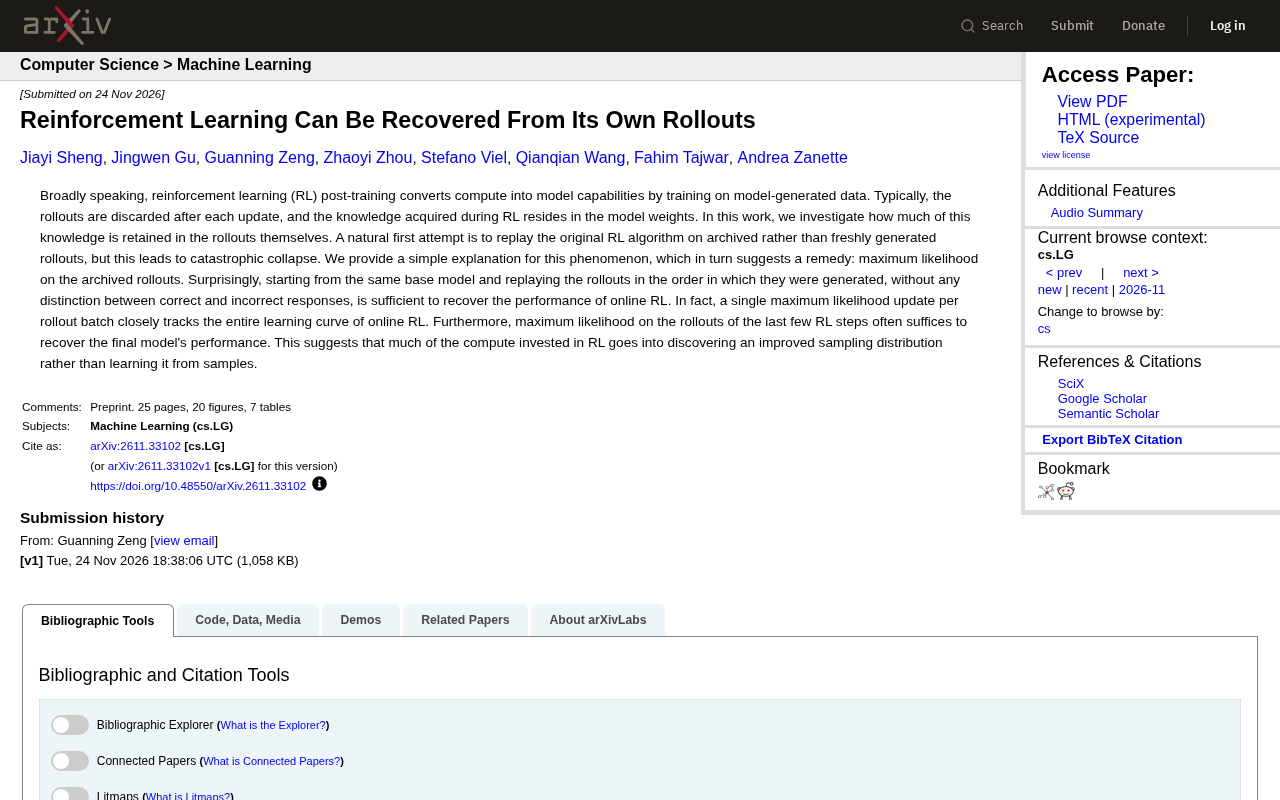
A natural idea: since rollouts contain data produced during the model's exploration, can we simply replay the original RL algorithm on archived rollouts instead of regenerating data? The answer is no—doing so leads to catastrophic collapse. The researchers offer a simple explanation and propose a remedy: maximum likelihood estimation (MLE) on the archived rollouts.
Surprisingly, starting from the same base model, replaying the rollouts in the order they were generated—without distinguishing correct from incorrect answers—is sufficient to recover the performance of online RL. This means that even without resampling, the model can re-learn the capability gains from RL simply by imitating the behavioral distribution in the old data.
Maximum likelihood estimation (MLE) is the most common method in statistics for estimating model parameters: given a set of observed data, find the parameter values that make the data most probable. In language model training, MLE corresponds to the standard next-token prediction loss (cross-entropy), which is the objective used in pretraining and instruction tuning. "Maximum likelihood on archived rollouts" essentially treats each trajectory produced during RL as a supervised sample, letting the model re-learn to reproduce the conditional distribution of tokens in that trajectory given the context. The difference from RL is that RL weights trajectories by reward signals (correct answers are reinforced, incorrect ones suppressed), whereas maximum likelihood treats every trajectory equally. This difference explains why "replaying the original RL algorithm collapses while MLE recovers performance"—offline replay cannot resample, importance-sampling corrections fail, and probabilities get pushed in degenerate directions outside the sampling distribution.
A Single Update Can Track the Entire Learning Curve
More strikingly, a single maximum likelihood update per rollout batch can closely track the entire learning curve of online RL. In other words, the effect that online RL achieves through multiple iterative updates can be approximately reproduced by offline maximum likelihood training.
Furthermore, the researchers found that maximum likelihood training on only the rollouts from the last few RL steps is often sufficient to recover the final model's performance. This suggests that earlier rollouts may contain less critical information, while later data already encapsulates most of the "essence" of the capability gains.
In RL training, the learning curve typically refers to the trajectory of reward or evaluation metrics over training steps, reflecting how model capability improves with iterations. Online RL algorithms (such as PPO, GRPO) require sampling new trajectories and computing policy gradients at each update, so every point on the learning curve depends on the model distribution at that moment. "Tracking" here means that the model trained with offline MLE achieves evaluation scores comparable to online training after several update steps. One explanation for this approximation is that, under certain settings, the net effect of RL post-training can be viewed as a reweighted fit to the rollout data distribution, and feeding data in chronological order lets the model evolve parameters in a direction similar to online training. This also explains why using only the last few rollouts can recover final performance—later data already reflects the converged sampling distribution.
Where Is the Compute Spent?
These findings lead to a profound inference: the substantial compute invested in RL may be primarily spent on discovering a better sampling distribution, rather than learning that distribution from samples. In other words, the core value of online RL lies in exploration—finding generation policies that yield high rewards. Once these policies are found, they can be extracted from data via simple supervised learning (maximum likelihood).
This view has implications for efficiency optimization in RL post-training. If the main cost of online RL is exploring the distribution rather than learning it, then perhaps compute demands can be reduced through more efficient exploration strategies, or existing rollout data can be used for offline distillation to avoid repeated sampling.
The phrase "discovering a better sampling distribution" points to the exploration-exploitation trade-off in RL. In language model RL, the policy itself is a distribution: the probability distribution over responses for each prompt. During online training, the model continuously generates, uses reward signals to judge which responses are good, and adjusts the distribution accordingly to concentrate on high-reward regions. The key is that moving the distribution to the right place requires first generating those good responses—a process that relies on sampling, scoring, and multiple iterations, with cost mainly spent on "finding" rather than "remembering." In contrast, supervised learning can fit the distribution given input-output pairs. If the exploration phase has already captured representative samples of the target distribution, then shifting compute from repeated sampling to a single offline fit could theoretically compress training overhead without sacrificing capability—this is the core efficiency implication of the conclusion.
Implications for RLHF and Model Iteration
Although the study does not mention specific applications, its conclusions have potential implications for paradigms such as reinforcement learning from human feedback (RLHF). In RLHF, the model generates many responses that are scored by humans or AI, and these rollouts are typically discarded. If this data alone is sufficient to recover RL effects, future training pipelines could be designed as: first run a round of online exploration to collect data, then consolidate capabilities through offline maximum likelihood training, saving the overhead of repeated sampling.
Of course, the conclusion is based on specific experimental settings, and its generality needs further validation. But at least it suggests that RL knowledge is not only in the weights but also partially encoded in the generated data—and the latter may be underestimated.
One-line Summary
Knowledge from RL post-training can be recovered from its generated rollouts via maximum likelihood, indicating that compute is mainly spent on exploring the sampling distribution.
Paragraph Summary
This study poses and validates a counterintuitive question: how much of the gains from RL post-training are retained in the discarded generated data (rollouts)? Experiments found that replaying the original RL algorithm directly on archived rollouts leads to catastrophic collapse, but maximum likelihood estimation can recover performance. Even more unexpectedly, replaying in generation order without distinguishing correct from incorrect answers, a single maximum likelihood update can closely track the full learning curve of online RL; using only rollouts from the last few RL steps often suffices to recover final model performance. The authors infer that the substantial compute invested in RL may be mainly spent on discovering a better sampling distribution rather than learning it from samples. This conclusion has potential implications for training pipeline design in paradigms like RLHF: one online exploration plus offline distillation could replace repeated sampling.
Related articles

Nothing CMF Buds 2A Drops to $17.89 on Black Friday: A New Low for ANC Earbuds
Nothing CMF Buds 2A wireless earbuds Black Friday deal: just $17.89 on Amazon, about $11 off retail and a record low. ANC earbuds at an entry-level price.

When AI Creation Gets Accused of "Spitting": Hacker News Heats Up Over the Glaude Controversy
A Hacker News post, "Spitting in the Face of Glaude," sparks debate on AI creation transparency and attribution ethics. This analysis examines the blurred creator identity behind the controversy and offers practical advice for AI content production.

Akai Embraces Custom Firmware: MPC Sample 1.4 Lets Users AI-Program Their Sampler
Akai embraces the modding community with MPC Sample 1.4 firmware, supporting vibe-coded custom firmware and effects. We analyze the impact of this open strategy on music hardware and AI-assisted programming.